
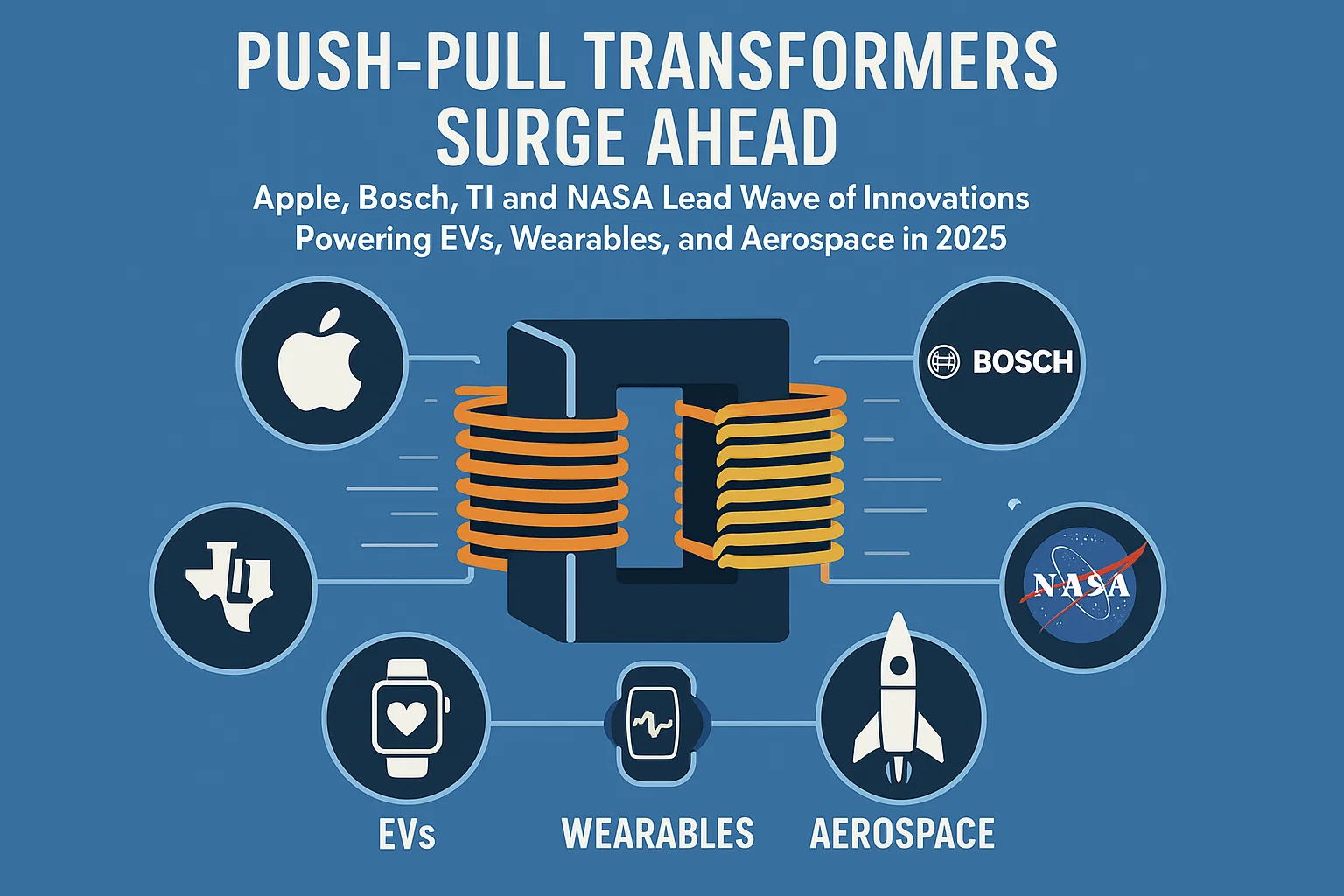
Push-Pull Transformers Surge Ahead: Apple, Bosch, TI, and NASA Lead Wave of Innovations Powering EVs, Wearables, and Aerospace in 2025
In an age where energy efficiency and compact design are paramount, push-pull transformers are emerging as a critical technology for modern power conversion systems. From electric vehicles to wearables, these transformer topologies are enabling high-efficiency, compact, and reliable solutions across industries. The push-pull transformer market is heating up fast: valued at US$ 678 million in 2024, it’s projected to grow at a CAGR of 4.1%, reaching US$ 934 million by 2032. This surge is fueled by a wave of innovation, integration in emerging tech, and the increasing demand for reliable isolated power supplies.
Access Your Free Sample Report- Push-Pull Transformers Market
- Texas Instruments’ Breakthrough in Push-Pull Controller ICs
In July 2025, Texas Instruments (TI) made headlines with the launch of its new push-pull controller IC, aimed specifically at improving isolated power supply designs. This controller not only enhances energy efficiency but also significantly reduces electromagnetic interference (EMI) and transformer core losses, particularly at high switching frequencies.
Key Features and Benefits:
- Low-noise operation, ideal for sensitive industrial environments.
- Enhanced thermal performance for prolonged use in demanding settings.
- Suited for both industrial control systems and electric vehicle power modules.
Expert Insight:
TI’s innovation addresses a major pain point: traditional push-pull converters suffer from flux imbalance and core saturation. Their new IC employs adaptive timing and active reset techniques to counteract these issues.
Market Impact:
This development is expected to accelerate the adoption of push-pull topologies in smart factories and EVs, driving the need for more compact and reliable power modules.
- STMicroelectronics Boosts EV Charging Efficiency
In June 2025, STMicroelectronics revealed its next-generation 800V DC-DC converter architecture using push-pull transformers. The innovation supports GaN and SiC-based semiconductor platforms, which are now becoming standard in high-voltage EV charging systems.
Why It Matters:
- Push-pull designs offer better efficiency and thermal performance at high voltages.
- Suitable for on-board chargers (OBC) and fast-charging infrastructure.
Technical Highlight:
Their solution uses dual-core high-frequency transformers, reducing magnetic losses and optimizing switching behavior.
Strategic Vision:
By adopting wide-bandgap technologies, STMicro’s push-pull system offers scalability and meets the next-gen EV standards being defined by OEMs.
Sustainability Impact:
Reducing energy loss during DC-DC conversion helps lower overall EV energy consumption, thereby indirectly reducing carbon emissions.
- Bosch’s AI-Powered Push-Pull Modules for Commercial EV Fleets
In May 2025, Bosch entered the spotlight with a new line of high-performance push-pull transformer-based DC-DC modules, specifically designed for heavy-duty commercial electric vehicles.
Innovation at a Glance:
- Uses high-frequency push-pull topology.
- Integrated AI-based thermal regulation system.
- Built to withstand harsh fleet usage scenarios.
Why Commercial Fleets?
Commercial EVs have significantly higher uptime and power demands. Bosch’s solution enhances heat dissipation, energy conversion efficiency, and system longevity.
Unique Selling Point:
The AI integration is novel. It predicts thermal spikes based on usage patterns and dynamically adjusts the switching frequency and cooling mechanisms.
Market Forecast:
This could set a new benchmark for fleet-grade EV power systems, and expect major OEMs to explore partnerships with Bosch for integration.
- Apple Pushes Boundaries with Miniaturized Push-Pull Transformers
In April 2025, Apple filed a groundbreaking patent that integrates miniaturized push-pull transformers into its next-gen wearables, including Apple Watch and AirPods.
What’s New?
- Ultra-compact transformer design.
- Lower thermal output.
- High-efficiency power conversion in wireless charging systems.
Implication for Consumers:
Longer battery life, faster charging, and reduced heating — especially important for small wearable devices.
Industry Perspective:
This patent signals a shift in how consumer electronics approach isolated power delivery. Apple’s influence may trigger a wave of similar innovations across other OEMs.
Innovation Driver:
Push-pull topologies are ideal for wearables due to their symmetrical operation and inherent noise reduction capabilities.
Download Sample Report PDF- Push-Pull Transformers Market
- Infineon’s Renewable Energy Play with Push-Pull in Microinverters
In March 2025, Infineon Technologies unveiled its newest microinverter platform for solar energy systems, utilizing push-pull transformers to enhance energy conversion and voltage regulation.
Application Area:
- Solar microinverters.
- Home and commercial photovoltaic (PV) systems.
- Decentralized energy grids.
Technical Strengths:
- Low EMI, critical for residential use.
- High isolation voltage.
- Efficient power regulation during variable sunlight conditions.
Eco-Friendly Engineering:
Push-pull topologies help reduce energy loss, making solar setups more sustainable and economically viable.
Big Picture:
As governments push for renewable adoption, Infineon’s push-pull-based architecture could become the default for new-age microinverters.
- NASA’s Push-Pull Deployment in Aerospace Systems
In February 2025, NASA disclosed the successful deployment of push-pull transformer-based DC-DC converters in their high-altitude drones and research aircraft.
Context:
Aerospace applications require compact, lightweight, and ultra-reliable power systems. Traditional solutions were too bulky or inefficient at high altitudes.
What NASA Did Differently:
- Developed lightweight, rugged transformers.
- Achieved high voltage isolation critical for avionics.
- Incorporated redundancy to ensure fail-safe performance.
Use Cases:
- Remote sensor payloads.
- Communication systems.
- Autonomous drones for atmospheric research.
Industry Takeaway:
Expect a ripple effect in commercial aerospace and defense, especially for UAVs and small satellite power systems.
Broader Industry Insights & Market Growth Drivers
The global push-pull transformer market’s projected growth from US$ 678 million in 2024 to US$ 934 million by 2032 can be attributed to several converging trends:
- Electrification of Mobility:
The rapid shift towards electric vehicles, both commercial and personal, is generating massive demand for efficient DC-DC converters. Push-pull topologies, with their high power density and cost-effectiveness, are ideal for these applications. - Miniaturization in Electronics:
As devices become smaller and smarter, compact and efficient power delivery becomes vital. Push-pull transformers excel in wearable, medical, and portable consumer electronics. - Renewable Energy Revolution:
Solar power systems, especially those designed for distributed energy grids, need reliable voltage conversion under fluctuating loads — a sweet spot for push-pull converters. - Aerospace and Defense Demand:
With governments and agencies investing in high-altitude drones, space exploration, and defense tech, push-pull transformers are filling the gap for lightweight and robust power management. - AI & Smart Control Integration:
Integrating AI and predictive control into power systems, like Bosch has done, opens new performance frontiers. Push-pull systems with real-time switching optimization can adapt to dynamic loads with minimal energy loss.
Challenges Ahead
Despite their advantages, push-pull transformers face certain hurdles:
- Magnetic saturation risks due to core imbalance.
- Design complexity in high-voltage applications.
- Thermal management, especially in compact environments.
However, companies like Texas Instruments and Bosch are already addressing these limitations with advanced controllers and AI-enhanced systems.
Click Here To Download Full Sample Report- Push-Pull Transformers Market
The Future Is (Push)-Pulling Its Weight
Push-pull transformers are no longer a niche power conversion topology — they’re powering some of the most critical advancements across EVs, consumer electronics, renewable energy, and aerospace. Backed by innovations from giants like TI, STMicroelectronics, Bosch, Infineon, Apple, and NASA, the technology is evolving to meet modern demands.
As the market heads toward US$ 934 million by 2032, driven by electrification, miniaturization, and sustainability trends, one thing is clear: push-pull transformers are not just supporting the future — they’re helping build it.

Comments (0)