
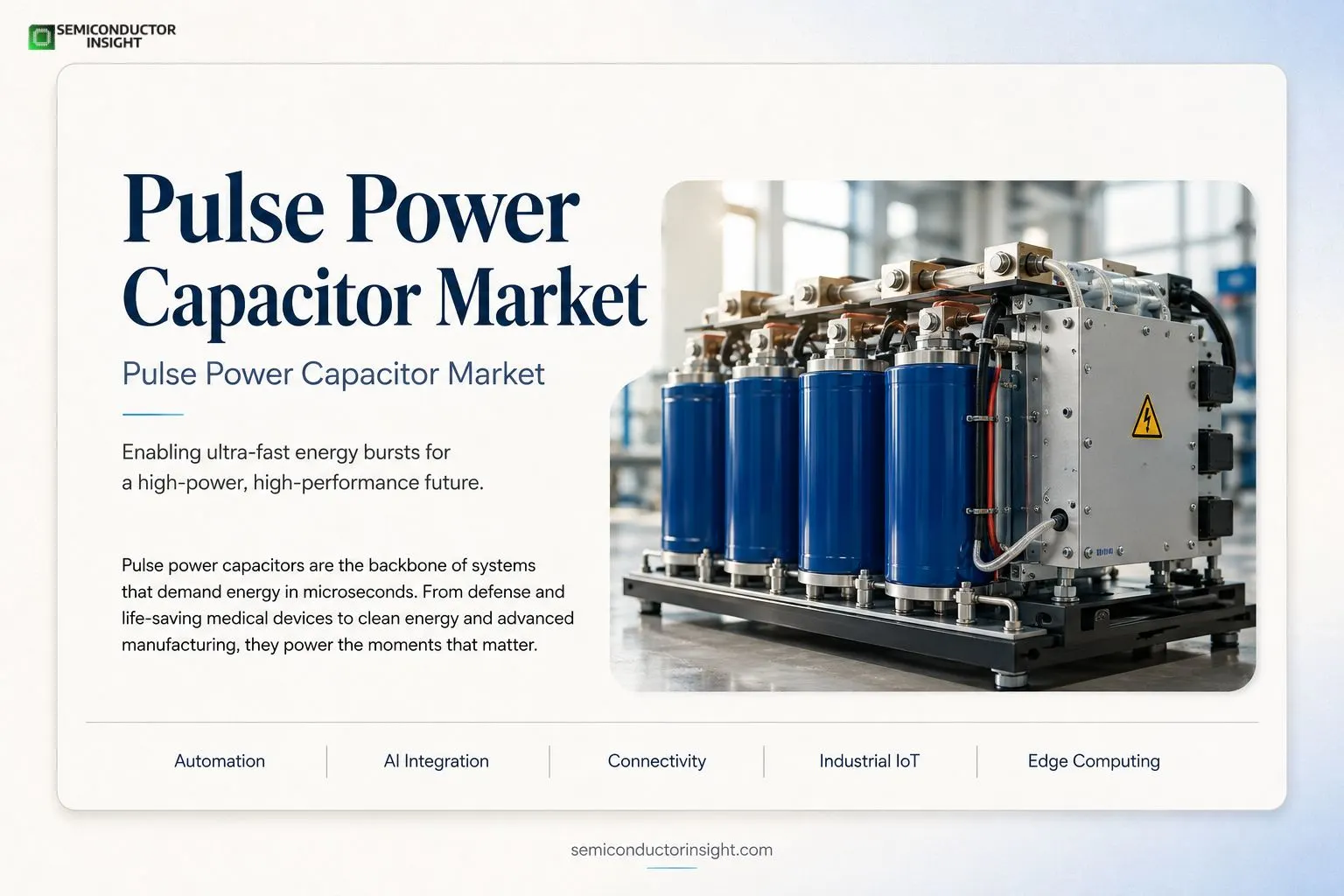
Pulse Power Capacitor Market 2026: The USD 1.35 Billion Race to Deliver Lightning in a Box
In a nondescript industrial park outside Dallas, a bank of capacitors the size of shipping containers sits silently for hours, soaking up electricity from the grid. Then, in a fraction of a millisecond, it releases a torrent of energy-hundreds of thousands of amps-into a magnetic coil, launching a projectile to hypersonic speeds without a gram of gunpowder. The scene, part of a U.S. Navy railgun testbed, looks like science fiction. But the device at the heart of it-the pulse power capacitor-is a very real, very physical piece of engineering that is finding its way into a surprising number of places far beyond weapon ranges.
Pulse power capacitors are not the garden-variety cylinders that smooth voltage in a power supply. They are purpose-built to store energy slowly and release it almost instantaneously, delivering a punch of current that can reach millions of amps in microseconds. They handle voltages that make ordinary electronics melt, and they do it without exploding, often for hundreds of thousands of cycles. In 2025, the global market for these specialized components was valued at about USD 1.35 billion, and it’s expected to more than double, reaching USD 3.12 billion by 2034-a compound annual growth rate of 6.8% over the forecast period. That growth is not coming from one killer app but from a convergence of needs that all demand the same thing: energy, fast.
The physics that makes pulse power special
A normal capacitor stores energy in an electric field between two metal plates separated by a dielectric. A pulse power capacitor uses the same principle, but it’s optimized for extreme energy density and fast discharge. Dielectrics are chosen for high permittivity and the ability to withstand enormous electric fields without breaking down: polymer films like polypropylene, impregnated paper, or ceramic-based composites. Internal construction minimizes inductance-the electrical property that resists changes in current-because even a few nanohenries would slow down the discharge and ruin the pulse shape.
The result is a device that can do things batteries and ordinary capacitors cannot. A battery can store lots of energy but releases it slowly; a pulse capacitor stores less total energy but releases it in a gush that can energize lasers, generate X-rays, form metal, or stabilize a wobbling power grid before a thermal plant even notices something is wrong.
Where the demand is coming from in 2026
The 6.8% CAGR isn’t being driven by a single industry but by a mix of legacy applications that keep growing and new ones that are just moving out of the lab. Medical devices have been steady buyers for years: defibrillators that restart hearts, lithotripters that shatter kidney stones, and MRI gradient amplifiers that need precise, high-current pulses. As populations age and healthcare spending rises, the demand for these medical pulse power systems climbs in lockstep.
Industrial uses are expanding too. Pulsed laser deposition, used to coat cutting tools and semiconductor wafers, requires capacitor banks that can deliver consistent, high-peak-power pulses. Electromagnetic forming, where a magnetic pulse shapes sheet metal without physical contact, is moving from niche aerospace applications into automotive manufacturing, where it can form complex shapes in aluminium and advanced high-strength steels without the springback that frustrates traditional stamping.
On the energy front, the integration of renewables is creating a less obvious need. Wind and solar farms don’t inherently provide the inertia that keeps a grid’s frequency stable; when a cloud passes or the wind drops, the grid frequency can dip within milliseconds. Large flywheel and battery systems can step in, but pulse capacitors, combined with power electronics, can react in microseconds, injecting reactive power to hold the line until slower storage can take over. A major European grid operator tested exactly such a system this spring, installing capacitor banks alongside a solar farm in southern Spain to provide “synthetic inertia.” The project, covered by a power engineering trade journal, reported that the capacitor system responded to frequency disturbances in under five milliseconds-orders of magnitude faster than any rotating machine.
Defense and research are the glamour drivers. Railguns, directed-energy weapons, and high-power microwave systems all depend on pulse capacitors. The U.S. Department of Defense’s budget for directed-energy prototyping rose again in 2026, and a significant slice of that money finds its way to capacitor manufacturers who build the energy storage modules that feed lasers and electromagnetic launchers. In fusion research, both magnetic confinement (tokamaks) and inertial confinement (laser fusion) need massive pulse power to heat plasma or drive lasers. The ITER project, while using superconducting magnets for confinement, still requires pulse power for plasma heating and current drive systems, and private fusion startups-of which there are now over thirty worldwide-are regular customers for bespoke capacitor banks.
North America’s mature market and its renewed investment
North America, as the report highlights, represents a robust and mature market for pulse power capacitors. The region’s strong industrial base and ongoing investments in power infrastructure and renewable energy projects consistently fuel the need for high-performance capacitors. But the 2026 picture is more dynamic than just “mature.”
The U.S. grid is undergoing a transformation, with the Inflation Reduction Act and bipartisan infrastructure spending pouring billions into transmission upgrades and renewable integration. Every new solar farm and every upgraded substation that needs fast voltage support is a potential home for pulse capacitors or their hybrid systems. Meanwhile, the reshoring of advanced manufacturing-particularly semiconductor fabs and electric vehicle battery plants-is creating clusters of industrial power quality demand that need the kind of fast-responding energy storage that pulse capacitors excel at.
The supply chain behind the supercapacitor’s lesser-known cousin
Pulse power capacitors look very different from the supercapacitors that grab headlines for electric buses. They use thin, high-quality polymer films-often sourced from a handful of chemical companies in Japan, Europe, and the United States-and are wound with meticulous care to avoid defects that could cause catastrophic failure. The metallization process, where a thin layer of aluminium or zinc is deposited on the film, requires vacuum chambers that look more like semiconductor equipment than traditional capacitor machinery. Yields matter enormously, and the companies that master high-speed winding with precise tension control and contamination-free cleanrooms dominate the market.
A market built on speed, not volume
The pulse power capacitor market will never rival consumer electronics in unit shipments, but it doesn’t need to. The value is in the engineering, the reliability, and the ability to survive millions of pulses without degrading. A single capacitor module for a railgun or a fusion laser can cost more than a luxury car, and it will be in service for decades. The 6.8% growth rate is a reflection of a world that increasingly needs precise, controlled bursts of energy-for healing, for manufacturing, for keeping the lights on, and for pushing the boundaries of physics. In 2026, those needs are quietly but steadily pulling a niche component into the infrastructure of modern life.
Check Out Our Latest Analysis Report: https://semiconductorinsight.com/report/pulse-power-capacitor-market/

Comments (0)