
Process Automation and Optical Detection in the Photoelectric Level Sensor Market
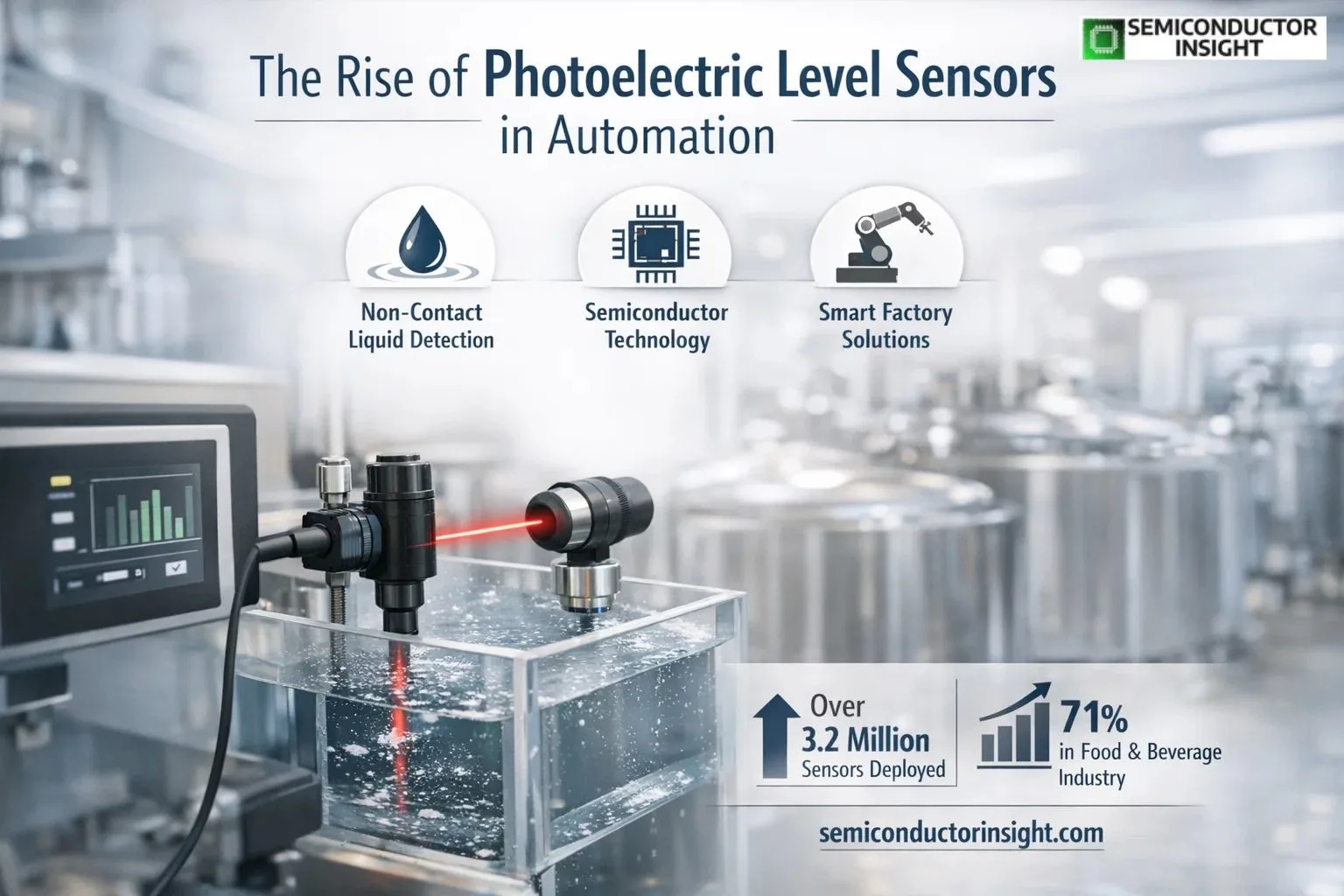
Industrial automation increasingly depends on precise monitoring technologies, and optical sensing has emerged as a critical component of modern process control. Within semiconductor-driven automation systems, photoelectric level sensors detect the presence or absence of liquids using beams of light rather than mechanical contact. The principle is simple yet highly effective: a light emitter sends a beam toward a receiver, and any change in light intensity caused by liquid interruption generates an electrical signal for monitoring systems.
This optical approach has enabled industries to transition away from traditional float or mechanical sensors toward more accurate and hygienic detection methods. In modern automated facilities, sensors serve as the eyes of machines, allowing equipment to identify fluid levels, detect overflow conditions, and regulate chemical processes with minimal human intervention.
Semiconductor-Driven Detection Systems in Modern Factories
Semiconductor components such as photodiodes, phototransistors, and microcontrollers form the core architecture of modern optical sensors. These components allow extremely fast signal processing, which enables detection of even subtle changes in light intensity.
Recent industrial data shows that more than 68% of manufacturers now integrate optical sensing technologies into automated production lines to improve real-time monitoring and reduce manual inspection requirements.
In manufacturing environments, liquid monitoring is particularly important in semiconductor fabrication, chemical processing, and precision cleaning processes. Even small variations in chemical bath levels or coolant tanks can disrupt production. As a result, semiconductor-based optical sensors have become standard in automated plants that rely on consistent fluid levels for process stability.
Another indicator of this transition is the rapid expansion of industrial sensor installations. Global shipments of photoelectric sensors exceeded 3.2 million units in recent industrial deployments, reflecting a major increase in automation adoption.
Non-Contact Monitoring for Hygienic and Chemical Processing
- One of the strongest advantages of optical sensors is their ability to detect liquid levels without direct contact. This feature is particularly valuable in industries where contamination must be avoided.
- Food and beverage production facilities rely heavily on these sensors to ensure hygiene and product quality. Studies indicate that around 71% of food processing plants deploy photoelectric sensing systems to monitor liquid ingredients and automated filling processes.
- Similarly, chemical manufacturing environments require highly reliable detection systems because corrosive liquids can damage mechanical sensors. Optical sensing technology provides a safer alternative because the detection mechanism relies on light rather than physical contact.
- Industrial reports show that about 59% of chemical processing facilities use optical sensors for liquid level monitoring in tanks, pipelines, and mixing units.
- These sensors also help prevent operational risks. Facilities that deployed optical liquid monitoring systems reported approximately 23% improvement in safety compliance and monitoring accuracy compared with conventional level measurement devices.
Compact Sensor Design Supporting Smart Factory Infrastructure
The push toward compact automation hardware has significantly influenced sensor engineering. Semiconductor miniaturization now allows manufacturers to produce highly compact sensing modules that can be installed in tight industrial spaces.
Recent technology adoption patterns show that over 42% of newly installed sensors are compact models designed for restricted equipment environments such as robotics, packaging machines, and semiconductor fabrication tools.
Smart factory initiatives are further accelerating this transformation. Connected sensors equipped with wireless modules and diagnostic capabilities enable predictive maintenance. In fact, IoT-enabled sensing systems have increased by about 41% in industrial deployments, enabling factories to monitor sensor performance remotely and reduce equipment downtime.
Another important trend is the integration of advanced signal processing algorithms. Modern optical sensors now include embedded controllers that filter environmental noise and adjust detection thresholds automatically. This innovation has improved system uptime by more than 30% in automated manufacturing environments, where consistent operation is critical.
To Stay Tuned with More meaningful and In-Depth Insights, Do Visit here: http://semiconductorinsight.com/report/global-photoelectric-level-sensor-market/
Precision Monitoring in Logistics, Robotics, and Fluid Systems
- Beyond process industries, photoelectric sensors also support logistics, robotics, and automated storage facilities. In these applications, sensors detect objects, containers, or liquids moving through conveyor systems.
- Industrial robotics relies heavily on optical detection for positioning and object identification. Recent robotics deployments across assembly lines reported over 600,000 sensors integrated into pick-and-place robotic systems, improving precision in material handling operations.
- Optical level sensors are also used in fluid management systems such as water treatment plants and cooling infrastructure. In wastewater facilities, optical detection helps regulate pump operations by monitoring tank levels and preventing overflow conditions.
- Industrial automation studies show that around 32% of water and wastewater systems incorporate optical level monitoring technologies, demonstrating their importance in infrastructure management.
- Another interesting application is warehouse automation. Laser-based optical sensors capable of detecting objects as small as 1 millimeters are now used in automated inspection systems to verify container fill levels and packaging integrity.
Advanced Optical Sensors Enhancing Reliability and Efficiency
Technological advancements in sensor engineering continue to improve reliability and precision. Manufacturers are now integrating AI-assisted calibration and dual-light optical systems that reduce measurement errors in reflective or transparent liquids.
For example, recently developed smart sensors have demonstrated 23% lower detection errors in automated assembly lines, while miniature optical sensors deliver 27% faster response times compared with earlier models.
These innovations highlight the increasing role of automation, industrial sensing, optical detection, and smart monitoring in modern manufacturing ecosystems. As industries continue adopting digital production systems, semiconductor-based optical sensing technologies are becoming an essential foundation for accurate, reliable, and scalable industrial operations.

Comments (0)