
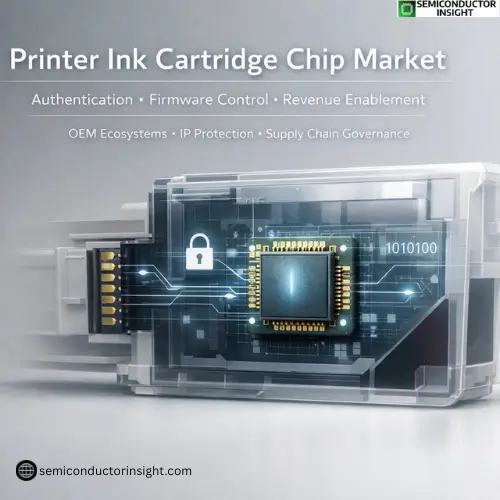
Printer Ink Cartridge Chip Demand Surge: Top Drivers and Forecasts
A Market Hidden Inside a Familiar Product
Every printed page carries an unseen layer of semiconductor intelligence. Printer ink cartridge chips, though physically small, govern authentication, ink tracking, compatibility verification, and lifecycle management. As printing hardware continues to evolve, these chips have become control points that directly influence revenue models, supply chains, and consumer behavior.
The target market surrounding cartridge chips operates at the intersection of semiconductors, firmware logic, and intellectual property enforcement. It is strategically critical because, in contrast to visible components, its influence is based on system authorization rather than mechanical performance.
Functional Position within the Printing Ecosystem
Ink cartridge chips communicate with printers to validate cartridge identity, monitor ink consumption, and restrict unauthorized refills. Their integration supports both operational accuracy and commercial control.
Beyond basic memory storage, newer designs embed encryption layers that interact with printer firmware updates. This evolution reflects a shift from simple identification toward active system governance, where chips determine whether printing proceeds at all.
Demand Forces Shaping the Market
The printer ink cartridge chip market expands alongside installed printer bases, especially in office, institutional, and commercial printing environments. While consumer printing volumes fluctuate, enterprise usage remains stable, reinforcing steady demand for chips tied to original equipment manufacturer (OEM) cartridges.
Another contributor is the tightening of firmware controls by printer brands, which increases chip complexity and replacement frequency. Each firmware iteration often requires updated chip logic, creating recurring demand rather than one-time supply.
For a more thorough report, please contact us using our most recent report:
https://semiconductorinsight.com/report/printer-ink-cartridge-chip-market/
Import Export Structure and Trade Sensitivities
Production of cartridge chips is geographically concentrated, with fabrication and programming often occurring in East Asia, while final cartridge assembly takes place closer to end markets. This separation introduces cross-border dependency.
Many importing countries classify cartridge chips under semiconductor or electronic component categories, subjecting them to customs valuation scrutiny. Trade restrictions, tariffs, and origin documentation requirements influence sourcing strategies, particularly for third-party cartridge manufacturers.
Regulatory enforcement varies by region. Some markets actively monitor chip imports to prevent IP infringement, while others maintain looser controls, allowing parallel supply channels to exist.
Regulatory and Compliance Environment
From a compliance standpoint, cartridge chips must align with electronic waste directives, hazardous substance restrictions, and data integrity standards. Environmental regulations increasingly affect packaging and disposal obligations, especially in regions enforcing circular economy frameworks.
In addition, legal disputes over chip cloning and firmware circumvention have elevated the importance of compliance-ready chip designs. Manufacturers now invest in traceability features to demonstrate lawful production and distribution.
Advantages and Limitations Balance
From an industry perspective, cartridge chips deliver both operational benefits and market friction.
Positive contributions include:
- Accurate ink level reporting for users
- Protection of printer hardware from incompatible supplies
- Predictable revenue streams for OEMs
Constraining aspects involve:
- Increased cartridge cost for end users
- Reduced accessibility for refill and reuse markets
Competitive Behavior and Market Positioning
Participants in this market range from OEM-aligned semiconductor suppliers to independent chip developers serving compatible cartridge manufacturers. Competitive differentiation arises from encryption advances, firmware adaptability, and response speed to printer software updates.
Suppliers capable of rapid redesign following firmware changes gain preference, as delays can disrupt entire cartridge product lines. This responsiveness has become a commercial advantage equal to pricing.
Supply Chain Risk and Continuity
Because cartridge chips are application-specific, inventory misalignment poses risk. Excess stock tied to outdated firmware quickly loses value. As a result, manufacturers increasingly adopt shorter production cycles and flexible programming models.
Some players integrate regional programming hubs to minimize cross-border delays and reduce exposure to trade disruptions. This localized approach supports continuity during regulatory or logistical uncertainty.
Why This Market Holds Strategic Weight?
Printer ink cartridge chip market illustrates how semiconductors extend beyond performance enhancement into behavioral control. Chips now influence what users can print, which supplies they purchase, and how often replacements occur.
As printers evolve toward connected and subscription-based models, cartridge chips will likely carry reminder logic, usage analytics, and security functions, reinforcing their role as system gatekeepers rather than passive identifiers.
Closing Perspective
Printer Ink Cartridge Chip Market thrives on control architecture rather than scale alone. Its future depends on how successfully suppliers navigate firmware evolution, regulatory scrutiny, and global trade complexity while maintaining compatibility and trust.
For stakeholders, understanding this market means recognizing that even the smallest semiconductor can dictate the economics of an entire industry segment.

Comments (0)