
How Semiconductor Physics is Redefining Portable Chlorine Sensor Market?
Portable Chlorine Sensor Market includes small, portable devices that use optical or electrochemical technologies to measure the amount of chlorine in water, air, and industrial environments.
For decades, ensuring safe drinking water meant relying on bulky equipment or color-matching test strips that left too much room for human error. But the landscape of water quality monitoring is shifting beneath our feet.
Today, the most exciting innovations in portable chlorine sensors are not happening in chemistry labs alone they are being driven by the semiconductor industry. We are witnessing a convergence where the precision of chip fabrication meets the urgent global need for reliable water safety.
The MEMS Revolution Shrinks the Lab
- One of the most significant breakthroughs comes from the application of Micro-Electro-Mechanical Systems (MEMS) technology.
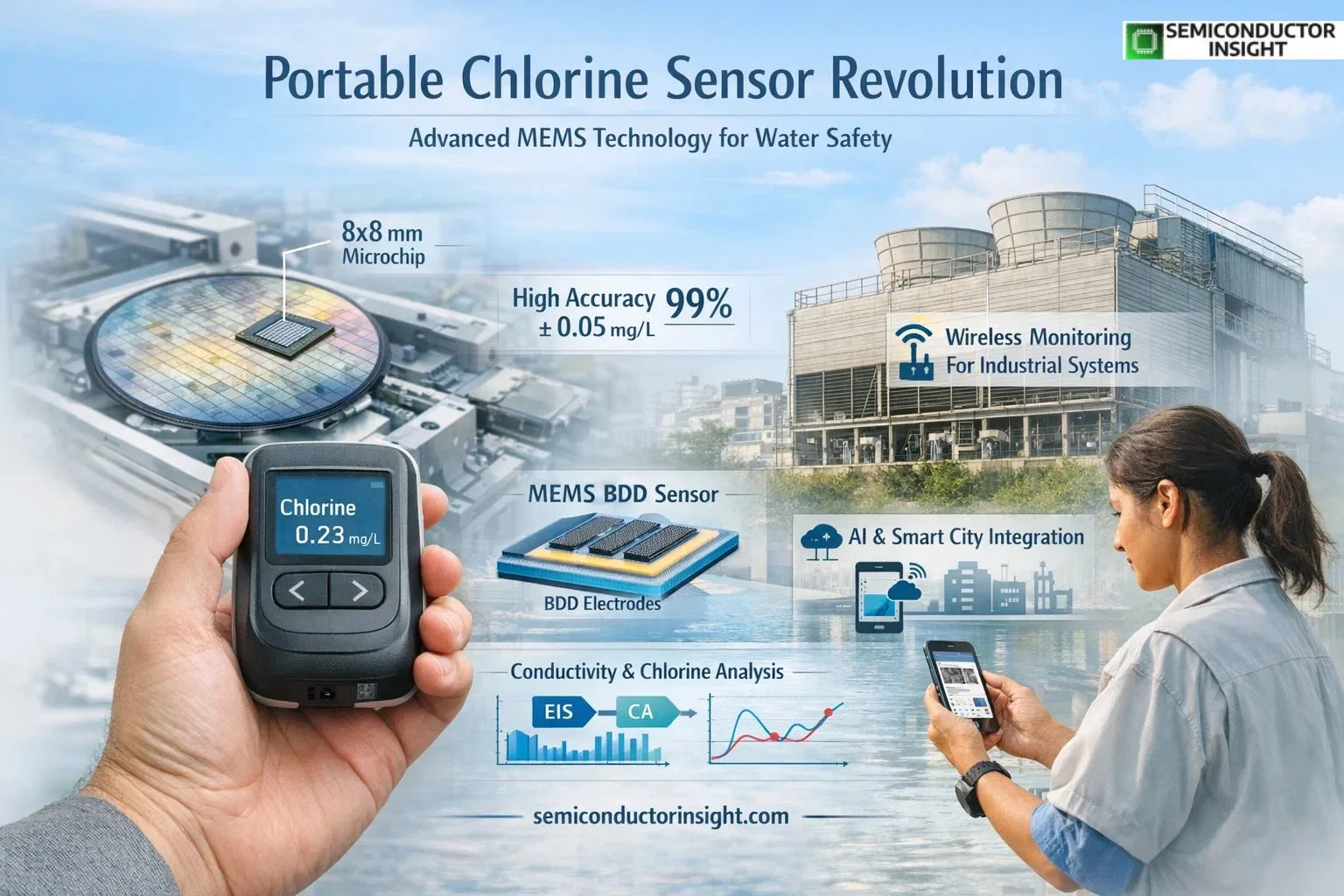
- Traditionally, accurate chlorine sensing required large, stationary electrochemical cells. Now, researchers are fabricating sensors on an 8 × 8 mmscale using the same batch-processing techniques used to make computer chips.
- This miniaturization is a game-changer. By leveraging boron-doped diamond (BDD) interdigitated electrodes, these new semiconductor devices offer stability that traditional materials cannot match.
- The real magic, however, lies in the signal processing. A recent study demonstrated a sensor that uses an alternating excitation strategy to tackle the age-old problem of conductivity
- When you test water, dissolved salts can skew the chlorine reading. By alternately applying electrochemical impedance spectroscopy (to measure conductivity) and chronoamperometry (to measure chlorine), the sensor feeds both data points into a multiple linear regression model.
- The result is an accuracy improvement of nearly 99%, with residuals controlled within ±0.05 mg/L. For a lifeguard or a water treatment operator, this means a device that actually tells the truth about the water’s safety, regardless of the water source.
From Silicon Wafers to Cooling Towers
The semiconductor supply chain is also enabling new form factors. High-quality thermal oxidation on silicon wafers provides the essential dielectric layers needed to build these rugged sensors. This allows engineers to create devices that are not just small, but robust enough to handle industrial environments.
Take the challenge of water-circulating cooling facilities. These systems, found on the rooftops of factories and office buildings, are breeding grounds for bacteria if chlorine levels drop too low. Traditional monitoring required manual sampling a labour-intensive and inconsistent process. University researchers have now developed a super-lightweight, wireless water quality monitor that uses a clever wet chemical analysis method driven by water head pressure rather than expensive, bulky pumps. By reducing reagent consumption to just a few microliters per test and utilizing low-power latch valves, this device can operate on solar power or batteries, sending real-time chlorine data wirelessly. It is a perfect example of how semiconductor-level efficiency is enabling a sensor-like appliance that can be deployed at massive scale, tackling the rapid industrialization and urbanization trends across the globe.
To find out more, feel free to browse our latest updated report: https://semiconductorinsight.com/report/portable-chlorine-sensor-market/
AI and the Smart City Integration
- Beyond the hardware, the software layer is advancing. In India, the Trichy Corporation recently deployed 75 portable testing kits integrated with an AI-backed verification mechanism.
- Health workers upload photos of water samples to a dashboard, and an AI tool analyzes the images to corroborate chlorination levels.
- This moves the portable sensor from being a simple measurement tool to a node in an intelligent network, ensuring accountability and data integrity across an entire city’s water supply.
- Similarly, in China, new-generation analyzers are being called digital sentinelsfor water safety.
- These devices are moving beyond single-parameter measurement; they now synchronize pH and temperature data while using machine learning models to automatically correct for environmental disturbances.
In one case, a provincial disease control centre deployed an online system that monitors chlorine levels in real-time, automatically triggering alarms and activating chlorinators when levels dropped to unsafe levels. This closed-loop system represents the ultimate goal for the portable chlorine sensor market: not just detection, but autonomous safety management.
We are moving past the era of the dumb test kit. The future of water safety is a Bluetooth-enabled, AI-assisted semiconductor device that fits in the palm of your hand, providing lab-grade accuracy whether you are monitoring a swimming pool in California or a municipal water tank in Tamil Nadu. As semiconductor fabs continue to push the boundaries of what can be built on a silicon wafer, the water industry is poised to reap the benefits of the digital transformation.

Comments (0)