

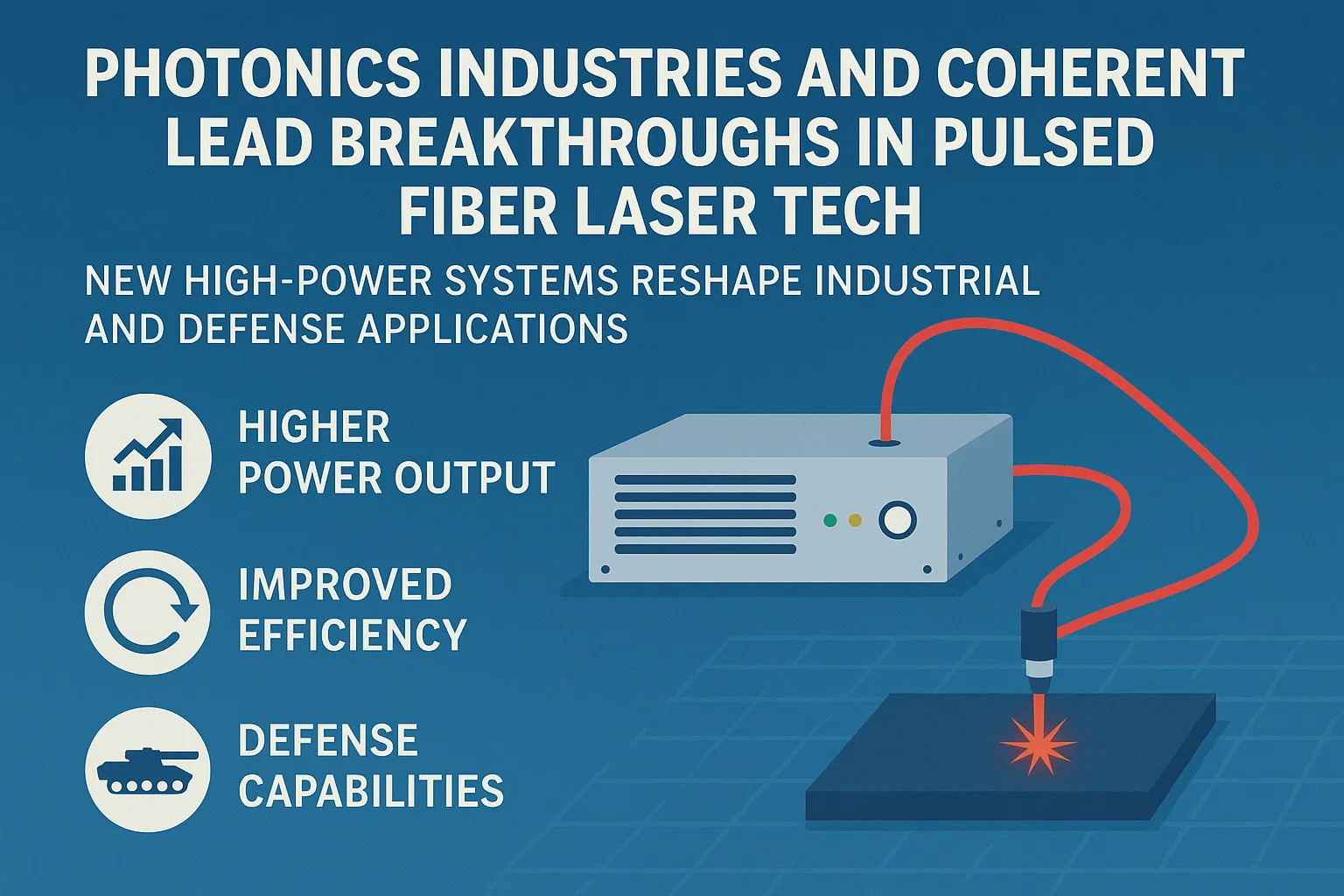
Photonics Industries and Coherent Lead Breakthroughs in Pulsed Fiber Laser Tech: New High-Power Systems Reshape Industrial and Defense Applications
The landscape of industrial manufacturing is undergoing a seismic shift, propelled by the integration of cutting-edge laser technologies. Among the most transformative is the pulsed fiber laser—a tool that delivers extreme precision, enhanced energy efficiency, and superior throughput across a wide range of industrial applications. From micromachining and glass cutting to defense and additive manufacturing, pulsed fiber lasers are becoming indispensable.
According to recent estimates, the global Industrial Pulsed Fiber Laser Market was valued at USD 1.45 billion in 2024 and is projected to reach USD 2.56 billion by 2032, growing at a CAGR of 8.5% during the forecast period of 2025 to 2032. This significant growth trajectory is fueled by multiple converging trends—rapid technological innovation, heightened demand in emerging sectors, and strategic investments by top industry players.
Access Your Free Sample Report- Industrial Pulsed Fiber Laser Market
Market Outlook: Industrial Pulsed Fiber Laser Set for Robust Expansion
The global shift toward automation, sustainability, and miniaturization in industrial processes is driving unprecedented demand for high-performance laser systems. Pulsed fiber lasers—known for their high peak power, excellent beam quality, and versatility—are increasingly deployed in precision manufacturing sectors such as:
- Electronics and semiconductors
- Automotive
- Aerospace
- Medical device manufacturing
- Defense and security
Key Market Highlights:
- 2024 Market Size: USD 1.45 billion
- Projected 2032 Market Size: USD 2.56 billion
- CAGR (2025–2032): 8.5%
- Asia-Pacific remains the largest market, driven by electronics manufacturing in China, Japan, and South Korea.
- North America and Europe are witnessing increased adoption in aerospace and defense.
Recent Industry Developments and Breakthroughs
- Photonics Industries’ Game-Changing RX‑1064‑300 Picosecond Laser
In June 2025, Photonics Industries launched the RX‑1064‑300, a new picosecond pulsed fiber laser that sets a new benchmark in the industry. This laser system boasts:
- Sub‑10 picosecond pulse widths
- >1 millijoule pulse energy
- 300 W average power
- Air-cooled, all-in-one (AIO) package
What makes this innovation significant is its compact form factor—75% smaller than traditional fiber lasers—combined with MHz burst mode capability, dynamic energy control, and position-synchronized output.
Target applications include:
- Glass cutting
- Ceramic drilling
- Precision micromachining
- Deep engraving of hard materials like tungsten and titanium
By delivering high power in a compact design, this model is poised to become a preferred tool for manufacturers aiming for efficiency and precision in constrained environments.
- Coherent’s EDGE FL™ High-Power Fiber Laser Series
Coherent Corp., one of the largest names in laser technology, launched its EDGE FL™ series in October 2024—a suite of high-power fiber lasers designed for cutting, welding, and drilling applications.
Key specifications:
- Power range: 1.5 kW to 20 kW
- Integrated beam delivery optics
- Customizable interfaces for seamless integration into machine tools
- Enhanced energy efficiency and modular scalability
This move reinforces Coherent’s stronghold in machine tool integration, helping OEMs improve cutting performance while minimizing operational costs.
- U.S. Navy’s $30 Million Deal with Coherent for SONGBOW Defense Lasers
Perhaps the most headline-grabbing development is Coherent’s contract with the U.S. Navy, announced in June 2025, to develop a 400 kW pulsed fiber laser subsystem for directed-energy weapons under the SONGBOW initiative.
Highlights:
- Multi-module integration of pulsed fiber lasers
- Real-time wavefront sensing and adaptive optics
- Target: UAVs, hypersonic threats, and cruise missiles
This contract, worth $30 million, is expected to push pulsed fiber laser tech into new territories—enabling mobile, rugged, and battlefield-ready systems that maintain accuracy over long distances.
- MPBC’s Color-Tuned Pulsed Fiber Lasers for Imaging and Life Sciences
During Photonics West 2025, MPB Communications (MPBC) introduced several niche fiber laser products targeting research and imaging applications:
- 695 nm picosecond pulsed laser (up to 2 W, 40–100 MHz repetition)
- 532 nm mode-locked fiber laser (pulse width: 15–70 ps)
- 633 nm single-frequency tunable laser (<100 kHz linewidth)
While not traditionally industrial in scope, these innovations will eventually influence biophotonics, fluorescence imaging, and advanced lithography, with potential crossover into semiconductor manufacturing and precision biomedical device machining.
Download Sample Report PDF- Industrial Pulsed Fiber Laser Market
Academic Breakthroughs in Pulsed Fiber Laser Technology
Alongside commercial releases, academic and national labs continue to push boundaries with fundamental research. Notable advancements include:
- All-Glass, All-Fiber High-Power Amplifiers
A recent arXiv publication outlined a monolithic fiber amplifier architecture capable of delivering multi-megawatt peak power and hundreds of watts average power. The innovation? It eliminates all free-space components, boosting durability and lowering maintenance.
- 2.45 km Fiber Delivery System
Another study demonstrated the delivery of 2 kW laser output over 2.45 km using hollow-core photonic fibers—a breakthrough for industrial mining, construction, and military deployments in remote regions.
- Multimode Wavefront-Shaped Amplifiers
By applying wavefront shaping to multimode amplifiers, researchers achieved a 168 W focused beam with beam quality matching single-mode performance. This paves the way for power scaling without degrading beam fidelity—a major leap for welding and deep-penetration applications.
Applications Driving Market Demand
- Precision Manufacturing
Industries such as semiconductors and electronics rely on short-pulse lasers for precise structuring and drilling. Pulsed fiber lasers offer:
- Minimal heat-affected zones (HAZ)
- High throughput
- Compatibility with thin films and micro-circuits
- Automotive Lightweighting
As EVs grow, automakers require fine welding and drilling of aluminum, copper, and new alloys. Pulsed fiber lasers deliver the non-contact, rapid processing required in battery cell production and EV chassis welding.
- Defense and Security
Pulsed lasers are now central to directed energy systems, target designation, and counter-drone technologies. Compactness, robustness, and power-scaling make fiber lasers the ideal candidates.
- Medical Device Fabrication
Titanium stents, surgical blades, and implantable devices require micron-level precision. Pulsed lasers enable efficient fabrication without introducing mechanical stress or contamination.
Regional Insights and Competitive Landscape
Asia-Pacific
- China, South Korea, and Japan dominate fiber laser production and consumption.
- Government investments in semiconductor self-reliance and EV infrastructure are driving demand.
- Local giants like Raycus and Maxphotonics are stepping up their global presence.
North America
- Strong defense spending and a vibrant additive manufacturing ecosystem boost demand.
- Companies like IPG Photonics, nLIGHT, and Coherent are driving local innovation.
Europe
- German machine toolmakers are integrating high-precision lasers for industrial cutting and welding.
- Europe is also investing in green manufacturing, making fiber lasers vital for low-emission production methods.
Challenges in the Industry
Despite the growth trajectory, the pulsed fiber laser market faces some headwinds:
- Thermal Management: As power levels increase, maintaining thermal stability without sacrificing compactness is a key challenge.
- Supply Chain Disruptions: Fiber preforms, rare-earth dopants (like ytterbium), and precision optics are vulnerable to geopolitical tensions.
- Beam Shaping Complexity: Adapting beam profiles for non-standard surfaces or multi-material interfaces requires continuous innovation in beam modulation.
Click Here To Download Full Sample Report- Industrial Pulsed Fiber Laser Market
Future Outlook: What Lies Ahead?
- AI-Enabled Smart Lasers
Adaptive optics and real-time beam modulation, guided by AI algorithms, will enable auto-correction and self-optimization during laser-material interaction.
- Quantum-Safe Manufacturing
Pulsed fiber lasers with ultra-short pulses are being explored for quantum component fabrication, setting the stage for new use cases in quantum computing and secure communication.
- Portable High-Energy Defense Systems
With Coherent’s SONGBOW program as a harbinger, expect more development in man-portable or vehicle-mounted laser defense systems by the early 2030s.
- Integration with Additive Manufacturing
High-repetition pulsed lasers will become vital in selective laser sintering (SLS) and laser metal deposition (LMD), where precision and speed are paramount.
Precision Power Meets Scalable Potential
The Industrial Pulsed Fiber Laser Market is no longer just a subsegment of photonics—it’s a pivotal pillar in the next generation of manufacturing, defense, and medical innovation. With power scaling, size reduction, and wavelength versatility all advancing rapidly, pulsed fiber lasers are poised to dominate both current applications and those yet to be discovered.
The road to USD 2.56 billion by 2032 will be paved by sustained R&D, robust industrial collaborations, and the global race for manufacturing excellence. As the barriers between research labs and factory floors dissolve, expect pulsed fiber lasers to evolve from specialized tools into mainstream engines of progress.

Comments (0)