
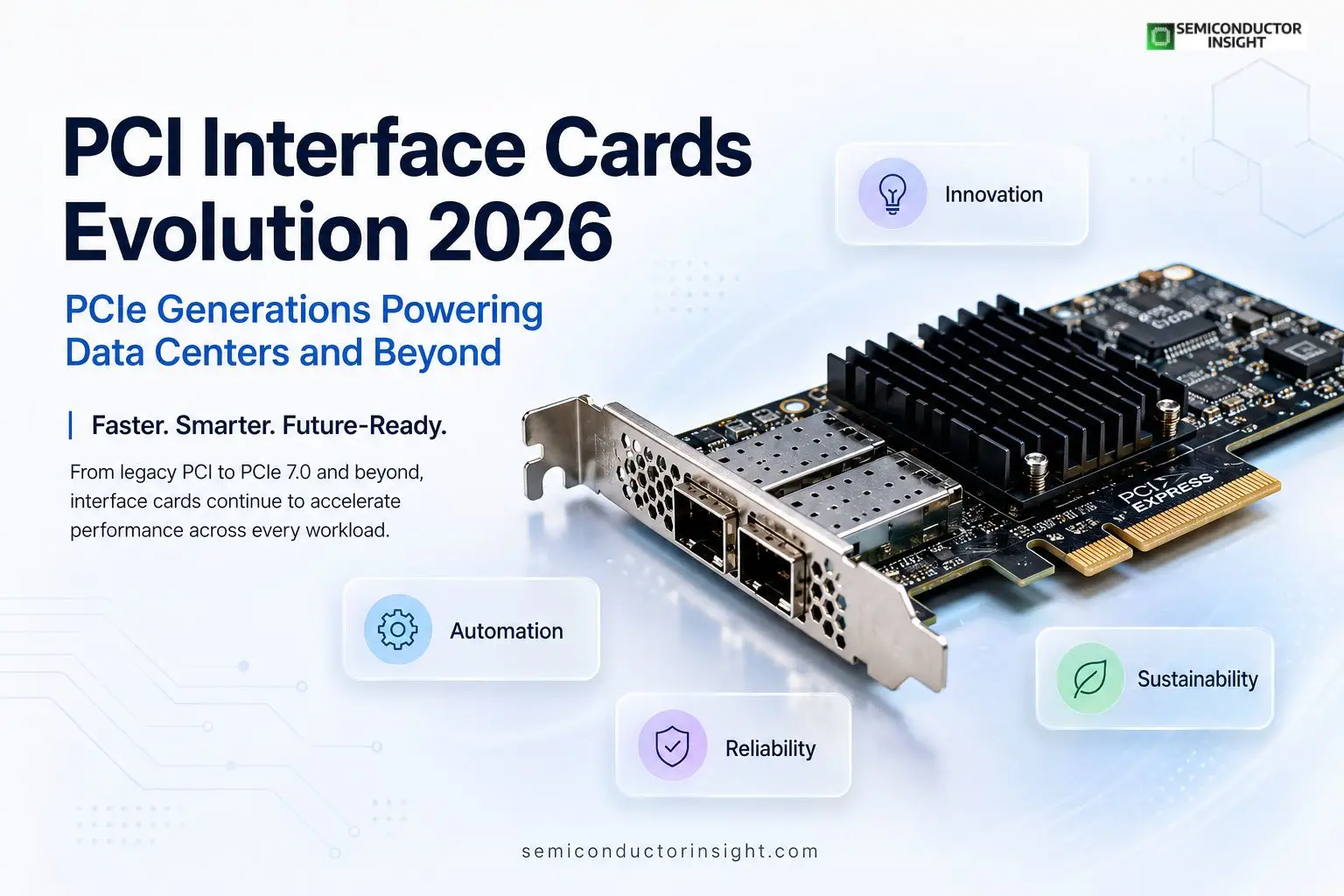
PCI Interface Cards Evolution 2026: PCIe Generations Powering Data Centers and Beyond
PCI interface cards continue to serve as essential bridges inside computers and servers, linking processors with specialized hardware components. These cards slot into motherboards to expand capabilities far beyond basic functions. Recent outlines how the original Peripheral Component Interconnect standard, introduced in the mid-1990s, transformed desktop and server architectures by enabling plug-and-play expansion for devices like network adapters and storage controllers. Its successor, PCI Express or PCIe, brought serial high-speed links that dramatically improved performance while maintaining broad compatibility across systems.
Today these interface solutions appear in everything from high-performance graphics processing setups to enterprise storage arrays. PCI-SIG, the organization maintaining the specifications, reports over 900 member companies collaborating on standards that ensure reliable interoperability worldwide. This collaborative ecosystem supports thousands of distinct products flowing into global supply chains each year.
How PCIe Interface Solutions Enable High-Speed Data Movement?
The shift from parallel PCI buses to serial PCIe lanes marked a turning point in computer architecture. Each lane in a PCIe connection handles independent data streams, allowing configurations from x1 for simple peripherals up to x16 for demanding applications like graphics cards. Recent generations deliver impressive throughput. PCIe 5.0 offers up to 32 GT/s per lane while PCIe 6.0 and 7.0 push further with PAM4 signaling techniques that maintain signal integrity at higher speeds.
In practice, a single x16 slot in modern servers can support multiple high-bandwidth connections simultaneously. This architecture proves vital for network interface cards that manage 100G, 400G, or even higher Ethernet traffic in data centers handling massive daily data volumes.
Evolution of Generations and Technical Milestones
ü Each new PCIe specification roughly doubles bandwidth roughly every three years. PCIe 7.0, finalized around 2025, targets 128 GT/s raw bit rates, supporting up to 242 GB/s in x16 configurations.
ü Early work on PCIe 8.0 aims for another doubling, expected around 2028, addressing demands from AI accelerators and disaggregated computing architectures.
ü These advancements go beyond raw speed. Features like improved power efficiency, enhanced security mechanisms, and better error correction help systems manage heat and reliability in dense server racks operating 24/7.
Integration Patterns in Contemporary Systems
Motherboard designs allocate varying numbers of PCIe lanes depending on the platform. Consumer systems might offer a mix of x16 for GPUs and several x1 or x4 slots for add-in cards. Server platforms provide far more lanes, often through chipsets or switches that expand connectivity for multiple network or storage cards.
Typical Connectivity Flow in a Server Setup:
- CPU communicates directly with primary PCIe slots.
- Chipset or switch fabric routes additional lanes to secondary cards.
- Cards interface with peripherals like Ethernet ports, SSD bays, or accelerator modules.
- Data moves bidirectionally with minimal overhead thanks to advanced protocol features.
This layered approach scales effectively for hyperscale environments where thousands of cards operate in coordinated clusters.
Specialized Cards and Their Practical Applications
Network interface cards represent one of the most common PCIe implementations. They offload TCP/IP processing and support virtualization features that allow multiple virtual machines to share physical network resources efficiently. Storage adapter cards manage RAID configurations or direct-attached storage arrays, moving petabytes of information in enterprise storage farms.
Video capture and processing cards find use in broadcasting and security monitoring stations. Sound cards, though less dominant than in past decades, still appear in professional audio workstations requiring low-latency multichannel input and output. Expansion cards also add USB or other legacy ports to systems needing broader compatibility.
Material and Design Considerations for Reliability
Card manufacturers focus on thermal management and signal integrity. High-speed designs incorporate advanced printed circuit board materials and careful trace routing to prevent crosstalk. Connectors follow PCI-SIG form factor guidelines ensuring mechanical stability even in environments with vibration or frequent maintenance access.
Power delivery has grown more sophisticated too. Modern cards often draw substantial wattage, requiring dedicated auxiliary power connectors and advanced voltage regulation on the card itself.
Global Adoption and Supply Chain Dynamics
· Manufacturing occurs across major electronics hubs, with components sourced from specialized semiconductor fabs and assembly plants.
· Government initiatives supporting domestic chip production indirectly benefit the ecosystem through increased investment in related technologies.
· Case examples from various sectors show how standardized interfaces reduce development time for new equipment by allowing modular upgrades rather than full system redesigns.
· In research laboratories, custom PCIe cards enable experimental setups ranging from quantum computing interfaces to high-energy physics data acquisition systems. These applications highlight the technology’s flexibility beyond commercial computing.
For More Detailed Insights, You Can Surf Our Latest Report Here: https://semiconductorinsight.com/report/pci-interface-cards-market/
Sustaining Momentum through Standards Collaboration
Ongoing work within PCI-SIG keeps the platform relevant. Working groups tackle emerging needs like optical interconnect explorations and tighter integration with compute fabrics. Developer’s conferences bring together engineers to share implementation experiences and shape future directions.
PCI interface cards remain foundational as computing workloads grow more data-intensive. Their continued evolution ensures systems stay adaptable, supporting everything from everyday computing to cutting-edge scientific and industrial applications worldwide.

Comments (0)