
Optics Transceiver Module Market Growth Story in Next Generation Connectivity
As digital infrastructure grows and global data consumption picks up speed, optics transceiver module market is expanding quickly. These modules function as the backbone of modern communication networks, enabling high-speed data transmission by converting electrical signals into optical signals and vice versa.
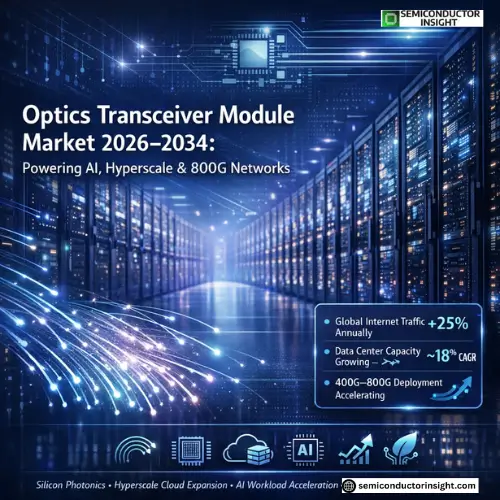
The increasing demand for cloud computing, AI workloads, and hyperscale data centres has significantly strengthened market expansion. Global internet traffic continues to grow by over 25% annually, while data center workloads are projected to increase more than threefold within the decade, driving large-scale deployment of optical communication hardware.
This technology has become essential for supporting ultra-fast network speeds, low latency transmission, and scalable data processing environments.
Inside the Semiconductor Core of Optical Transceivers
- Optical transceiver modules are fundamentally driven by semiconductor innovation. The performance of these devices depends heavily on integrated photonic components, laser diodes, and high-precision semiconductor chips.
- Modern modules use silicon photonics technology, enabling faster signal transmission with reduced power consumption. Silicon-based photonic chips improve bandwidth capacity while lowering operational heat generation, making them ideal for large-scale computing environments.
- Advancements in III-V semiconductor materials, including gallium arsenide and indium phosphide, are enhancing laser efficiency and signal stability. These materials enable transmission speeds exceeding 400G and 800G, supporting next-generation network infrastructure.
- Continuous semiconductor miniaturization and integration are increasing module efficiency while reducing manufacturing costs, strengthening overall market competitiveness.
Bandwidth Explosion and Hyperscale Computing Demand
The rapid expansion of hyperscale data centres is one of the most significant forces shaping the optics transceiver module market. Cloud providers are deploying advanced optical modules to manage massive data transfer volumes across distributed computing environments.
Global data centre capacity is expanding at nearly 18% annually, while network speed requirements continue to evolve from 100G to 400G and beyond. Optical transceivers enable efficient high-bandwidth connectivity between servers, storage systems, and switching equipment.
The transition toward AI data processing, machine learning training environments, and large-scale analytics platforms further accelerates demand for high-performance optical communication hardware.
You can freely browse our most recent updated report to learn more about it before scrolling further:
https://semiconductorinsight.com/report/optics-transceiver-module-market/
Evolution of Form Factors and Module Architecture
Innovation in module design is transforming product capabilities. Manufacturers are introducing compact and energy-efficient architectures that enhance performance while reducing physical footprint.
Key technological developments include:
- QSFP-DD and OSFP form factors supporting ultra-high data rates
- Improved thermal management systems for energy efficiency
- Advanced signal processing technologies reducing transmission errors
- Integrated photonic circuits enabling faster switching speeds
These design innovations are improving scalability and allowing network operators to manage increasing traffic demands efficiently.
Manufacturing Innovation and Supply Chain Transformation
The optics transceiver market is also benefiting from improvements in semiconductor manufacturing processes. Advanced wafer fabrication techniques and automated assembly systems are increasing production precision and reliability.
Manufacturers are investing heavily in advanced packaging technologies and chip integration methods to enhance performance and reduce signal loss. At the same time, global supply chain optimization and localized semiconductor production initiatives are strengthening component availability.
This transformation is improving cost efficiency and accelerating product commercialization across global markets.
Emerging Applications across Intelligent Technologies
Optical transceiver modules are expanding beyond traditional networking applications into emerging technology ecosystems.
The growth of 5G infrastructure, edge computing systems, and smart city networks is creating new opportunities for high-speed optical connectivity. Autonomous systems, industrial automation, and real-time analytics platforms require reliable high-bandwidth communication, increasing deployment of advanced optical modules.
The integration of optical communication with AI-driven data environments is expected to further strengthen demand for high-capacity transceiver technologies.
Performance Efficiency and Energy Optimization Trends
Energy efficiency has become a critical focus area in optical communication hardware. Data centers account for nearly 1-2% of global electricity consumption, increasing pressure to develop low-power networking solutions.
New optical transceiver designs reduce power usage through improved semiconductor efficiency, optimized signal processing, and enhanced cooling mechanisms. These innovations help organizations minimize operational costs while maintaining high transmission performance.
Sustainable technology adoption is therefore emerging as a key differentiator in the market.
Further, optics transceiver module market continues to evolve alongside global digital transformation and semiconductor innovation. The convergence of high-speed networking requirements, advanced semiconductor materials, and increasing data generation is creating a robust technology ecosystem.
As data traffic volumes grow and computing environments become more complex, optical transceiver modules will remain central to enabling scalable connectivity infrastructure. Ongoing semiconductor advancements, manufacturing innovation, and intelligent network integration position this market as a critical component of future communication systems.

Comments (0)