
Online vs. Offline Monitoring in the High Frequency Current Transformer HFCT Market 2026
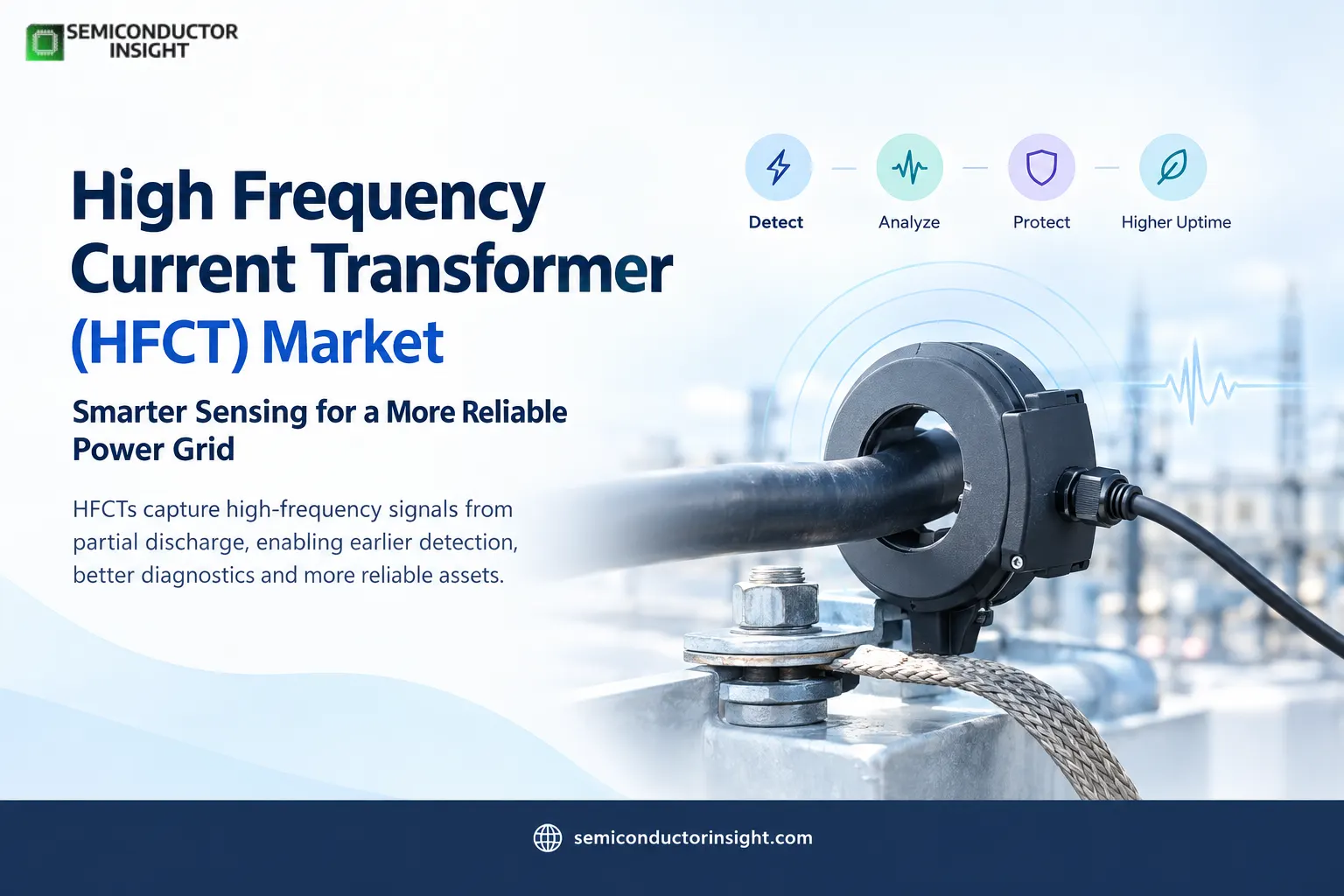
A power cable can continue carrying its rated load while an insulation defect is quietly developing inside it. That makes partial discharge one of the most important signals for condition monitoring. High Frequency Current Transformers (HFCTs) occupy a specialized position in this process because they can capture the high-frequency transient currents associated with partial discharge without requiring direct electrical connection to the high-voltage conductor.
The technology is becoming particularly relevant as utilities, industrial facilities and data-intensive infrastructure increasingly move toward online condition monitoring rather than relying exclusively on scheduled inspections.
The Signal Hidden Inside the Grounding Path
- Partial discharge produces extremely fast electrical pulses. An HFCT placed around a suitable grounding connection can detect these high-frequency components and transfer them to a measurement system for analysis.
The basic chain is surprisingly compact:
Insulation defect → Partial discharge → High-frequency transient → HFCT sensor → Acquisition system → PRPD / signal analysis → Condition assessment
- An HFCT is optimised for transient and high-frequency signals, in contrast to a typical current transformer that is mainly intended for power-frequency measurement.
- Because of this distinction, it can be used to identify activity that would otherwise go unnoticed in typical working currents of 50 Hz or 60 Hz. HFCTs are especially well suited for online PD detection on power cables, according to IEEE study.
Why 2025-2026 Is an Important Standards Window?
A significant development for the broader partial-discharge ecosystem came from the IEC 60270:2025 revision. Published on 5 June 2025, the fourth edition replaced the 2000 edition and its 2015 amendment. The standard addresses charge-based partial-discharge measurement, measurement frequencies, test circuits, analogue and digital methods, calibration and interference discrimination.
IEC 60270 also points toward IEC TS 62478 for higher-frequency measurement ranges. This distinction matters for HFCT applications because high-frequency sensing frequently sits alongside other electromagnetic measurement techniques rather than operating as an isolated diagnostic method.
For equipment manufacturers, laboratories and utilities, standardized measurement practices can help make increasingly sophisticated diagnostic systems more comparable and repeatable.
The Frequency Story Is More Important Than It Looks
HFCT technology is fundamentally about capturing information carried by fast electrical transients.
The useful signal can be buried beneath switching noise, electromagnetic interference and normal operating activity. Cable length adds another complication because high-frequency discharge signals can attenuate as they travel.
Research on online cable monitoring identifies noise, dynamic range, bandwidth limitations and signal attenuation as important considerations when HFCTs are deployed on energized cable systems.
This explains why the sensor itself is only one component of the solution. The acquisition electronics, filtering, synchronization and signal-processing algorithms can be equally important.
A Real 10 Kilometer Monitoring Example
The practical value of HFCT sensing becomes clearer in field deployments.
- OMICRON has documented an online monitoring case involving three underground power cables, each 10 kilometers long. HFCT sensors were installed at cable terminations and joints, with data acquired from multiple accessory groups.
- The monitoring architecture combined synchronized measurements with statistical time-domain reflectometry to help locate PD activity.
In another documented case, calibration pulses of 100 pC were injected into HFCT sensors, while a monitoring system used a 900 kHz center frequency and 300 kHz bandwidth. Warning and alert thresholds were established at 30 pC and 50 pC, respectively. The investigation eventually traced a PD-like signal to a transformer approximately 1.8 km from the monitoring point.
These examples demonstrate that the commercial value of HFCT technology lies not merely in detecting a pulse, but in helping engineers determine whether that pulse represents a genuine defect and where it originated.
The Application Map Is Expanding
- Power cables remain one of the most established applications, particularly at joints, terminations and grounding connections. However, HFCT measurements are increasingly being investigated for transformers, rotating machines, GIS-related equipment and HVDC insulation systems.
- Recent IEEE research published in April 2026 demonstrated an AI-enabled approach for identifying partial-discharge sources in high-voltage rotating-machine insulation using HFCT measurements. The researchers converted HFCT-acquired signals into phase-resolved partial-discharge patterns and achieved 98.3% overall classification accuracy using a custom ConvNeXt deep-learning model.
- That development represents a major conceptual shift: the HFCT is becoming not only a sensor but also a source of machine-readable data for automated diagnosis.
HFCT Is Joining a Multi-Sensor Diagnostic Stack
The market is also moving away from the idea that one sensor should solve every diagnostic problem.
A 2026 IEEE study compared HFCT, UHF and TEV sensing approaches for corona and surface-discharge detection under HVDC conditions. The research examined differences in signals across time and frequency domains and used pulse-sequence analysis to characterize discharge behaviour.
This points toward a more sophisticated architecture:
HFCT + UHF + TEV + Voltage/Current Data + AI → Multi-Source Insulation Diagnosis
For high-value assets, combining sensor modalities can improve confidence when electromagnetic interference or complex equipment geometry makes individual measurements difficult.
Want to learn more about the report? Check out our latest updated version for free: https://semiconductorinsight.com/report/high-frequency-current-transformer-hfct-market/
Semiconductor Technology Is Quietly Raising the Bar
Although the application sits within power engineering, semiconductor technology is deeply embedded in modern HFCT measurement systems.
High-speed acquisition requires increasingly capable analogue front ends, ADCs, digital signal processors, communication interfaces and embedded processors. Filtering that once required substantial dedicated hardware can increasingly be performed digitally.
That opens several development pathways:
- Higher-speed analogue-to-digital conversion
- Lower-noise signal acquisition
- FPGA-based transient processing
- Edge AI for preliminary PD classification
- Time-synchronized multi-channel acquisition
- Remote data transmission from substations
- Automated PRPD pattern recognition
The result is a convergence between power diagnostics and semiconductor-enabled edge intelligence.
Why Installation Design Still Matters
HFCT performance cannot be judged only from a datasheet.
Installation location, grounding arrangement, cable geometry and electromagnetic environment can substantially influence what the sensor receives. For MV cables, commercially available HFCT designs can be installed around grounding braids and are intended for both online and offline PD measurement.
Research has also examined split-core and variable-air-gap HFCT configurations because online monitoring can expose the sensor core to substantial power-frequency current and potential saturation.
This makes mechanical design, magnetic-core behaviour and installation flexibility important areas of technological differentiation.
The New Value Proposition Is Early Evidence
The strongest use case for HFCT technology is not simply finding an existing fault. It is identifying evidence of insulation deterioration while intervention is still possible.
That changes maintenance from:
Failure → Emergency repair → Outage
Toward:
Signal → Diagnosis → Risk assessment → Planned intervention
For utilities operating underground cables, industrial plants with critical motors and generators, data centers, renewable-energy infrastructure and high-voltage substations, that transition can have operational significance far beyond the price of the sensor.
Where the Technology Goes Next?
The direction emerging in 2026 is clear: HFCT measurements are becoming increasingly digital, synchronized and algorithmically interpreted.
Future systems are likely to place greater emphasis on continuous monitoring, multi-sensor correlation and automated classification rather than simply displaying PD waveforms to an engineer.
The most interesting development may therefore happen at the intersection of HFCT hardware, semiconductor acquisition electronics and AI-based diagnostics.
As power networks become more complex and asset owners seek earlier warning of insulation deterioration, the High Frequency Current Transformer is evolving from a specialist measurement accessory into an important sensing node within the broader digital condition-monitoring architecture.

Comments (0)