
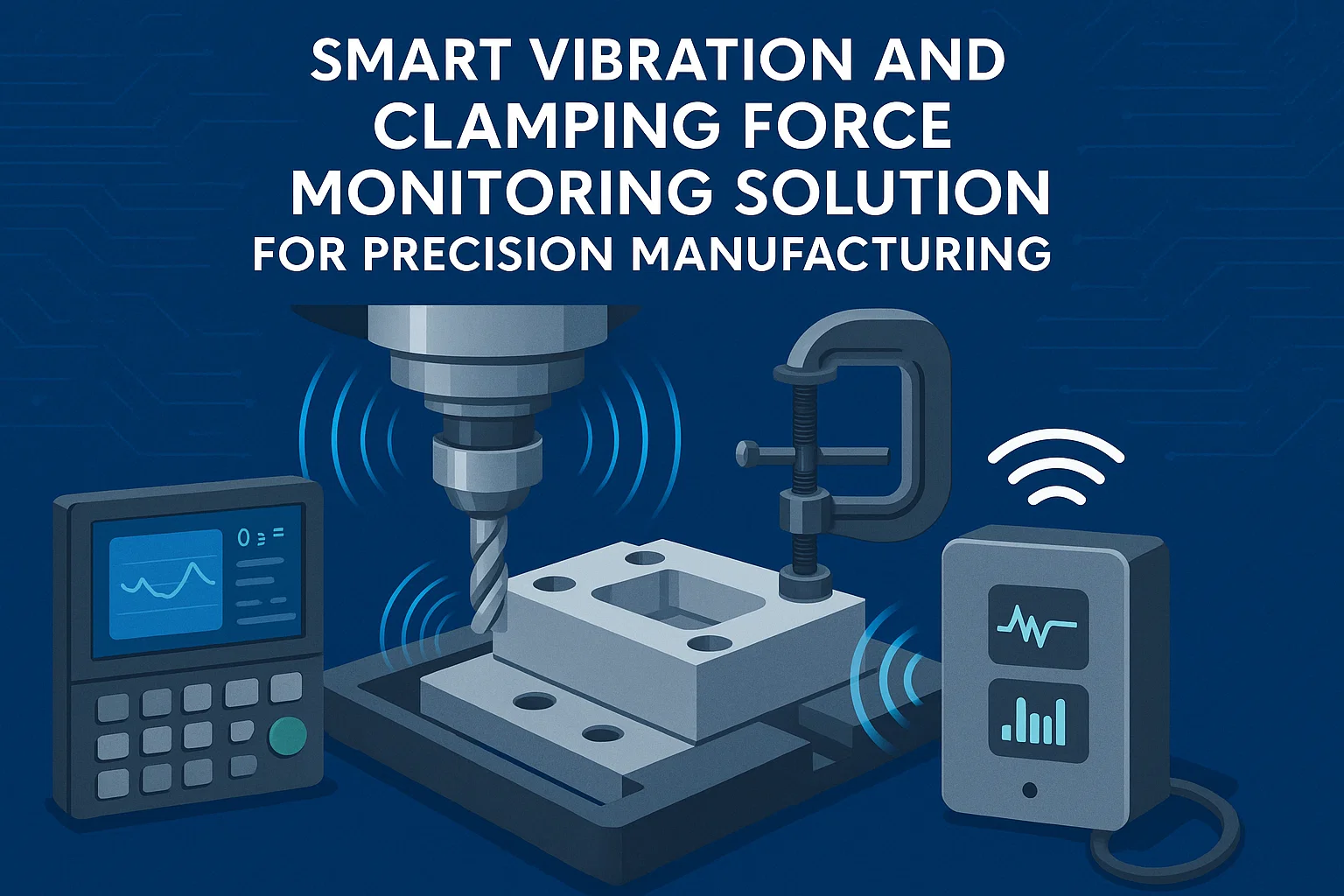
OncQue Unveils Smart Vibration and Clamping Force Monitoring Solution for Precision Manufacturing
In an era where precision, efficiency, and safety define industrial competitiveness, the role of sensors has never been more critical. Among them, clamping force sensors have carved out a vital niche. These specialized devices measure the force exerted by clamping mechanisms in machine tools, robotics, automotive systems, and advanced manufacturing equipment. By ensuring that the right amount of force is applied, clamping force sensors safeguard against product defects, machine damage, and even catastrophic failures.
The market has shown robust growth in recent years. Valued at US$ 298 million in 2024, the global clamping force sensors market is projected to climb to US$ 467 million by 2032, expanding at a CAGR of 5.8% from 2025 to 2032. This growth is being fueled not only by the rising adoption of automation and robotics but also by continuous technological advancements and new product launches.
Access Your Free Sample Report- Clamping Force Sensors Market
Understanding the Role of Clamping Force Sensors
At their core, clamping force sensors ensure that workpieces or components are held with optimal strength during machining, welding, assembly, or testing. Too little force, and the workpiece might slip, leading to inaccuracies or accidents. Too much force, and the part or the tool could be damaged.
Key applications include:
- Machine Tools – Monitoring bolt preload, spindle forces, and workholding devices.
- Robotics – Ensuring stable grip in automated assembly lines and collaborative robots.
- Automotive & Aerospace – High-precision assembly, safety-critical component handling, and quality assurance.
- Research & Material Testing – Advanced laboratories using sensors for tensile, compression, and fatigue testing.
The technology behind these sensors varies, with strain gauges, piezoelectric sensors, fiber optic sensors, and capacitive systems each offering unique advantages. The right choice often depends on the precision required, the operating environment, and cost considerations.
Market Outlook: From 2024 to 2032
The projected rise of the clamping force sensor market from US$ 298 million in 2024 to US$ 467 million by 2032 reflects a broader trend in industrial automation. Several key factors are driving this trajectory:
- Smart Manufacturing & Industry 4.0 – Sensors are central to real-time monitoring and digital twin systems.
- Robotics Expansion – Growth in both industrial and collaborative robots is boosting demand for force monitoring solutions.
- Quality & Safety Demands – Industries such as aerospace and automotive are enforcing stricter process controls.
- Miniaturization & Precision – Microelectronics and medical device manufacturing require ultra-sensitive clamping force monitoring.
- Research & Innovation – New sensing methods like fiber Bragg gratings (FBGs) and multi-axis sensing are expanding possibilities.
Recent Industry Developments
Let’s explore the most notable recent news and technological advancements reshaping this market.
1. OncQue’s Smart Vibration & Clamping Force Monitoring Solution (June 2025)
OncQue, a specialist in sensing technologies, introduced a dual monitoring system that combines vibration detection with clamping force monitoring. This integrated solution is tailored for industrial equipment such as robotic arms, motors, and machine tools.
Key Highlights:
- Time-based and threshold-based monitoring for clamping force.
- Statistical Process Control (SPC)-ready data output.
- Vibration detection using 3-axis sensors (±16g, resolution 0.0005g/LSB).
- Combined monitoring features with CSV export.
- Options for wired or wireless integration, aligning with Industry 4.0 connectivity trends.
By combining force and vibration sensing, OncQue’s system addresses two of the biggest pain points in precision manufacturing: equipment wear and part slippage. This innovation is expected to gain traction in high-volume manufacturing sectors where downtime and defects translate directly into lost revenue.
2. Lorenz Messtechnik’s Compression Ring Force Sensor (July 2025)
Germany-based Lorenz Messtechnik unveiled a new generation of compression ring force sensors, designed to measure bolt preload and clamping forces with unprecedented accuracy.
Notable Features:
- Measuring range: 15 kN to 1500 kN.
- Stainless steel design with ultra-thin profile for integration in tight spaces.
- High natural frequency, making it suitable for dynamic measurements.
- USB3-based LCV-USB3 sensor interface, enabling up to 5000 measurements per second.
- Plug-and-play software with configurable settings for fast deployment.
This development highlights the growing need for reliable and high-speed force measurements in industries such as aerospace, where bolt preload verification is critical to safety. Lorenz’s innovation also reflects a wider trend toward sensor miniaturization and digital integration.
Download Sample Report PDF- Clamping Force Sensors Market
3. TME’s Overview of Force Sensors in Industrial Automation (May 2025)
While not a product launch, TME’s industry report provided valuable insights into the evolving role of force sensors. It highlighted:
- Strain gauges remain dominant due to versatility and affordability.
- Piezoelectric sensors excel in dynamic applications.
- Capacitive and inductive sensors are gaining ground for specialized applications requiring high sensitivity.
- Integration of AI algorithms with force data is enabling predictive maintenance.
This overview reinforces the notion that the clamping force sensor market is not static; instead, it is diversifying with multiple sensor technologies coexisting to address different needs.
4. Ultraforce MT510 3-Axis Force Sensor (December 2024)
Ultraforce introduced the MT510 multi-axis force sensor, allowing force measurement in three directions simultaneously.
Why It Matters:
- Robotics and automation increasingly require multi-axis sensing to ensure safe human-robot collaboration.
- Material testing applications benefit from full force vector measurements.
- Compact and precise, the MT510 supports advanced applications in robotics, medical devices, and aerospace R&D.
The product reflects the industry’s shift toward multi-functional, compact, and highly precise sensors, aligning with miniaturization trends.
5. Tianjin University’s Fiber Bragg Grating (FBG) Sensor Breakthrough (August 2025)
Researchers at Tianjin University reported significant progress in developing fiber Bragg grating-based clamping force sensors.
Advantages of FBG sensors:
- Immunity to electromagnetic interference.
- High sensitivity and precision.
- Suitability for harsh environments like nuclear plants or space applications.
Academic innovations such as this one indicate that the future of clamping force sensing may lean toward optical technologies, especially in high-stakes industries like aerospace and defense.
6. Schunk’s Sensory Clamping Force Blocks
Schunk, a leader in automation and gripping systems, introduced clamping force blocks with integrated sensory functions.
Features:
- Pneumatic/hydraulic actuation with real-time force sensing.
- Data output via IO-Link for seamless integration into industrial networks.
- Monitoring of both clamping pressure and jaw position.
By embedding sensing directly into clamping devices, Schunk reduces the need for external sensors while improving real-time data accessibility, a cornerstone of predictive maintenance and smart factory operations.
Broader Industry Implications
The innovations above reflect a few clear macro trends in the clamping force sensor market:
- Integration of Multi-Sensing Capabilities
Companies like OncQue and Schunk are embedding force sensing with other functions (vibration, pressure, position) for more comprehensive machine monitoring. - Shift Toward Digital & Plug-and-Play Interfaces
Lorenz’s USB3 sensor and Schunk’s IO-Link-ready devices highlight the move away from analog systems toward digital, software-driven solutions. - Miniaturization & Precision
Ultra-thin ring sensors and compact multi-axis solutions show how sensors are being designed for tight spaces without sacrificing performance. - Fiber Optic & Optical Sensing
Academic research is exploring FBG-based sensors, which could dominate in extreme environments where conventional sensors fail. - Industry 4.0 Readiness
Wireless, real-time data, and cloud connectivity are no longer optional they are becoming standard features for modern clamping force sensors.
Challenges Facing the Market
Despite these advancements, several challenges remain:
- High Cost of Advanced Sensors – Multi-axis and optical systems are still expensive.
- Integration Complexity – Retrofitting older machinery with modern sensing systems is not always straightforward.
- Standardization Issues – Lack of universal standards for digital interfaces hampers interoperability.
- Competition from Alternatives – In some cases, vision systems and indirect load monitoring are being tested as substitutes for direct force sensing.
Click Here To Download Full Sample Report- Clamping Force Sensors Market
Future Outlook
Looking forward, the clamping force sensor market is expected to evolve in several directions:
- AI & Predictive Analytics – Force data will be combined with AI models to forecast equipment failure before it happens.
- Wireless & Energy-Harvesting Sensors – Self-powered sensors could reduce wiring complexity.
- Integration into Smart Clamps & Fixtures – Sensors will increasingly be embedded within clamping systems themselves.
- Adoption in Emerging Industries – Medical robotics, electric vehicle (EV) battery assembly, and microelectronics manufacturing will drive demand.
By 2032, the US$ 467 million market size will reflect not just expansion in volume, but also in technological sophistication.
The clamping force sensor industry is undergoing a transformation fueled by innovation. From OncQue’s dual monitoring systems and Lorenz’s high-frequency compression sensors to Schunk’s sensory clamping blocks and Tianjin University’s optical breakthroughs, the sector is pushing the boundaries of what force measurement can achieve.
As the global market grows steadily at a CAGR of 5.8%, industries ranging from automotive to aerospace are set to benefit from more accurate, reliable, and connected force sensing technologies. For manufacturers and engineers, investing in these innovations is not just about meeting today’s precision requirements it’s about preparing for the smart factories of tomorrow.

Comments (0)