
NOR Flash Memory Solutions Fueling 5G Base Station Expansion Worldwide
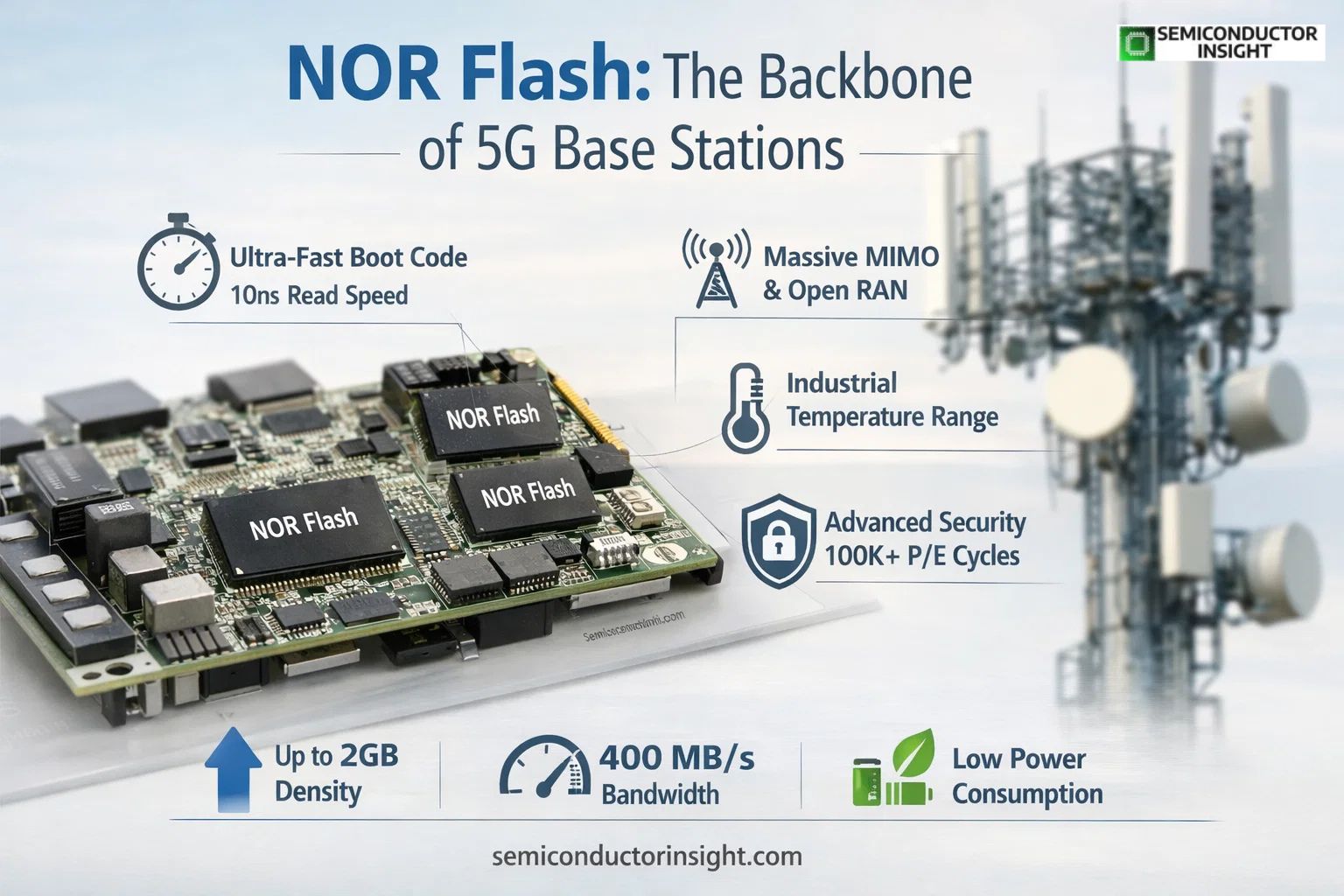
As telecom operators race to densify networks and deliver ultra-low latency connections, NOR Flash memory has quietly become a backbone component inside 5G base stations. NOR Flash excels in storing crucial boot code, firmware, configuration parameters, and safe execution routines that must activate promptly when power cycles or systems reboot, in contrast to mass-storage alternatives that manage user data. Its execute-in-place functionality reduces startup times and increases dependability in always-on situations by enabling processors to run code straight from memory without first copying it to RAM.
In a typical 5G macro base station, multiple NOR Flash devices support baseband processors, radio frequency units, and power management subsystems. Engineers often specify densities ranging from 128 Mb up to 2 GB or higher per station, depending on the complexity of edge computing tasks now migrating closer to the antenna.
Recent deployments show that as operators shift toward Open RAN architectures and massive MIMO configurations, the need for fast random reads and industrial-grade temperature tolerance has grown sharply.
Technical Edge That Keeps 5G Sites Running Smoothly
- NOR Flash shines in scenarios where instant access and high endurance count most. Random read speeds can reach tens of nanoseconds, far outperforming alternatives for code-fetch operations.
- Many devices now support advanced interfaces like Octal SPI or HyperBus, pushing effective bandwidth toward 400 MB/s while keeping power draw low during standby.
- This matters enormously in 5G sites, where a single active antenna unit can dominate energy use, and every watt saved on auxiliary systems helps control operating expenses.
- Endurance ratings commonly hit 100,000 program/erase cycles, with some specialized parts extending further for frequent over-the-air firmware updates.
- Data retention over decades under wide temperature swings makes NOR Flash suitable for outdoor cabinets exposed to heat, cold, and humidity.
- Suppliers have introduced features like integrated security engines and post-quantum cryptography support to protect against emerging threats in public networks.
Read the full insights by clicking the link below: https://semiconductorinsight.com/report/nor-flash-5g-base-stations-market/
How Interface Innovations and Density Advances Help?
The move toward serial interfaces has reduced pin counts and board space inside compact base station designs. Quad and octal modes deliver higher throughput without the complexity of parallel buses, which helps engineers pack more functionality into weatherproof enclosures. At the same time, process nodes around 28-55 nm balance cost, yield, and performance for these mature yet critical devices.
Manufacturers continue to push density while preserving reliability. Parts reaching 1 GB and 2 GB handle the growing code footprint caused by advanced beam forming algorithms, AI-assisted radio resource management, and security protocols. Low-power variants further assist operators chasing sustainability targets, especially as global 5G population coverage outside China heads toward 50% or more in 2025.
Supply Dynamics and Industry Realities in 2026
Semiconductor fabrication priorities have shifted in recent years, with heavy investment flowing into high-bandwidth memory for AI data centers. This has occasionally tightened capacity for NOR Flash produced on shared mature lines, prompting closer collaboration between suppliers and telecom OEMs. Leading producers maintain dedicated support for communications infrastructure, emphasizing long product lifecycles and extended temperature qualifications essential for field deployment.
Winbond, Macronix, Infineon, Micron, and GigaDevice remain key names delivering devices tailored for networking. Their roadmaps include enhanced security features and better integration with system-on-chip platforms used in radio access networks. As edge computing grows inside base stations, the ability to execute complex routines directly from NOR Flash becomes even more valuable.
Linking Broader Network Trends to Memory Choices
- The push for energy efficiency across 5G infrastructure directly influences memory selection. Features like dynamic power scaling and fast wake-up from deep sleep states in modern NOR parts help minimize idle consumption in auxiliary subsystems. Operators experimenting with battery-backed or renewable-powered small cells particularly value components that maintain data integrity during power fluctuations.
- Global coverage forecasts point to continued expansion, with GSMA projections indicating substantial growth in 5G connections through the decade. Each additional site whether supporting enhanced mobile broadband, ultra-reliable low-latency communications, or massive machine-type connections relies on dependable boot and configuration storage to deliver promised performance without frequent maintenance.
Practical Takeaways for Telecom and Semiconductor Teams
Engineers evaluating memory for next-generation 5G gear should weigh random read performance, interface speed, endurance under temperature stress, and security capabilities together. Testing real-world boot sequences and firmware update cycles under simulated field conditions reveals how different NOR solutions behave when massive MIMO arrays or edge AI workloads come online.
Procurement groups increasingly look for suppliers offering long-term availability commitments and customization options for specific radio unit designs. As 5G-Advanced and early 6G discussions gain momentum, the foundational role of NOR Flash in ensuring instantaneous, trustworthy operation is only set to deepen.
This specialized memory technology may not grab daily headlines like high-bandwidth DRAM, yet it quietly enables the uptime, speed, and security that define successful 5G deployments worldwide. As networks grow denser and smarter, NOR Flash memory continues proving its worth where reliability cannot be compromised. (Word count: 682)

Comments (0)