
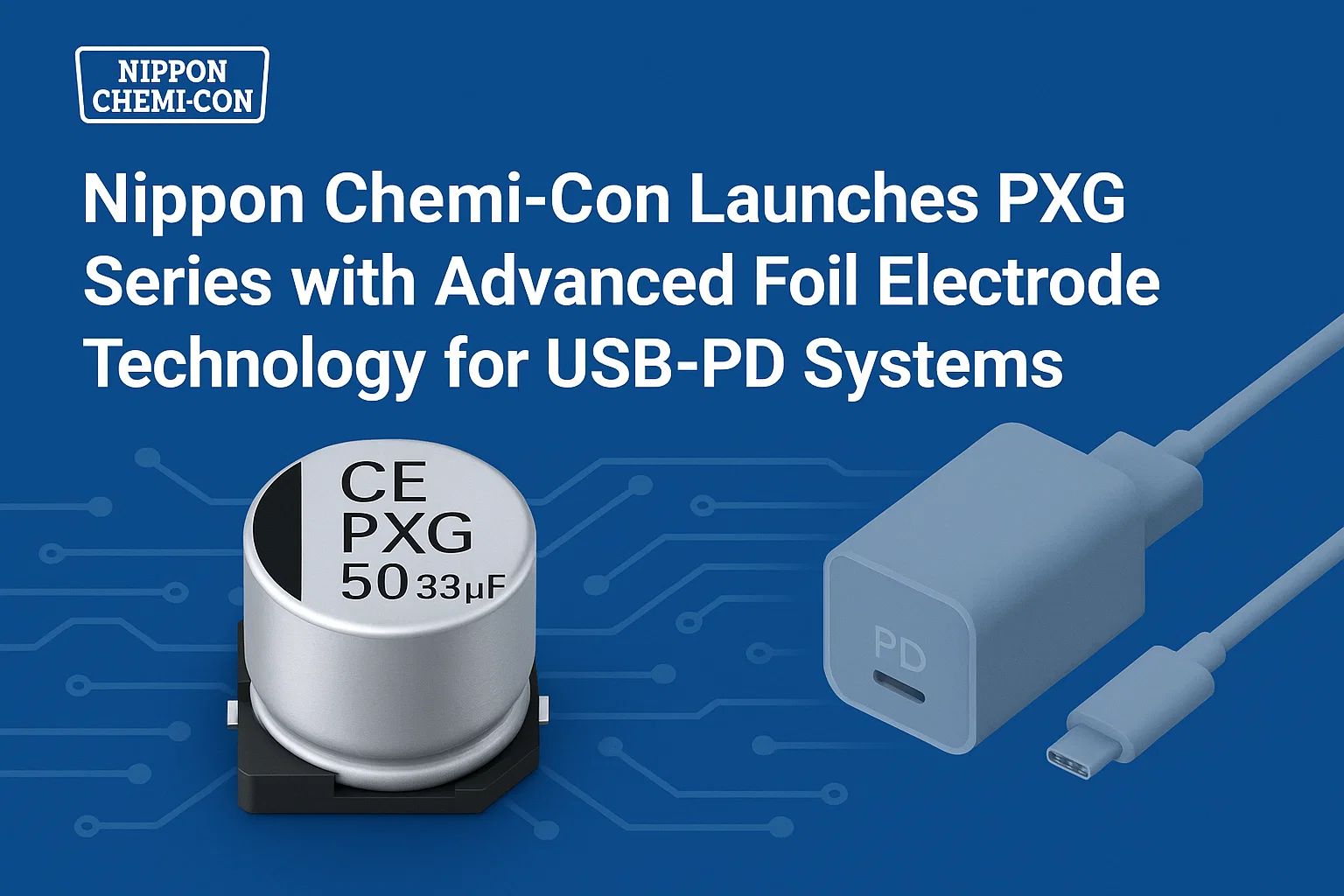
Nippon Chemi-Con Launches PXG Series with Advanced Foil Electrode Technology for USB-PD Systems
The world of electronics is undergoing a quiet revolution, and capacitors often the unsung heroes of power electronics are at the center of it. Among the many capacitor technologies, foil electrode type film capacitors have gained renewed attention in recent years due to their durability, stability, and expanding use in next-generation industries such as electric vehicles (EVs), renewable energy, 5G networks, and smart grids.
According to the latest data, the Foil Electrode Type Film Capacitors market was valued at USD 937 million in 2024 and is projected to reach USD 1,426 million by 2032, growing at a CAGR of 6.6% during the forecast period. This growth is driven by new material breakthroughs, improved foil electrode designs, AI-assisted research, and supply-chain localization efforts, especially in Asia.
Access Your Free Sample Report- Foil Electrode Type Film Capacitors Market
What Are Foil Electrode Type Film Capacitors?
Film capacitors are a class of capacitors that use thin plastic films as the dielectric medium. Within this category, foil electrode type film capacitors stand out because they use separate metal foils as electrodes placed on either side of the dielectric film.
Unlike metallized film capacitors, where the electrode is a thin metal coating deposited directly on the dielectric film, foil electrode capacitors use thicker, more robust foils. This design provides:
- Higher current handling capability
- Excellent pulse stability
- Low series resistance (ESR)
- Longer service life
These properties make foil electrode capacitors particularly attractive in applications where reliability, high voltage resistance, and pulse handling are essential such as motor drives, renewable energy inverters, aerospace, and automotive electronics.
Market Growth and Dynamics (2024–2032)
The growth trajectory of the foil electrode type film capacitor market reflects broader global trends in electrification, digitalization, and energy transition.
Market Size and CAGR
- 2024 Market Value: USD 937 million
- 2032 Projection: USD 1,426 million
- CAGR (2024–2032): 6.6%
Growth Drivers
- Electric Vehicles (EVs) – EV adoption is accelerating worldwide, and foil electrode film capacitors are integral to traction inverters, DC link circuits, and onboard charging systems.
- Renewable Energy – Wind turbines, solar inverters, and grid stabilization systems rely on durable capacitors for handling fluctuating loads.
- 5G Networks & High-Frequency Electronics – The need for capacitors that can operate reliably at higher frequencies and temperatures is pushing the adoption of advanced film capacitor designs.
- Industrial Automation – Smart factories and robotics require stable power conditioning, an area where foil capacitors excel.
- Aerospace and Defense – Foil capacitors are valued in mission-critical systems for their reliability and ability to withstand harsh conditions.
Regional Trends
- Asia-Pacific leads in both production and consumption, with China pushing strongly toward domestic capacitor materials to reduce dependence on imports.
- North America is driven by the EV boom and renewable projects.
- Europe maintains demand through automotive electrification and grid modernization efforts.
Recent Developments in Foil Electrode Film Capacitors
The past two years have seen significant breakthroughs in materials, electrode design, and manufacturing technologies. Let’s examine them in detail.
1. AI-Assisted Discovery of Advanced Dielectric Polymers
Researchers at Berkeley Lab and collaborators pioneered the use of machine learning algorithms to scan over 50,000 polymer candidates in search of new dielectric materials.
Why it matters:
- Conventional polypropylene films face limitations in high-temperature environments.
- New polymers discovered via AI show better heat resistance, higher dielectric strength, and lower energy loss.
- This enables foil capacitors to function in demanding EV and aerospace conditions without rapid aging.
This marks a new era where computational science and AI accelerate capacitor material innovation, cutting down years of trial-and-error laboratory work.
2. China’s Push for Domestic High-Performance Dielectrics
In 2024, Chinese research institutes announced breakthroughs in locally developed dielectric films.
Key advancements:
- Improved insulation performance, thermal stability, and mechanical strength.
- Reduced dependence on imported high-end films.
- Lowered costs for local manufacturers.
Applications:
- New Energy Vehicles (NEVs)
- 5G communications equipment
- Smart home systems
This aligns with China’s broader push for supply-chain independence, ensuring capacitor production is resilient against global disruptions.
Download Sample Report PDF- Foil Electrode Type Film Capacitors Market
3. Nippon Chemi-Con’s Electrode Foil Innovation
Nippon Chemi-Con, a leading Japanese capacitor manufacturer, unveiled the PXG series, incorporating new high-gain electrode foils and conductive polymer technology.
Benefits:
- Higher capacitance values at low voltages (16V–25V).
- Optimized for USB-PD power delivery systems and DC input circuits.
- Demonstrates how electrode foil design can push the performance envelope without requiring radical dielectric changes.
This highlights the synergy between electrode engineering and dielectric material development.
4. Structural and Packaging Improvements
Manufacturers are rethinking capacitor geometry and internal connections to minimize parasitic inductance and resistance.
Emerging improvements include:
- Layer stacking for reduced ESR.
- Foil edge shaping for better current distribution.
- Heat-resistant encapsulation materials for prolonged service life.
These structural tweaks may seem minor, but collectively they deliver higher reliability under high-frequency switching a must for modern power electronics.
Applications Driving Innovation
Electric Vehicles (EVs)
- Capacitors are essential in traction inverters, stabilizing the DC link that feeds power to the motor.
- Foil capacitors offer long lifespans and stable operation under repeated charging/discharging cycles.
- Thermal stability improvements are particularly relevant as EV power electronics move toward 800V architectures.
Renewable Energy
- Solar and wind power systems demand long-life capacitors for DC filtering, reactive power compensation, and harmonic suppression.
- Foil capacitors ensure high current carrying capability and low failure rates crucial for reducing downtime in renewable plants.
5G and High-Frequency Electronics
- As communication networks move toward millimeter-wave frequencies, capacitors must handle faster switching speeds without overheating.
- AI-designed dielectrics could be game-changers here.
Aerospace and Defense
- Foil capacitors are preferred for satellites, avionics, and defense radar systems, where failure is not an option.
- Their ruggedness and high surge capability provide a competitive edge over metallized film alternatives.
Challenges Facing the Industry
Despite strong growth, foil electrode film capacitors face hurdles:
- Dielectric Breakdown – High voltages and switching stresses lead to aging and capacity loss.
- Heat Management – Effective cooling and thermal design remain critical in high-power applications.
- Cost vs Performance Trade-offs – New materials and advanced foils increase costs, which may hinder adoption in consumer electronics.
- Miniaturization Limits – Compared to electrolytic capacitors, film capacitors are bulkier, which limits use in ultra-compact devices.
Click Here To Download Full Sample Report- Foil Electrode Type Film Capacitors Market
Future Outlook (2025–2032)
Looking ahead, several trends will shape the future of foil electrode type film capacitors:
- AI-Driven Materials Science: Wider adoption of computational chemistry to discover new films with superior dielectric properties.
- Localized Supply Chains: Countries will continue investing in domestic capacitor materials to reduce import dependency.
- Integration with EV and Renewable Ecosystems: Foil capacitors will remain a backbone component in electrification and clean energy systems.
- Hybrid Capacitor Designs: Combining foil electrodes with nanostructured dielectrics could bridge the gap between energy density and reliability.
- Sustainability: Recycling and environmentally friendly film materials will become an industry focus as demand scales up.
By 2032, foil electrode type film capacitors will not only expand in market value but also evolve technologically, positioning themselves as indispensable enablers of a cleaner, smarter, and electrified future.
With market growth from USD 937 million in 2024 to USD 1,426 million by 2032 (CAGR 6.6%), and with ongoing innovations in dielectric materials, electrode foils, and manufacturing, the industry is entering an exciting phase.

Comments (0)