
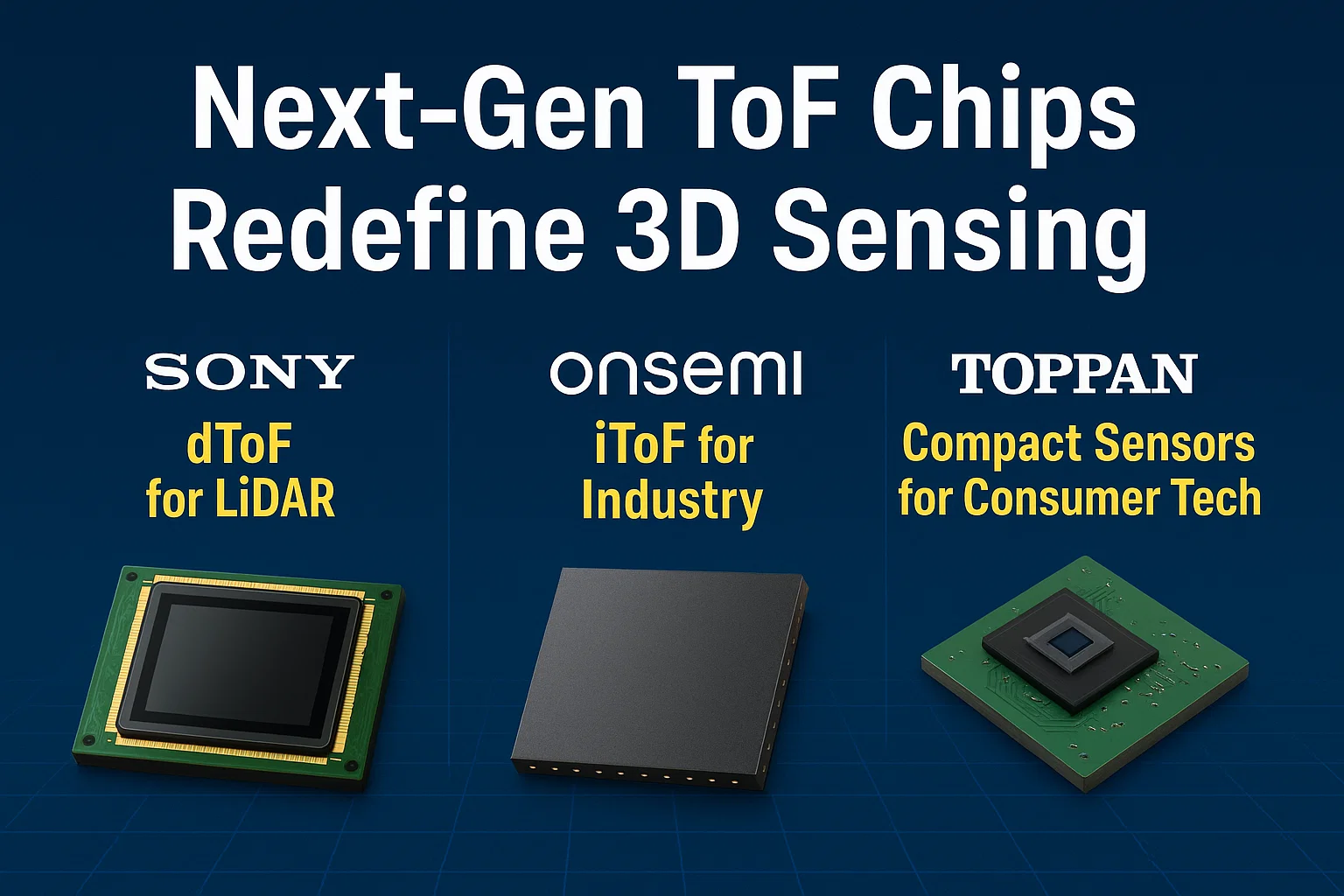
Next-Gen ToF Chips Redefine 3D Sensing: Sony’s dToF for LiDAR, onsemi’s iToF for Industry, Toppan’s Compact Sensors for Consumer Tech
The global Time-of-Flight (ToF) chip market is undergoing a remarkable transformation. Valued at US$ 3,878 million in 2024, it is projected to grow to US$ 15,830 million by 2032, registering a CAGR of 22.8% during the forecast period. This extraordinary growth is fueled by rising adoption in automotive LiDAR, industrial automation, robotics, AR/VR, smartphones, and smart home devices.
ToF chips have moved beyond niche applications, emerging as a core enabler of 3D sensing in an era defined by autonomous mobility, machine vision, immersive experiences, and precision robotics. Recent industry announcements from Sony Semiconductor Solutions, onsemi, and Toppan Holdings highlight the speed of innovation and the critical role ToF plays in shaping next-generation sensing ecosystems.
Access Your Free Sample Report- Time-of-flight Chip Market
Understanding Time-of-Flight (ToF) Chips
Time-of-Flight chips measure the time it takes for light to travel to an object and back. By calculating this time delay, they determine precise depth information, enabling real-time 3D mapping. Two major approaches dominate:
- Direct ToF (dToF): Measures photon arrival time directly using SPADs (Single-Photon Avalanche Diodes). Known for accuracy in long-range and outdoor applications, making it ideal for automotive LiDAR.
- Indirect ToF (iToF): Uses modulated light and phase detection to calculate distance. It is more cost-effective and suited for short-to-mid range applications like smartphones, AR/VR, and robotics.
Together, dToF and iToF create a versatile ecosystem, supporting both consumer-grade depth sensors and mission-critical autonomous systems.
Recent Industry Developments Driving Growth
1. Sony Semiconductor Solutions Unveils IMX479 – A Breakthrough dToF SPAD Sensor for Automotive LiDAR
In June 2025, Sony Semiconductor Solutions (SSS) announced its latest innovation: the IMX479 stacked dToF SPAD depth sensor, purpose-built for automotive LiDAR.
- Key Features:
- 3×3 SPAD pixel unit structure
- High-resolution 520 dToF pixels
- Frame rate up to 20 fps, among the fastest in the market
- Stacked design improves photon detection efficiency (PDE)
- Enhanced distance accuracy in low-light and high-speed driving conditions
- Why It Matters:
The IMX479 is designed for advanced driver-assistance systems (ADAS) and autonomous driving, where real-time depth sensing is critical for collision avoidance, pedestrian detection, and object tracking. - Market Impact:
Sony’s entry into automotive-grade ToF cements its role as a global leader in image and depth sensing. With sample shipments starting autumn 2025 at around ¥35,000 per unit, adoption in high-end LiDAR systems is highly anticipated.
2. onsemi Launches Hyperlux™ ID – First Real-Time iToF Sensor for Industrial Applications
In March 2025, onsemi introduced the Hyperlux™ ID series, the industry’s first real-time indirect ToF (iToF) sensor targeted at industrial environments.
- Key Features:
- Designed for factory automation, logistics, and robotics
- Real-time depth capture with low-latency processing
- Optimized for indoor operations and variable lighting conditions
- Energy-efficient for battery-powered industrial robots
- Why It Matters:
Industrial automation is moving toward vision-based robotics that require high-precision depth sensing. By offering real-time iToF performance, onsemi addresses the growing need for fast and reliable object detection in warehouse robotics, AGVs (Automated Guided Vehicles), and smart factories. - Market Impact:
With Industry 4.0 and AI-powered manufacturing, onsemi’s innovation could become a cornerstone of next-gen industrial robotics.
3. Toppan Holdings Introduces Next-Gen Compact 3D ToF Sensor
In November 2024, Toppan Holdings revealed a compact 3D ToF sensor designed for consumer electronics and service robots.
- Key Features:
- Based on proprietary Hybrid ToF™ technology
- Supports HDR (High Dynamic Range) for better imaging in diverse lighting
- Pixel binning capability for improved efficiency
- Low power consumption for wearable and mobile devices
- Smaller form factor enables integration in smart glasses, cleaning robots, and AR devices
- Why It Matters:
By miniaturizing ToF sensors without compromising performance, Toppan enables widespread integration into portable and battery-powered devices. This opens doors for consumer-grade 3D sensing in areas such as smart wearables, metaverse applications, and home automation. - Market Impact:
Sampling began in May 2025, with mass production scheduled for October 2025, positioning Toppan to gain significant traction in consumer electronics.
Download Sample Report PDF- Time-of-flight Chip Market
4. FMCW LiDAR Emerges as a Challenger to ToF
While ToF dominates today, Frequency-Modulated Continuous-Wave (FMCW) LiDAR is gaining ground in high-performance applications.
- Advantages over ToF:
- Higher resistance to interference and blooming
- Better handling of high optical power levels
- Provides velocity data in addition to distance
- Potentially lower cost per unit at scale
- Implications:
FMCW does not replace ToF but rather complements it. Future autonomous vehicles and robotics systems may deploy a hybrid sensing suite, combining ToF’s strength in resolution with FMCW’s robustness.
5. Industry Insight: ToF + Sensor Fusion for Autonomous Systems
Experts highlight that ToF sensors, when combined with LiDAR, radar, and camera systems, create highly accurate 3D maps. This sensor fusion is vital for autonomous driving and advanced robotics, reducing blind spots and improving real-world reliability.
- Example Applications:
- Autonomous delivery robots navigating urban environments
- ADAS in next-gen EVs combining ToF + AI perception
- AR headsets blending ToF depth maps with camera vision for immersive experiences
Market Dynamics
Growth Drivers
- Autonomous Mobility: Self-driving cars and drones depend heavily on ToF chips for navigation.
- Consumer Electronics: Smartphones, AR/VR devices, and smart wearables increasingly integrate ToF for biometric recognition and 3D imaging.
- Industry 4.0: Robotics, automation, and logistics rely on depth sensors for precision mapping and object detection.
- Healthcare: ToF cameras enable gesture recognition and patient monitoring.
- Smart Homes: From robot vacuums to gesture-controlled appliances, ToF chips enhance convenience.
Challenges
- Competition from FMCW LiDAR and structured light in specific applications.
- Cost pressures in consumer markets.
- Scalability of automotive-grade reliability standards for mass deployment.
Opportunities
- Integration with AI edge processors for real-time decision-making.
- Metaverse applications where immersive 3D environments require accurate depth perception.
- Healthcare innovation, including touchless diagnostics and rehabilitation.
Regional Outlook
- North America: Leads in autonomous driving and robotics R&D, with Tesla, Waymo, and Boston Dynamics heavily investing in ToF.
- Europe: Focuses on automotive LiDAR adoption, driven by regulatory pushes for ADAS and pedestrian safety.
- Asia-Pacific: The largest growth hub, with Sony, Samsung, Huawei, and Xiaomi integrating ToF into smartphones and electronics.
- Middle East & Africa: Growing demand for smart infrastructure and security surveillance systems.
Click Here To Download Full Sample Report- Time-of-flight Chip Market
Where the ToF Market is Headed
The next decade will define the role of ToF chips in shaping human-machine interactions, autonomous systems, and immersive experiences. Key trends include:
- Miniaturization for Wearables: Compact designs will make ToF ubiquitous in AR glasses and health trackers.
- AI-Powered ToF: Edge AI integration will reduce latency, enabling smarter, real-time depth sensing.
- Mass Adoption in Automotive: ToF will become a standard component in Level 3+ autonomous vehicles.
- Smart Cities: Urban infrastructure—from traffic monitoring to public safety—will increasingly rely on ToF chips.
- Hybrid Sensing: ToF will coexist with FMCW LiDAR, radar, and advanced imaging, powering sensor fusion ecosystems.
The Time-of-Flight chip industry is entering a golden era of innovation. With Sony pushing automotive-grade dToF sensors, onsemi pioneering industrial iToF, and Toppan driving miniaturization for consumer electronics, the technology’s versatility is undeniable.
Backed by a 22.8% CAGR and strong cross-sector adoption, ToF chips are set to become an integral building block of intelligent systems worldwide. Whether in autonomous vehicles, AI-driven factories, smart homes, or immersive AR/VR worlds, ToF chips will continue to shape the way machines perceive depth and interact with the world.

Comments (0)