
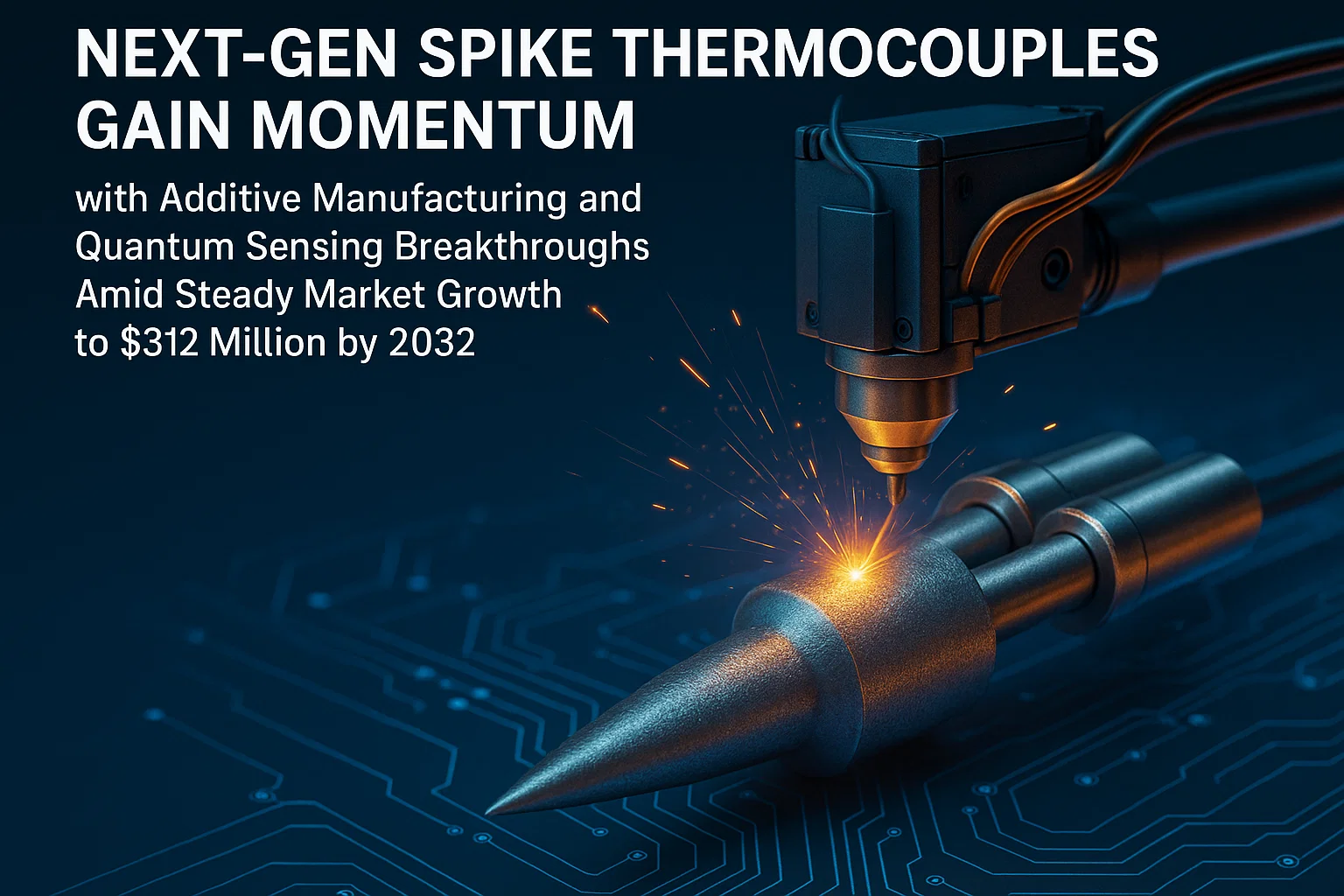
Next-Gen Spike Thermocouples Gain Momentum with Additive Manufacturing and Quantum Sensing Breakthroughs Amid Steady Market Growth to $312 Million by 2032
In an increasingly digitized and automated industrial world, the ability to measure and control temperature precisely has become non-negotiable. Among the most reliable solutions in this space is the spike thermocouple—a robust, high-precision temperature sensor designed to withstand some of the most extreme environments in industries like aerospace, energy, semiconductors, and advanced manufacturing.
According to the latest data, the Spike Thermocouples Market was valued at US$ 234 million in 2024 and is projected to reach US$ 312 million by 2032, expanding at a steady CAGR of 3.6% during the forecast period. This seemingly modest growth rate belies a wave of technological innovation, geopolitical repositioning, and industrial transformation reshaping the landscape of temperature sensing.
Access Your Free Sample Report- Spike Thermocouples Market
What Are Spike Thermocouples?
Spike thermocouples, also known as profile thermocouples, are temperature sensors that use two dissimilar metal wires joined at one end to form a measuring junction. When exposed to heat, they generate a small voltage proportional to the temperature. What distinguishes spike thermocouples from other types is their pin-pointed, durable tip which allows for fast response times, reliable insertion into process media, and temperature profiling in kilns, furnaces, and reactors.
Their superior mechanical robustness and thermal responsiveness make them indispensable in:
- Semiconductor fabrication (CVD/ALD processes)
- Gas turbines and jet engines
- Chemical reactors
- Food and pharmaceutical sterilization systems
Growth Drivers
- Increasing demand in semiconductor manufacturing
- Expanding aerospace and defense industries
- Enhanced energy efficiency regulations
- Innovation in high-temperature alloys and sensor durability
Challenges
- Rising competition from fiber optic and infrared sensors
- Supply chain vulnerabilities due to rare metal dependencies
- Complex calibration and signal drift in ultra-high temperature applications
Recent Technological Developments
1. Additive Manufacturing Breakthroughs
In August 2024, researchers published findings on a new additive-manufacturing method for thermocouples that embed tungsten-nickel and molybdenum conductors in ceramic matrices. This configuration not only improves temperature resistance but also allows for:
- Faster response times
- Reduced signal drift
- Extended lifespan under cyclic thermal loads
These breakthroughs mean that spike thermocouples can now function at temperatures exceeding 1700°C without degradation—opening up use cases in metal smelting, hydrogen furnaces, and next-gen nuclear reactors.
This innovation, according to materials scientists, could reduce maintenance costs by up to 30% in high-temperature operations.
2. Quantum Thermocouple Research
In April 2025, a team of quantum physicists revealed a working prototype of a quantum thermocouple that exploits the thermal transport properties of electrons at nanoscale. Although not yet commercialized, this quantum device demonstrates:
- Ultra-high sensitivity at micro-Kelvin resolution
- Ability to function without an external power source
- Integration potential with MEMS and nanosensors
For spike thermocouple manufacturers, this represents both a challenge and an opportunity. Future devices might blend the macroscale robustness of spike thermocouples with the precision of quantum tech for ultra-demanding applications such as quantum computing environments or deep-space probes.
Key Players Driving Market Expansion
Omega Engineering (Spectris plc)
A leader in industrial measurement instruments, Omega has diversified its product line with the recent expansion of fiber-optic temperature sensors, positioning them as complementary solutions to traditional spike thermocouples.
In April 2025, the company launched its FOT-X line, designed to operate in high-electromagnetic interference (EMI) environments. These compete directly with thermocouples in aerospace, medical, and nuclear sectors.
However, Omega continues to invest in spike thermocouple R&D—particularly for:
- Multi-point profiling systems
- Harsh chemical atmosphere probes
- Autonomous calibration modules
Thermo Electric Instrumentation BV
Based in the Netherlands, this company is a specialist manufacturer of spike/profile thermocouples tailored to semiconductor fabs, glass production, and solar PV industries.
Their spike thermocouples are distinguished by:
- Ultra-pure ceramic insulation
- Class 1 calibration (±0.4%)
- Compatibility with cleanroom assembly
Recent collaborations with photovoltaic panel manufacturers and 3D semiconductor chip makers have positioned Thermo Electric as a premium supplier for wafer-level thermal profiling.
Download Sample Report PDF- Spike Thermocouples Market
BASF Catalysts – EXACTUS® Technology
Although known for platinum-based thermocouples, BASF’s EXACTUS® line of optical pyrometers now presents a hybrid solution for environments where spike thermocouples may degrade.
EXACTUS devices feature:
- Measurement ranges up to 2400°C
- Sub-degree precision with 001°C resolution
- Integration with PLC and AI analytics platforms
This move highlights an industry convergence where optical and contact-based sensors coexist, with spike thermocouples remaining indispensable for direct-contact applications like crucible monitoring and reflow oven profiling.
Regional Insights
North America
- Dominated by aerospace, defense, and automotive R&D
- High demand from SpaceX, Boeing, and DARPA-funded projects
- Strong academic and commercial synergy in sensor innovation
Europe
- Robust presence of semiconductor fabs and renewable energy
- Companies like Thermo Electric BV driving precision engineering
- Adoption of RoHS-compliant thermocouples
Asia-Pacific
- Fastest-growing region due to electronics and industrial automation
- China and India investing in localized thermocouple production
- Japan and South Korea leading in ceramic insulation tech
Supply Chain and Localization Trends
TRM–MICC Joint Venture in Shanghai
To counter supply chain volatility, Thermal Resources Management (TRM) has partnered with MICC Ltd to open a new facility in Shanghai focused on:
- Localizing production of Type K and N spike thermocouples
- Developing anti-drift shielding for hydrogen-rich environments
- Shortening lead times in Asia-Pacific distribution
This localization strategy aligns with efforts to decouple from rare-earth dependencies and reduce costs, especially amid ongoing global logistics uncertainties.
Competitive Technology Landscape
| Technology | Key Features | Use Cases |
| Spike Thermocouples | Contact, robust, high-temp range | Reactors, kilns, jet engines |
| Fiber Optic Sensors | EMI-resistant, non-conductive | Medical, aerospace, nuclear |
| Infrared Sensors | Non-contact, fast response | Food, automotive, HVAC |
| Quantum Thermocouples | Ultra-sensitive, nanotech-based | Future tech, lab research, deep space |
Despite competition, spike thermocouples hold their ground due to:
- Direct contact accuracy
- Customizable tip and sheath options
- Compatibility with legacy systems
Click Here To Download Full Sample Report- Spike Thermocouples Market
Future Outlook: What Lies Ahead?
As we move toward a more connected, automated, and high-performance industrial future, the role of spike thermocouples is expected to evolve but not diminish. Here’s what the next decade might bring:
1. Smart Spike Thermocouples
Integration with IoT and AI could yield sensors capable of:
- Self-diagnostics and predictive maintenance
- Wireless data transmission
- Cloud analytics integration
2. Hybrid Sensing Systems
Expect increasing demand for dual-mode sensors that combine optical and thermoelectric sensing in a single probe—ideal for redundancy in critical systems.
3. Eco-Friendly and Recyclable Designs
With rising pressure for sustainability, manufacturers may adopt recyclable sheathing materials, minimize precious metal usage, and explore green calibration fluids.
The Spike Thermocouples Market, projected to reach $312 million by 2032, represents a critical but often underappreciated backbone of modern industry. From semiconductors to jet engines, the ability to measure temperature reliably at extreme conditions remains vital—and spike thermocouples deliver that capability with proven reliability.
As technology advances, so too will these humble but powerful sensors. Whether through quantum breakthroughs, AI integration, or sustainable design, spike thermocouples are well-positioned to adapt, evolve, and thrive in the thermally demanding world of tomorrow.

Comments (0)