
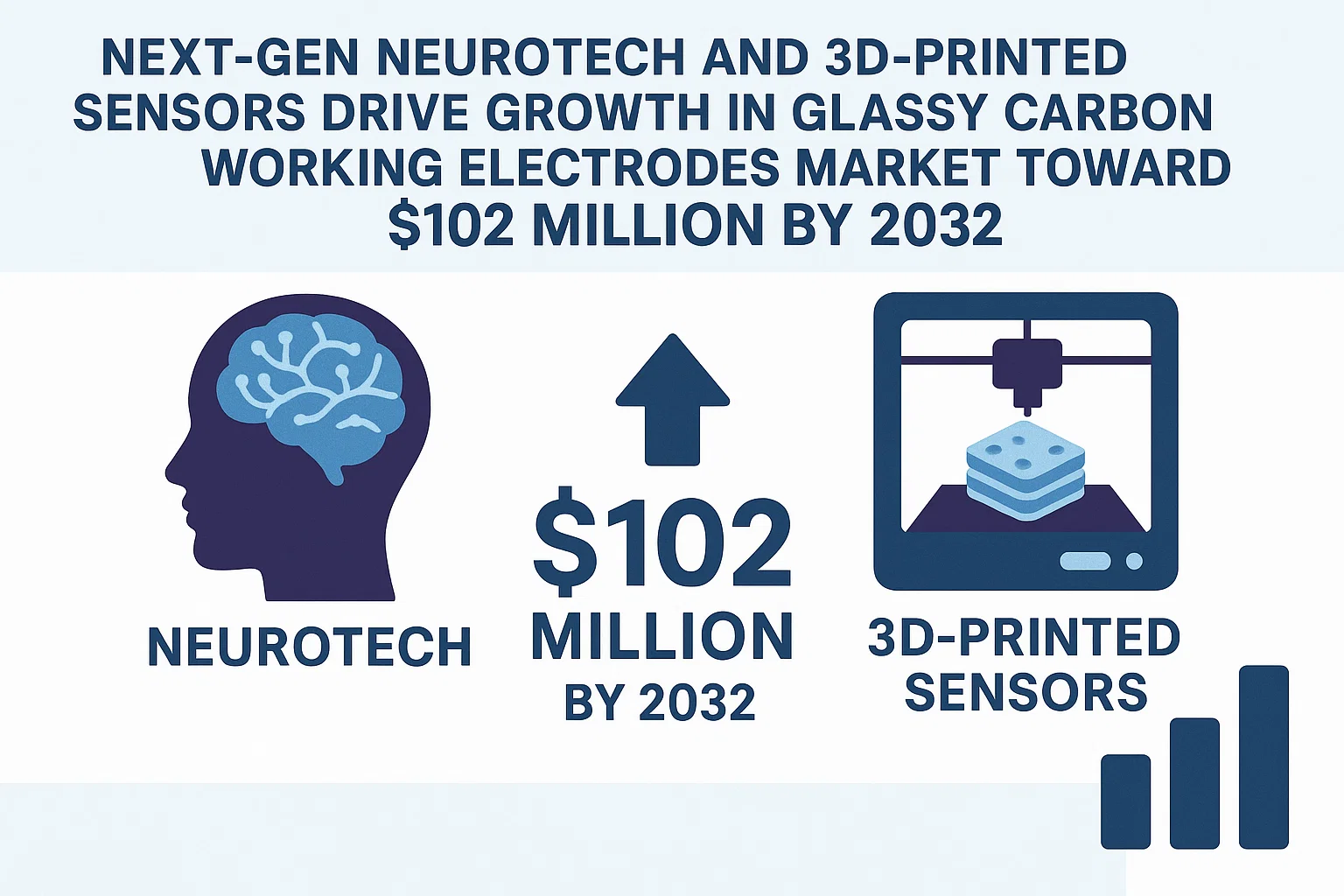
Next-Gen Neurotech and 3D-Printed Sensors Drive Growth in Glassy Carbon Working Electrodes Market Toward $102 Million by 2032
Glassy carbon, often known as vitreous carbon, is a form of pure carbon notable for its high chemical resistance, exceptional thermal stability, and electrochemical inertness. When utilized as a working electrode in electrochemical systems, glassy carbon offers a broad electrochemical window, low background currents, and the ability to be easily polished for repeatable experiments. These unique characteristics make it a preferred material in research and industrial applications involving biosensing, environmental monitoring, neural interfaces, and fuel cell technologies.
In recent years, the demand for glassy carbon working electrodes has experienced steady growth, driven by advances in material science, miniaturization of electrochemical systems, and the expanding use of sensor technologies across various industries. The global Glassy Carbon Working Electrodes Market was valued at US$ 73 million in 2024 and is projected to reach US$ 102 million by 2032, growing at a CAGR of 4.2% over the forecast period from 2025 to 2032.
Access Your Free Sample Report- Glassy Carbon Working Electrodes Market
Recent Scientific Developments in Glassy Carbon Electrode Technology
- Fiber‑Like Microelectrode Arrays for Neurochemical Detection
One of the most remarkable innovations in this domain emerged from a 2025 study published in Frontiers in Bioengineering and Biotechnology. Researchers developed fiber‑like batch‑fabricated glassy-carbon electrodes (fGCFs) designed for detecting dopamine in real time. These electrodes are produced using micro-electromechanical systems (MEMS) techniques and show great promise for use in neuroscience and neuroprosthetic applications.
The electrodes offer high conductivity, low impedance, and efficient electron transfer. Their fabrication using batch microfabrication ensures scalability and uniformity—key aspects for commercialization in neurochemical sensing.
This advancement positions glassy carbon as a frontrunner in next-gen biosensors that can provide real-time insights into neurotransmitter activity, potentially revolutionizing the treatment of neurological disorders such as Parkinson’s, depression, and schizophrenia.
- 3D-Printed Penetrating Neural Electrode Arrays
An innovative approach from a recent study in Biomedical Microdevices involved the use of stereolithographic 3D printing combined with pyrolysis to create penetrating glassy carbon electrodes. These offer superior signal-to-noise ratios (SNRs)—as high as 50 compared to 20 in platinum electrodes—making them particularly suited for neural interfacing and electrophysiology applications.
These electrodes can be customized in terms of geometry, density, and configuration, allowing tailored solutions for specific neural recording needs. Moreover, their biocompatibility and mechanical resilience further increase their utility in long-term implantable devices.
This shift towards additive manufacturing could significantly reduce costs and open up new possibilities for patient-specific devices and wearable neural diagnostic tools.
- Enhanced Material Stability and Structural Integrity
Despite the widespread belief in the inertness of glassy carbon, a 2022 study in ChemElectroChem challenged this notion by demonstrating that prolonged exposure to acidic electro-oxidative conditions can lead to surface oxidation and degradation. At voltages above ~1.8 V (vs RHE), structural defects can form, altering the electrochemical performance of the material.
This has significant implications for researchers and industries relying on GC’s long-term stability in harsh electrochemical environments. It also pushes the focus toward improved surface passivation techniques, chemical doping, or protective coatings that can maintain integrity in extreme conditions—an area ripe for future R&D investments.
Industry Trends and Applications
- Biomedical and Biosensing Applications
The biomedical sector remains one of the fastest-growing end-user markets for glassy carbon working electrodes. The material’s compatibility with human tissue, resistance to biofouling, and precision in electrochemical measurements make it ideal for:
- Blood glucose sensors
- Implantable neural electrodes
- Brain-machine interfaces
- Wearable biosensors
The emergence of electrochemical sensing as a non-invasive diagnostic tool—especially post-COVID—has led to growing adoption in remote health monitoring, fitness tracking, and personalized medicine.
- Environmental Monitoring and Water Quality Testing
GC electrodes are increasingly being used in portable devices designed to monitor heavy metals, nitrates, and pollutants in environmental samples. Their chemical stability and low background current are advantageous in trace-level detection applications.
Emerging countries, especially in Asia-Pacific and Africa, are deploying electrochemical water testing kits at scale due to rising concerns about groundwater contamination and industrial waste. The adaptability of glassy carbon in field conditions further solidifies its role in sustainable environmental practices.
- Energy and Fuel Cell Technology
In the realm of energy, glassy carbon electrodes are being explored for use in:
- Microbial fuel cells
- Electrocatalysis
- Battery characterization
- Redox flow batteries
Ongoing research into advanced electrocatalysts using glassy carbon substrates is expected to unlock better performance in terms of charge transfer and reaction kinetics. This is especially important in the global push toward green hydrogen and decarbonized energy systems.
Download Sample Report PDF- Glassy Carbon Working Electrodes Market
Market Dynamics: Key Drivers and Challenges
Key Growth Drivers
- Miniaturization and Portability
- Handheld diagnostic devices are gaining traction, particularly in resource-constrained regions, fueling demand for small, reliable working electrodes like GC.
- Rise in Neurotech Startups
- Companies like Neuralink, Paradromics, and Blackrock Neurotech are investing heavily in brain–computer interface (BCI) systems. Glassy carbon electrodes are at the forefront of these innovations due to their low impedance and high signal fidelity.
- Academic and Institutional Research
- Universities and public research institutions continue to play a major role in developing next-gen electrochemical techniques using glassy carbon substrates.
- Sustainable Environmental Regulations
- As environmental compliance becomes stricter, GC-based sensors for detecting pollutants and monitoring chemical waste are in high demand.
Ongoing Challenges
- Fabrication Complexity
- Producing uniform, defect-free glassy carbon components at scale remains technically challenging and capital intensive.
- Surface Fouling
- Despite its chemical stability, GC can still suffer from biofouling or contamination in real-world environments, which affects performance.
- Competition from Emerging Materials
- Alternatives such as boron-doped diamond, graphene, and carbon nanotubes are making inroads into applications traditionally dominated by glassy carbon.
Regional Outlook
North America
- Home to major neurotech and biomedical research institutions.
- Strong demand in healthcare diagnostics and neuroscience.
- Key players: Pine Research, Bioanalytical Systems, CH Instruments.
Europe
- Focused on environmental compliance and green technology.
- Germany, the UK, and France investing in clean energy applications.
Asia-Pacific
- Fastest-growing regional market due to rising healthcare infrastructure in China and India.
- Government-led environmental monitoring programs are boosting demand.
Rest of the World
- Latin America and Africa present untapped potential in water testing and mobile diagnostics but face infrastructure and cost constraints.
Emerging Startups and Academic Collaborations
- Neuralink (USA): Developing ultra-high density BCIs, possibly leveraging GC electrodes for recording.
- Paradromics (USA): Uses penetrating microelectrode arrays, potentially incorporating novel carbon-based materials.
- ETH Zurich & EPFL (Switzerland): Active in developing implantable GC neural probes.
- IIT Bombay (India): Researching printable GC-based sensors for field deployment in environmental and agricultural monitoring.
Such partnerships between academia and startups are crucial in bridging the gap between research and commercialization, helping bring advanced GC technologies into mainstream use.
Click Here To Download Full Sample Report- Glassy Carbon Working Electrodes Market
Future Outlook
Looking ahead to 2032, several developments are expected to shape the landscape of the glassy carbon working electrode market:
- Widespread use in smart wearable diagnostics
- More affordable and scalable 3D printing of GC electrodes
- Integration with AI-driven sensor platforms
- Rising adoption in decentralized and personalized medicine
While the market remains niche compared to other materials, the value of glassy carbon in precision sensing and extreme conditions ensures it will retain a crucial place in the electrochemical ecosystem.
Glassy carbon working electrodes, though often under the radar, are at the heart of numerous technological revolutions—from neural implants and biosensing to environmental monitoring and clean energy. With ongoing innovation in material science and manufacturing techniques, their importance is only set to grow.
As the global market rises from US$ 73 million in 2024 to US$ 102 million by 2032, stakeholders across academia, industry, and healthcare must recognize the transformative potential of this versatile material. Strategic investments in R&D, manufacturing scalability, and interdisciplinary collaboration will be key to unlocking the next frontier in electrochemical sensing.

Comments (0)