
Network Capacity Expansion Driving Growth in the 5G Antennas Market
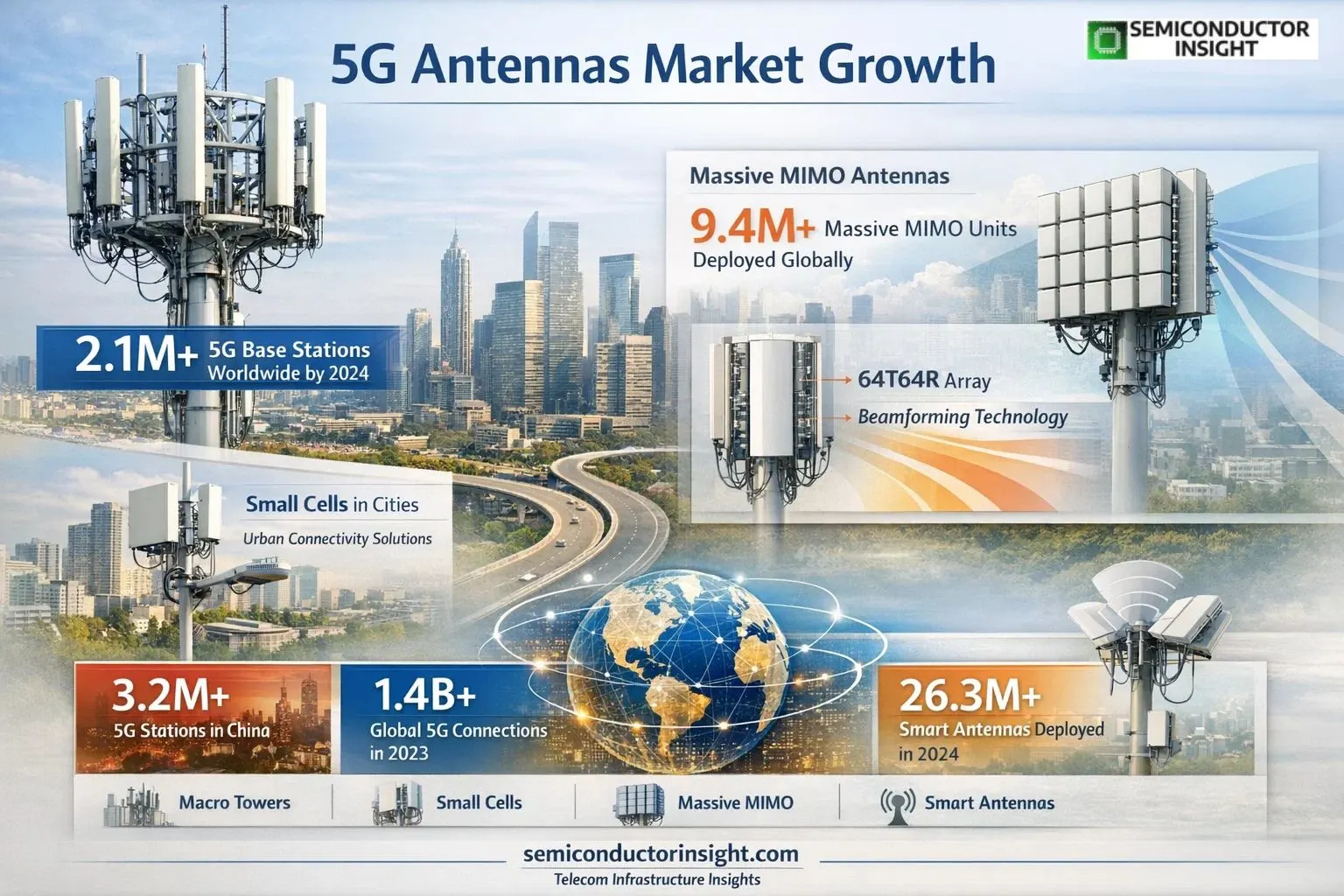
Antennas are becoming one of the most important pieces of gear in current telecom infrastructure since next-generation wireless networks are being set up so quickly. 5G Antennas Market is growing because telecom companies are putting up a lot of macro towers, small cells, and distributed antenna systems to provide fast connections with low latency. By 2024, there were more than 2.1 million 5G base stations around the world, and each one needed many antenna arrays to enable sophisticated wireless communication technologies.
A single 5G base station can have between 8 and 128 antenna elements, which lets it send signals to several users and frequencies at the same time. This design lets telecom networks handle the huge amounts of mobile data traffic that smartphones, industrial IoT devices, and linked cars create.
To Know More about the Report, You Can Freely Browse Our Latest Updated Report: https://semiconductorinsight.com/report/5g-antennas-market/
Rise of Massive MIMO in Next-Generation Antenna Architecture
One of the most transformative technologies in modern wireless infrastructure is Massive MIMO, which dramatically improves spectral efficiency and network capacity. Massive MIMO antenna systems utilize dozens or even hundreds of antenna elements to transmit and receive signals simultaneously.
More than 9.4 million massive MIMO antenna units have already been installed globally as telecom operator’s upgrade from 4G LTE to 5G infrastructure.
This architecture enables features such as dynamic beam steering and interference reduction, allowing networks to deliver consistent high-speed connectivity even in densely populated urban areas. For instance, telecom operators in South Korea and the United States deploy 64T64R antenna arrays, enabling higher throughput and improved signal quality in crowded city environments.
The integration of semiconductor components, including RF front-end modules and power amplifiers, is also increasing antenna performance. These advanced chipsets enable antennas to operate across multiple frequency bands while reducing energy consumption.
Beam forming Technology Reshaping Wireless Signal Transmission
Another critical innovation shaping modern telecom infrastructure is Beam forming, a technology that directs wireless signals toward specific devices rather than broadcasting signals in all directions. This capability improves both signal strength and network efficiency.
Beam forming antennas are increasingly used in urban networks where millions of devices compete for bandwidth. Instead of spreading signals uniformly across an area, beamforming focuses energy in targeted directions, enabling faster downloads and improved latency performance.
In high-traffic environments such as stadiums, airports, and smart cities, beamforming antennas allow telecom networks to maintain stable connectivity for thousands of simultaneous users. The technology also reduces signal interference, which is particularly important for high-frequency spectrum bands used in advanced 5G deployments.
Small Cells and Urban Infrastructure Deployments
Urban connectivity demands have triggered widespread adoption of small cell antennas, which complement traditional macro towers by providing localized coverage in dense environments. These compact antennas are installed on streetlights, buildings, and public infrastructure.
Cities across Asia and Europe are increasingly integrating small cells into their telecom architecture. For example, the European telecom ecosystem expects the deployment of nearly 1 million 5G base stations across the European Union as operators expand network capacity in metropolitan areas.
Small cell deployments enable faster mobile broadband speeds while supporting emerging technologies such as autonomous transportation, augmented reality applications, and real-time industrial automation.
Global Telecom Infrastructure Investments and Deployment Scale
- Large-scale investments by governments and telecom operators are accelerating antenna deployment worldwide. Global telecom infrastructure programs are expanding rapidly as countries modernize their digital ecosystems.
- China alone has deployed more than 2 million 5G base stations, making it the largest 5G infrastructure network globally.
- In India, nationwide spectrum auctions generated INR 1.5 trillion in telecom investment, enabling major carriers to accelerate commercial 5G rollout across metropolitan and tier-2 cities.
- Overall, global 5G connections surpassed 4 billion users in 2023, reflecting the massive scale of infrastructure upgrades taking place across telecom networks.
- These investments directly increase demand for high-performance antennas capable of supporting higher frequency bands, wider bandwidths, and complex network architectures.
Multi-Band and Smart Antenna Design Innovation
A defining feature of modern telecom networks is the shift toward multi-band antenna systems capable of supporting multiple wireless technologies simultaneously. These antennas allow operators to run 4G LTE and 5G networks on the same infrastructure while maximizing spectrum efficiency.
Smart antennas are also emerging as a critical segment of the industry. In 2024 alone, more than 26.3 million smart antennas were deployed worldwide to support advanced telecom networks.
Smart antenna systems integrate AI-driven signal optimization, adaptive frequency management, and real-time traffic balancing. These capabilities enable telecom networks to dynamically adjust coverage based on user density and network demand.
As wireless ecosystems continue evolving toward ultra-high-capacity connectivity, antenna design will remain at the center of telecom innovation. Semiconductor technologies, advanced materials, and integrated RF components are transforming antenna systems into intelligent network nodes capable of supporting the digital infrastructure of connected societies.

Comments (0)