
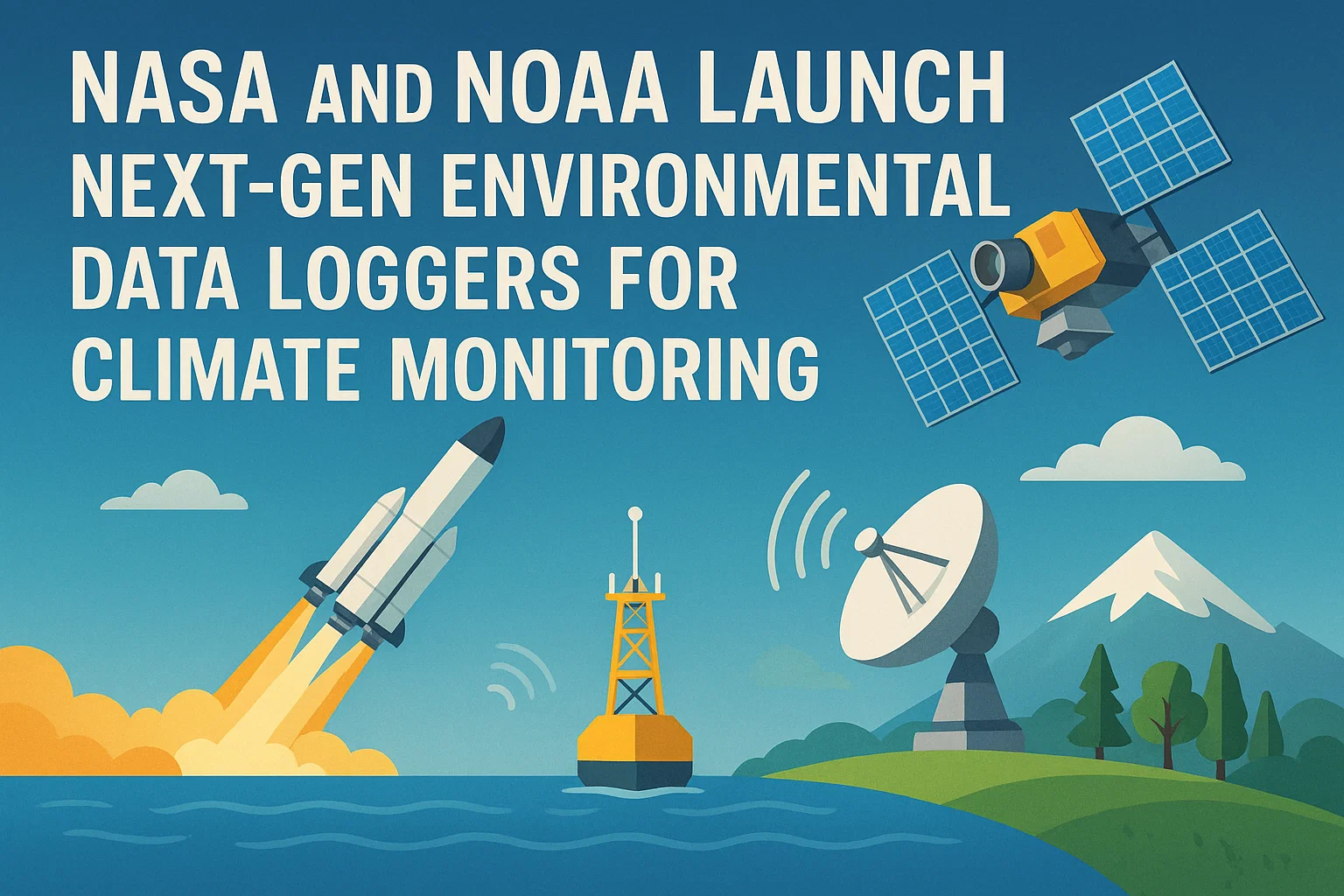
NASA and NOAA Launch Next-Gen Environmental Data Loggers for Climate Monitoring
The world is entering an age where environmental intelligence is no longer optional it’s essential. From catastrophic wildfires and record-breaking heatwaves to tightening food safety regulations and rising public concern over air quality, the need for reliable, real-time data on environmental conditions has never been greater. At the heart of this shift lies a small but powerful technology: the environmental monitoring data logger.
These compact devices, designed to measure, record, and transmit environmental variables such as temperature, humidity, air quality, water purity, and noise levels, are quietly becoming the backbone of climate resilience, smart cities, and sustainable industries.
According to recent market figures, the Environmental Monitoring Data Logger market was valued at $736 million in 2024 and is projected to reach $1.133 billion by 2032, growing at a CAGR of 6.4% during the forecast period. This growth trajectory underscores how central these devices are to the challenges and opportunities of the next decade.
Access Your Free Sample Report- Environmental Monitoring Data Logger Market
1. Climate-Driven Demand: Monitoring a Warming World
The reality of climate change is no longer abstract. Extreme weather events are occurring with alarming frequency, from devastating wildfires in California to deadly floods in Asia. Traditional monitoring systems, often reliant on centralized infrastructure, are too slow to provide actionable data in real time.
That’s where environmental data loggers come in. These devices can be deployed rapidly across affected regions, creating a network of sensors that feeds live updates to authorities, scientists, and communities.
- Case in Point: California Wildfires (2024)
During one of the state’s most destructive wildfire seasons, local governments deployed IoT-based smoke and air quality data loggers across vulnerable zones. The devices provided minute-by-minute updates on air pollution levels, allowing health departments to issue timely evacuation orders and distribute masks to at-risk populations. - Why It Matters: Climate-driven disasters are unpredictable. Portable, battery-powered loggers offer a scalable solution, filling data gaps where permanent stations can’t reach. This democratization of environmental intelligence helps save lives and reduces economic losses.
2. NASA and NOAA Push Boundaries: From Ground to Space
In June 2024, NASA announced a breakthrough project integrating portable, low-power loggers with satellite-based monitoring for greenhouse gases such as methane and carbon dioxide. By pairing ground-level measurements with space-based imaging, scientists can pinpoint leaks, emissions hotspots, and regional pollution patterns with unprecedented accuracy.
Meanwhile, NOAA (National Oceanic and Atmospheric Administration) has expanded its use of data loggers in ocean buoys, helping track ocean acidification, coral bleaching risks, and rising sea temperatures. These insights are crucial for fisheries, coastal communities, and climate models.
- Key Innovation: The hybridization of edge computing loggers with satellite data, creating layered monitoring systems that reduce blind spots.
- Broader Implication: Such systems are laying the groundwork for a global environmental monitoring grid, where land, air, and sea data converge to provide a holistic picture of Earth’s health.
3. Smart Cities Get Smarter
As urban populations swell, cities are under pressure to become more sustainable, livable, and resilient. Environmental data loggers are increasingly seen as critical infrastructure in this transformation.
- Amsterdam & Barcelona Projects (2024): Both cities announced the rollout of street-level loggers to measure air quality, noise pollution, and heat islands. The collected data isn’t just for policymakers it’s fed into public apps, allowing residents to check hyperlocal environmental conditions in real time.
- Citizen Empowerment: Imagine walking to work and receiving a phone notification advising you to take a cleaner air route because sensors on your street have detected unusually high nitrogen dioxide levels. That’s no longer science fiction it’s already happening in parts of Europe.
- Economic Benefit: Cities armed with granular environmental data can make smarter infrastructure investments, reduce healthcare costs linked to pollution, and attract environmentally conscious businesses.
4. Food Safety and Pharma: Cold Chains Under Scrutiny
The supply chain for perishable goods from fresh produce to life-saving vaccines relies on precise temperature and humidity control. A small deviation can mean spoiled goods, financial losses, or compromised patient safety.
In September 2024, the New York Times reported that the FDA introduced stricter rules requiring more robust monitoring of perishable goods in transit. This has accelerated the adoption of IoT-enabled data loggers that monitor:
- Temperature fluctuations during transport.
- Relative humidity levels for sensitive produce.
- CO₂ concentrations in cold storage.
- Pharmaceutical Example: During COVID-19 vaccine rollouts, data loggers were essential to ensuring doses remained within safe storage ranges. The new FDA regulations formalize these practices, embedding them into everyday logistics.
- Market Insight: The cold chain monitoring segment is projected to be one of the fastest-growing submarkets within the environmental data logger industry, driven by pharmaceuticals, biotech, and globalized food trade.
Download Sample Report PDF- Environmental Monitoring Data Logger Market
5. AI at the Edge: From Data Collection to Data Intelligence
Traditional data loggers are designed to collect and transmit data. But with the rise of edge computing and artificial intelligence, these devices are evolving into mini-decision-makers.
A 2024 feature in MIT Technology Review highlighted startups embedding AI algorithms directly into loggers. Instead of simply logging air quality levels, for instance, the device can analyze patterns in real time and trigger alerts when anomalies occur.
- Benefits:
- Reduced latency (faster responses).
- Lower reliance on cloud infrastructure.
- Energy efficiency through smarter sampling.
- Use Case: In industrial plants, AI-enabled loggers can detect early signs of equipment malfunction through unusual emission patterns, preventing costly breakdowns.
- The Next Step: Imagine distributed networks of AI loggers working together, predicting pollution spikes or heatwaves before they happen. This is where the industry is headed.
6. Regulatory Push: EU’s Bold Standards
In May 2024, the Financial Times reported that the European Union tightened its regulations on industrial emissions. Factories in high-emission sectors must now deploy continuous environmental data logging systems to remain compliant.
- Implications:
- Manufacturers are racing to integrate loggers into their compliance frameworks.
- Partnerships are emerging between sensor hardware firms and compliance software providers to automate reporting.
- Non-compliance comes with steep financial penalties, incentivizing industries to act quickly.
This regulatory wave is not limited to Europe. Similar frameworks are being considered in North America and Asia, meaning environmental logging is becoming a baseline requirement for doing business globally.
7. Humanitarian Applications: Tech for Crisis Response
Beyond regulation and commerce, environmental monitoring data loggers are proving invaluable in humanitarian contexts.
After devastating floods in Bangladesh in late 2024, BBC News reported that aid organizations deployed portable water-quality loggers in refugee camps to track contamination levels and prevent cholera outbreaks.
- Why It Works: The devices are lightweight, battery-operated, and capable of transmitting data wirelessly even in remote or infrastructure-damaged areas.
- Impact: Within days, health workers had actionable data to direct clean water distribution, saving thousands from waterborne diseases.
This illustrates how environmental loggers aren’t just about compliance or profit they’re about safeguarding human lives.
8. Market Outlook: The Road to 2032
With the market projected to grow from $736 million in 2024 to $1.133 billion by 2032, several forces are converging to shape the industry:
- Technological Advancements: AI, IoT, and energy-efficient sensors are making loggers smarter and more versatile.
- Regulatory Pressure: Governments are mandating monitoring across industries.
- Climate Imperatives: Rising disasters make real-time monitoring a necessity.
- Consumer Awareness: Citizens are demanding transparency on air quality, food safety, and corporate sustainability.
Regional Insights:
- North America remains a leader in regulatory-driven adoption.
- Europe is advancing through smart city initiatives and strict emission standards.
- Asia-Pacific is poised for the fastest growth due to rapid urbanization and vulnerability to climate disasters.
9. Challenges Ahead
Despite the momentum, the industry faces hurdles:
- Data Overload: More sensors mean more data. Converting raw information into actionable insights remains a challenge.
- Interoperability: Devices from different manufacturers often lack standardization, complicating integration.
- Costs: While prices are falling, high-quality loggers remain expensive for widespread deployment in developing regions.
- Cybersecurity: IoT-enabled devices raise concerns about data privacy and hacking.
Overcoming these barriers will be essential for sustained growth.
Click Here To Download Full Sample Report- Environmental Monitoring Data Logger Market
10. A Future Built on Data
Environmental monitoring data loggers may be small, but their impact is enormous. They are:
- Guardians of climate resilience, warning us when wildfires or floods pose imminent danger.
- Silent protectors of health, ensuring vaccines and food arrive safely.
- Voices for transparency, empowering citizens to demand cleaner air and water.
- Tools of justice, holding industries accountable to regulatory standards.
As the market grows steadily toward $1.133 billion by 2032, these devices are set to become as common and indispensable as smartphones or GPS systems. In an uncertain world, they offer one crucial certainty: knowledge, in real time, when it matters most.

Comments (0)