
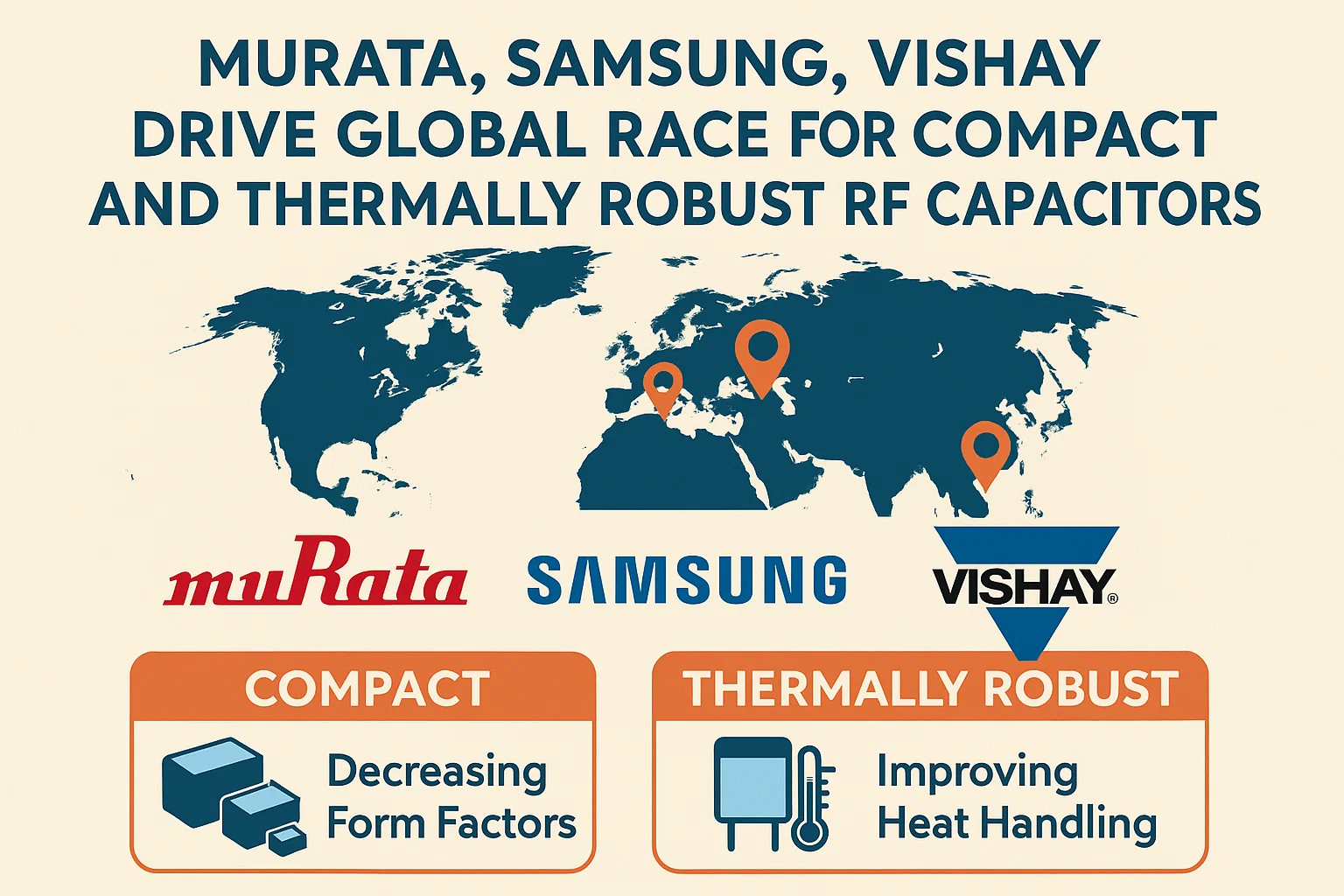
Murata, Samsung, Vishay Drive Global Race for Compact and Thermally Robust RF Capacitors
In a world racing toward 5G expansion, autonomous vehicles, IoT, and advanced radar systems, the need for high-performance passive electronic components has surged exponentially. Among these, RF (Radio Frequency) ceramic capacitors have taken center stage due to their compact size, low-loss characteristics, high reliability, and capability to operate at ultra-high frequencies.
As of 2024, the RF ceramic capacitor market was valued at USD 1.45 billion. Forecasts suggest it will reach USD 2.12 billion by 2032, growing at a CAGR of 5.5% from 2025 to 2032. This growth is driven by significant technological developments, rising 5G infrastructure investment, EV innovation, and demand for advanced defense and aerospace systems.
Access Your Free Sample Report- RF Ceramic Capacitor Market
Understanding RF Ceramic Capacitors: The Backbone of High-Frequency Electronics
RF ceramic capacitors are passive electronic components optimized to handle signals in the radio frequency range (3 kHz to 300 GHz). Their role is vital in filtering, tuning, impedance matching, and decoupling functions across a wide range of high-frequency applications.
What makes them unique is the use of high-Q (quality factor) ceramic dielectric materials, which allow them to operate with low loss, tight tolerances, and stable performance under thermal and electrical stress. These properties are especially important in:
- 5G base stations
- Microwave systems
- Automotive radar
- RFID systems
- Satellite communications
- IoT devices and wearables
Market Snapshot: Where Are We Today?
According to industry evaluations, the RF ceramic capacitor market was valued at USD 1.45 billion in 2024. By 2032, it is projected to surpass USD 2.12 billion, propelled by rising demand across both consumer and industrial sectors.
Key Growth Drivers:
- 5G Deployment: Increasing installations of small cells and antennas require high-frequency components like RF MLCCs.
- Automotive Electronics: ADAS, radar, infotainment, and EV powertrains demand heat-resistant, stable capacitors.
- Aerospace and Defense: High-performance and high-reliability components for radar, communications, and navigation systems.
- IoT and Edge Devices: Need for compact, low-profile capacitors with superior frequency stability.
Key Recent Developments in the RF Ceramic Capacitor Industry
1. Quantic Eulex Launches Breakthrough XG Series Gap Capacitors
In June 2025, Quantic Eulex unveiled the XG Series, a revolutionary advancement in ceramic capacitor technology. Unlike traditional MLCCs (Multilayer Ceramic Capacitors), these gap capacitors use single-layer embedded electrodes that dramatically reduce parasitic inductance and resistance.
Notable Features:
- 10x capacitance performance compared to conventional RF MLCCs
- Low ESR (Equivalent Series Resistance) and high self-resonant frequency
- Compact form factor with greater current and voltage handling
- Excellent for use in high-density RF modules, satellite hardware, and 5G infrastructure
This launch has been recognized by industry analysts as transformative, offering the potential to significantly reduce BOM (Bill of Materials) and improve performance margins across complex RF systems.
2. Murata’s Ultra-Miniature MLCCs for 5G Smartphones & Base Stations
Murata Manufacturing continues to lead the innovation front. In mid-2025, it introduced a new range of ultra-miniature, high-frequency MLCCs tailored for 5G smartphones, routers, and base stations.
Highlights:
- Up to 30% reduction in footprint
- Maintains high Q performance and signal stability
- Supports high-speed data transmission in compact 5G modules
With 5G adoption growing rapidly, these miniaturized capacitors help manufacturers meet space-saving and thermal dissipation requirements without compromising frequency response.
3. Kyocera AVX Pushes Boundaries with mmWave Compatibility
In March 2025, Kyocera AVX took a significant leap forward by unveiling new dielectric materials designed to enhance performance at millimeter-wave (mmWave) frequencies. These developments are critical for:
- High-speed satellite communication systems
- Telecom mmWave modules
- Next-gen radar and RF transceivers
Additionally, Kyocera launched the industry’s first 47 µF MLCC in a 0402 form factor, enabling 2.1× higher capacitance than any existing 0402-size capacitors. Applications range from AI processors to edge computing and mobile high-frequency circuits.
Download Sample Report PDF- RF Ceramic Capacitor Market
4. Samsung Electro-Mechanics Expands Manufacturing in Vietnam
To meet surging global demand, Samsung Electro-Mechanics in April 2025 opened a state-of-the-art production facility in Vietnam, specifically focusing on:
- Automotive-grade high-frequency capacitors
- Components optimized for ADAS and electric powertrains
- Temperature-resilient MLCCs for high-humidity environments
This move underscores the shift of component production hubs to Southeast Asia, ensuring cost efficiency, proximity to supply chains, and reduced geopolitical risks.
5. Vishay’s High-Temperature C0G Capacitors for Harsh Environments
In late 2024, Vishay Intertechnology introduced a new line of C0G capacitors that can operate at temperatures up to 175°C. These capacitors are ideal for:
- Aerospace systems
- Electric aircraft propulsion
- Industrial inverters and EV power modules
By maintaining stability across extreme temperatures, Vishay’s innovation meets the demand for rugged, mission-critical RF solutions in aerospace and defense sectors.
Technology Trends Shaping the Future of RF Ceramic Capacitors
A. Miniaturization and High Capacitance Density
The trend toward smaller, lighter devices is pushing manufacturers to deliver higher capacitance in smaller packages. Kyocera’s 47 µF 0402 MLCC is a prime example of this push for high-density performance without sacrificing reliability.
B. Thermal Stability and Environmental Endurance
Capacitors must now operate reliably across wide temperature ranges—from -55°C to +175°C—and withstand humidity, vibrations, and electrical stress. Companies like Vishay and Samsung are leading the charge in rugged component design.
C. mmWave and 5G Compatibility
Components must work efficiently at frequencies exceeding 30 GHz. New dielectric materials and low-ESL architectures are allowing capacitors to function in mmWave telecom modules, satellite systems, and advanced radar.
D. Embedded Capacitors and Gap Capacitor Architecture
The shift from discrete capacitors to embedded or gap capacitors (as seen in Quantic Eulex’s XG Series) is gaining traction. This enables:
- Lower component count
- Better signal integrity
- Higher system-level performance
Applications Driving Market Expansion
1. 5G Infrastructure
Massive MIMO antennas, RF front ends, and signal processors require thousands of compact, high-frequency capacitors. As 5G deployment reaches global scale, especially in urban environments, demand is expected to spike.
2. Electric and Autonomous Vehicles
Capacitors in EVs must support sensor fusion systems, motor controllers, and radar modules. MLCCs optimized for automotive radar (77–81 GHz) are seeing sharp adoption.
3. Defense and Aerospace Systems
Military communication systems, GPS, missiles, and avionics demand capacitors with radiation resistance, long life, and thermal stability. Defense spending in the U.S., India, and the EU is boosting this segment.
4. Consumer Electronics and IoT
Wearables, smartwatches, wireless earbuds, and home IoT hubs all require tiny, efficient capacitors to maintain signal clarity and battery performance.
Regional Insights
- Asia-Pacific leads the RF ceramic capacitor market, with manufacturing hubs in China, Japan, South Korea, and Vietnam.
- North America remains a tech innovation hub—especially in aerospace, defense, and satellite communications.
- Europe is seeing rapid automotive electrification and strong adoption of industrial automation, fueling demand for robust capacitors.
Challenges and Opportunities Ahead
Challenges:
- Raw material cost fluctuations (barium titanate, palladium)
- Geopolitical tensions impacting semiconductor supply chains
- R&D investment intensity needed to innovate at scale
Opportunities:
- Integration into SiP (System-in-Package) designs for RF front ends
- AI-driven testing and quality control
- Green manufacturing practices to align with global ESG targets
Click Here To Download Full Sample Report- RF Ceramic Capacitor Market
Building the Future with RF Ceramic Capacitors
As industries stretch into the realms of 5G, AI, satellite networks, autonomous mobility, and quantum computing, the humble ceramic capacitor is quietly becoming one of the most powerful enablers of the high-frequency age.
Innovations like Quantic Eulex’s XG Series, Kyocera’s high-capacitance MLCCs, and Murata’s miniature powerhouses are reshaping the RF ecosystem—making systems faster, smaller, and more reliable than ever before.
With strong growth projections, rising demand across sectors, and constant technological evolution, the RF ceramic capacitor industry is not just keeping pace with change—it’s helping lead it.

Comments (0)