
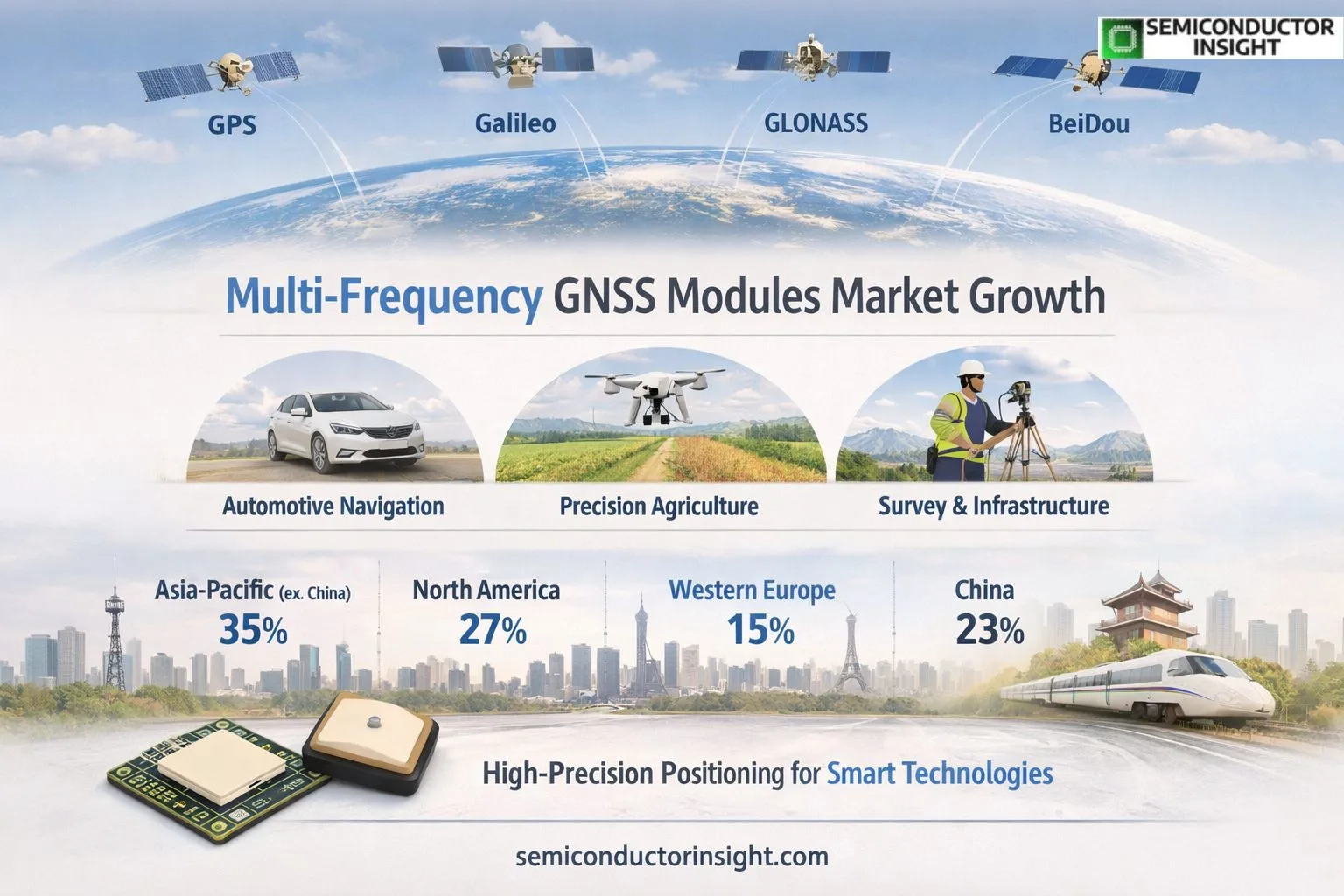
Multi-frequency GNSS Modules Market Expansion as Advanced Satellites Enable Centimetre-Level Positioning
The semiconductor ecosystem supporting global navigation systems has undergone a significant transformation with the rise of multi-frequency GNSS modules. These modules analyse signals from several satellite frequencies at once, in contrast to conventional single-band positioning devices, allowing for faster signal acquisition and improved positioning accuracy.
As satellite constellations expand and modern applications demand centimetre-level accuracy, multi-frequency GNSS modules are becoming an essential component across automotive electronics, robotics, drones, precision agriculture, and infrastructure monitoring.
According to data published by the European Union Agency for the Space Programme, the Galileo navigation system alone had over 4 billion GNSS-enabled devices in operation globally in 2023, a number that continues to expand as smartphones, vehicles, and industrial devices integrate advanced positioning capabilities. Semiconductor manufacturers are increasingly embedding multi-band GNSS chips into modules to improve reliability in urban environments where signal interference and reflections are common.
Global Satellite Infrastructure Enabling Multi-Band Positioning
- The rapid deployment of navigation satellites has created a strong foundation for multi-frequency GNSS technology. Currently, the world operates four major global navigation constellations: GPS from the United States, Galileo from Europe, GLONASS from Russia, and BeiDou from China. Together they support more than 120 operational navigation satellites in medium Earth orbit.
- The U.S. GPS constellation maintains 31 operational satellites, transmitting multiple civilian frequencies including L1, L2, and L5 signals.
- Meanwhile, China’s BeiDou network reached 35 satellites in orbit, providing global coverage and additional regional augmentation capabilities.
- The European Galileo system operates 28 satellites, offering high-accuracy services designed for commercial and scientific applications.
- Multi-frequency GNSS modules leverage these diverse signals simultaneously, allowing receivers to reduce atmospheric interference and deliver improved positioning precision.
- In practical deployments, dual-frequency modules can achieve position accuracy below 1 meter, while advanced multi-band modules combined with correction services can achieve centimetre-level positioning used in surveying and autonomous navigation.
Smart Semiconductor Architectures for Next Generation Multi Frequency GNSS
The development of GNSS modules closely tracks improvements in the architecture of semiconductor chips. Modern navigation chipsets use small system-on-chip architectures to combine RF front-end circuitry, baseband computation, and signal correlation engines. Qualcomm, Broadcom, MediaTek, and u-blox are just a few of the companies that have made multi-band GNSS chips that can handle signals from more than one constellation at the same time.
For instance, Broadcom’s dual-frequency GNSS chipset for smartphones works with both L1 and L5 satellite bands, which makes location more accurate even in crowded cities. According to mobile device organizations, shipments of smartphones alone surpassed 1.2 billion units worldwide in past year 2023. A rising number of these devices now come with multi-frequency locating chips.
These advances to semiconductors also make modules smaller and use less power, which means that GNSS modules can be built into drones, wearable devices, and IoT sensors. Now, antennas, RF processing, and signal decoding may all fit into one small module that is less than 10 millimeters wide.
Autonomous Systems and Smart Mobility Driving Adoption
- One of the most significant application areas for multi-frequency GNSS modules is the automotive sector. Modern vehicles increasingly rely on precise positioning for advanced driver assistance systems (ADAS), fleet telematics, and autonomous navigation technologies. Global vehicle production exceeded 93 million units in 2023, estimated by the International Organization of Motor Vehicle Manufacturers, providing a substantial foundation for GNSS-enabled navigation systems.
- Automotive manufacturers are integrating multi-frequency GNSS modules with inertial measurement units and sensor fusion software to improve positioning accuracy during lane-level navigation and automated driving. High-precision navigation is particularly important for electric vehicles, delivery robots, and autonomous trucks operating in complex urban environments.
- Beyond automotive systems, the drone industry has become a major adopter of high-precision positioning modules. Civil drone registrations in the United States alone exceeded 870,000 aircraft, according to the Federal Aviation Administration, and many commercial drones rely on multi-band GNSS modules for stable flight control and geofencing operations.
Precision Agriculture and Infrastructure Monitoring
Agriculture represents another growing area where multi-frequency GNSS modules deliver measurable operational improvements. Precision farming equipment such as automated tractors, harvesters, and crop monitoring drones rely on accurate satellite positioning to optimize planting patterns and fertilizer application. In large-scale planting operations, farms employing satellite-guided machinery have reported field efficiency improvements reaching 20 acres per day, according to data on agricultural equipment from the US Department of Agriculture.
Surveying, construction, and infrastructure monitoring also depend on high-accuracy GNSS modules. Survey-grade receivers using multi-frequency positioning can achieve centimeter-level measurement accuracy, enabling applications such as bridge monitoring, land surveying, and pipeline alignment.
With satellite constellations continuing to expand and semiconductor integration advancing rapidly, the multi-frequency GNSS module ecosystem is moving toward a future defined by precision, satellite, navigation, and semiconductor innovation across connected industries.
Lastly before we wrap up, don’t forget to look at our most recent exclusive report for in-depth insights: https://semiconductorinsight.com/report/multi-frequency-gnss-modules-market/?add_to_wishlist=42129
Regional Overview of GNSS Chipset Adoption
Regional demand for GNSS chipsets varies based on satellite infrastructure and technology adoption. Asia-Pacific excluding China accounts for around 35% of global chipset shipment volume in 2024, supported by navigation systems such as BeiDou, QZSS, and NavIC that are widely integrated into smartphones and automotive platforms.
China represents the fastest-growing market, driven by the expansion of the BeiDou-3 constellation and domestic semiconductor deployment across consumer electronics and mobility systems.
Western Europe contributes nearly 15% of global GNSS shipments, supported by the Galileo satellite program and its adoption in aviation, automotive navigation, and industrial positioning.
North America holds about 27% of the global chip market, largely supported by the long-established GPS ecosystem and the ongoing deployment of the GPS III satellite network. Meanwhile, the Middle East and Africa represent a smaller but developing market where satellite navigation adoption is gradually increasing across logistics, aviation, and infrastructure monitoring systems.

Comments (0)