
Market Share Analysis of Halogen Lamps for Semiconductors in Legacy and Advanced Nodes
In an industry driven by rapid innovation, some technologies continue to hold their ground not because they are new, but because they are dependable, predictable, and process-stable. Halogen lamps fall squarely into this category. While newer light and heat sources are emerging, halogen lamps remain deeply embedded in semiconductor manufacturing, supporting critical thermal and illumination functions where consistency outweighs experimentation.
The halogen lamp for semiconductor market reflects this balance between innovation and reliability. Rather than being displaced, halogen lamps are evolving quietly, maintaining relevance across both mature and advanced fabrication environments.
Why Halogen Lamps Still Matter in Semiconductor Fabrications?
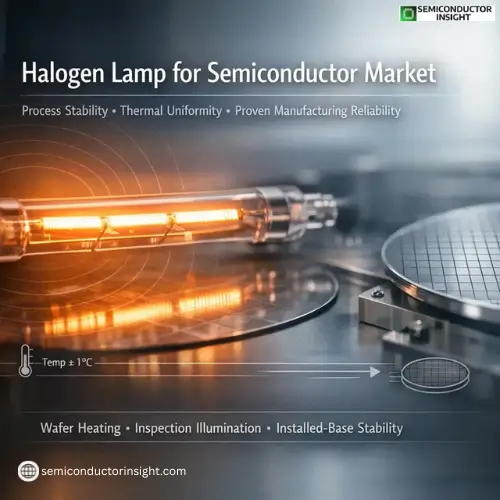
Semiconductor manufacturing depends heavily on controlled heat and stable illumination, particularly during wafer inspection, thermal treatment, and process monitoring. Halogen lamps offer fast response times, uniform heat output, and predictable spectral characteristics, making them suitable for processes where even minor deviations can affect yield.
Unlike some alternative technologies that require complex control systems, halogen lamps deliver direct, easily regulated thermal energy, allowing engineers to fine-tune process conditions with confidence. This simplicity is often an advantage in high-throughput environments where downtime and recalibration carry high costs.
The continued demand for halogen lamps is less about innovation cycles and more about process trust.
Integration across Multiple Semiconductor Process Stages
Halogen lamps are not confined to a single application within semiconductor fabrications. Their usage spans multiple stages, particularly where thermal stability and illumination consistency are critical.
They are commonly integrated into:
- Rapid thermal processing systems for controlled heating
- Wafer inspection tools requiring stable light intensity
- Annealing and drying processes where uniform temperature distribution is essential
This broad integration strengthens the market’s position, as demand is distributed across several tool categories rather than relying on a single process step.
Advanced Nodes Still Rely on Mature Supporting Technologies
While advanced nodes capture industry attention, they do not eliminate the need for reliable supporting systems. Even in leading-edge fabrications, certain processes continue to rely on halogen lamps due to their known performance behavior under tightly controlled conditions.
As chip architectures become more complex, fabrications increasingly value components that introduce zero uncertainty into the process. Halogen lamps, with decades of operational data behind them, meet this requirement effectively.
In many cases, risk avoidance matters more than adopting the latest alternative.
Market Demand Is Driven by Installed Base Stability
One of the defining characteristics of the halogen lamp for semiconductor market is its strong connection to the existing installed base of equipment. Semiconductor tools are capital-intensive assets designed for long operational lifespans.
As long as these tools remain productive, demand for compatible halogen lamps remains steady. Rather than fluctuating with short-term semiconductor cycles, the market benefits from maintenance-driven demand patterns, contributing to overall stability.
This dynamic creates:
- Predictable replacement demand
- Long-term supply contracts
- Consistent aftermarket revenue streams
Regional Manufacturing Trends Support Sustained Consumption
Asia-Pacific dominates semiconductor manufacturing volume, and this concentration directly influences halogen lamp demand. High fabrication utilization rates across foundries, memory manufacturers, and legacy node producers ensure consistent replacement and refurbishment requirements.
Meanwhile, North America and Europe maintain demand through:
- Specialty semiconductor production
- R&D and pilot lines
- Equipment refurbishment and resale markets
These regional differences shape product specifications and pricing strategies, reinforcing the need for tailored offerings rather than standardized solutions.
Efficiency Improvements without Process Disruption
While halogen lamp technology is mature, manufacturers continue to refine designs to improve energy efficiency, lifespan, and thermal uniformity. Importantly, these improvements are introduced without disrupting existing tool compatibility.
This approach allows fabrications to:
- Enhance performance incrementally
- Reduce operating costs
- Maintain qualification stability
Incremental optimization, rather than radical change, defines innovation in this market.
Competitive Focus on Quality and Consistency
Competition in the halogen lamp for semiconductor market centers less on pricing wars and more on quality assurance, batch consistency, and delivery reliability. Semiconductor manufacturers cannot afford variability, making supplier credibility a decisive factor.
As a result, the market favors established players with proven manufacturing controls, strong technical support, and the ability to meet tight specification tolerances consistently.
Before Final Thoughts, Don’t Forget To Surf Our Latest Report Here:
https://semiconductorinsight.com/report/halogen-lamp-for-semiconductor-market/
In a sector where innovation often steals the spotlight, halogen lamps quietly continue to perform. Their presence in semiconductor manufacturing is a reminder that progress is not always about replacement it is often about refinement and trust.
The halogen lamp for semiconductor market stands as a stable pillar within a rapidly evolving industry, proving that proven technologies still matter when precision, reliability, and process control are non-negotiable.

Comments (0)