
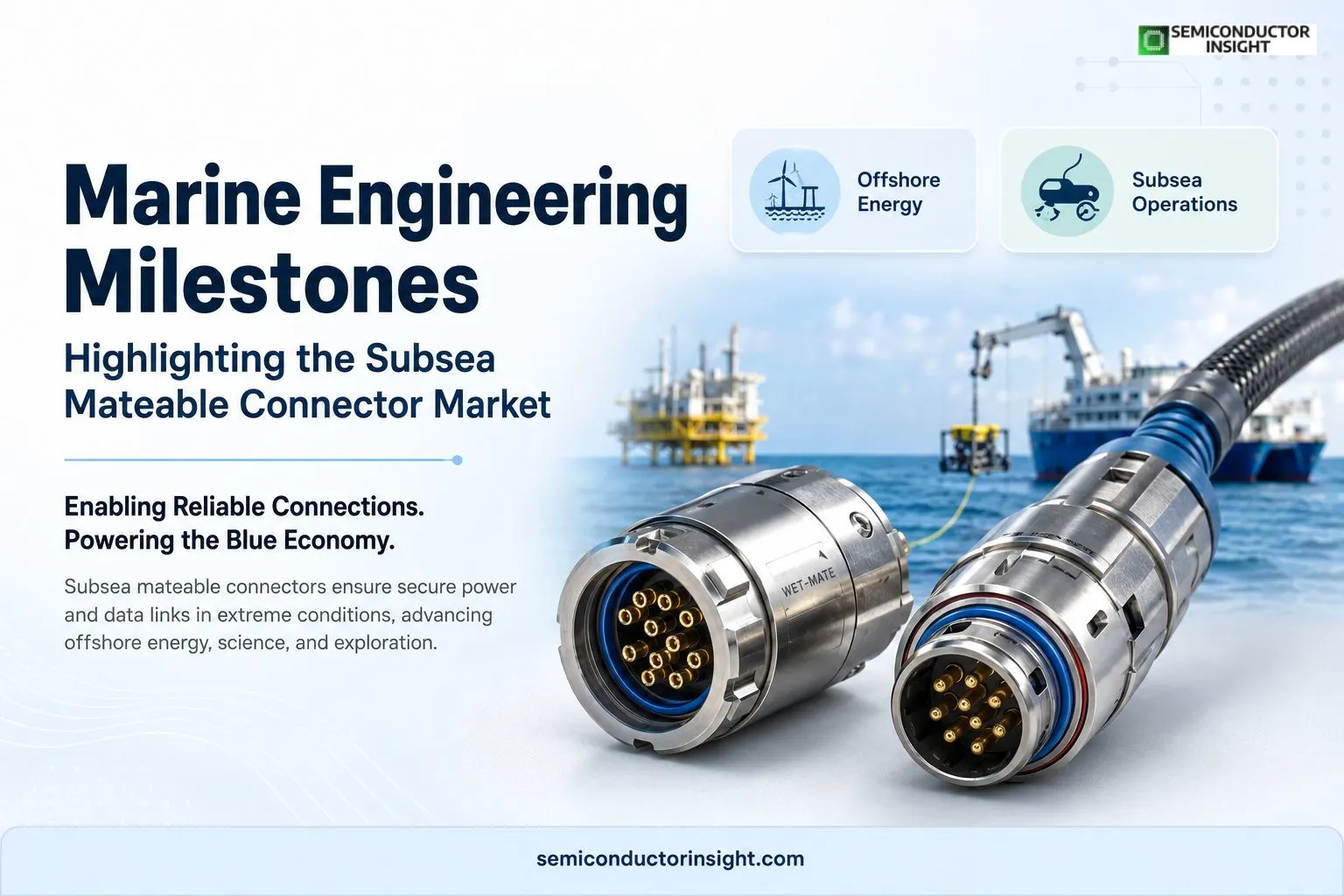
Marine Engineering Milestones Highlighting the Subsea Mateable Connector Market
Engineers working on underwater systems face immense challenges where even minor connection failures can halt entire operations thousands of meters below the surface.
The subsea mateable connector market addresses these demands through specialized wet-mate and hybrid designs that allow mating and demating while fully submerged, maintaining power, data, and signal integrity in extreme pressure, corrosion, and temperature variations.
Wet-Mate Technology Enabling Flexible Subsea Operations
- Wet-mate connectors stand out for their ability to connect and disconnect underwater without surfacing equipment.
- This capability proves invaluable for remotely operated vehicles (ROVs) and autonomous underwater vehicles (AUVs) during inspection, repair, and maintenance tasks.
- Manufacturers incorporate pressure-balanced oil-filled (PBOF) mechanisms that equalize internal and external pressures, preventing seawater ingress while protecting internal contacts.
- Recent field deployments in offshore wind arrays demonstrate how these connectors support dynamic cabling in moving tidal environments, reducing the need for costly vessel interventions.
Material Innovations Supporting Extreme Depth Performance
Developments in titanium alloys, specialized polymers, and glass-to-metal seals enhance durability against saltwater corrosion and pressures exceeding 10,000 psi. Government-backed research through institutions like the U.S. Naval facilities has tested designs capable of sustained operation at full ocean depths, with some prototypes maintaining low contact resistance after thousands of mating cycles.
In one documented case from deep-ocean simulation systems, connectors facilitated reliable power and data transfer during pressure testing of marine equipment prototypes.
Integration with Renewable Energy and Subsea Grids
Offshore wind and tidal energy projects increasingly depend on robust subsea connections for power export and array networking. The U.S. Department of Energy tracks offshore wind capacity targets approaching 30 gigawatts by 2030, requiring extensive underwater connector deployments for inter-array cables and export lines. European initiatives under the Green Deal similarly call for thousands of high-voltage interfaces in the North Sea.
These connectors help transmit electricity from floating platforms while withstanding constant motion and biofouling risks.
Curious about the report? Dive into our newest updated version at no cost: https://semiconductorinsight.com/report/subsea-mateable-connector-market/
Support for Scientific Seabed Observatories
Cabled ocean observatories rely on long-term, reliable wet-mate connectors to link sensors, cameras, and instruments across seafloor networks. Projects funded by bodies such as the National Science Foundation use these components to stream real-time data on seismic activity, ocean chemistry, and marine life from remote sites.
One Chinese research effort in the South China Sea successfully tested an electro-optical wet-mate prototype at 1,600 meters in 2023, achieving performance comparable to leading international standards.
- Defence and Naval Applications Expanding Capabilities
Naval programs worldwide incorporate subsea mateable connectors in submarine systems, underwater surveillance, and mine countermeasures. The technology supports modular mission payloads on unmanned vehicles, allowing quick reconfiguration during operations. Historical developments from U.S. Civil Engineering Laboratory prototypes in the late 1970s laid groundwork for modern coaxial designs used in secure communications.
- Hybrid Electrical-Optical Solutions for Data Intensive Missions
Modern connectors often combine power transmission with high-bandwidth fiber optics in single compact units. This hybrid approach benefits telecommunications cable repairs and real-time video feeds from deep-sea ROVs exploring shipwrecks or hydrothermal vents. Non-contact inductive coupling variants under exploration aim to eliminate physical wear during repeated connections.
Challenges in Manufacturing and Deployment
Producing these precision devices involves rigorous qualification testing under simulated ocean conditions, including vibration, thermal cycling, and hydrostatic pressure. Lead times for custom high-voltage units can extend several months due to specialized material sourcing and certification requirements from maritime safety authorities.
Field service teams from established suppliers often deploy globally to support installation on live platforms.
Emerging Role in Underwater Data Centres and Aquaculture
Innovative applications include powering submerged data centres that leverage Natural Ocean cooling for energy efficiency. Aquaculture monitoring systems also adopt compact connectors for sensor arrays tracking water quality and fish health in offshore farms, supported by sustainable seafood production initiatives.
The subsea mateable connector market continues evolving as marine industries push boundaries in energy, science, and exploration. Each successful deployment represents collaborative progress between researchers, engineers, and operators committed to reliable performance where failure carries high consequences. These technologies quietly enable the growing blue economy by keeping critical underwater connections alive in the planet’s most unforgiving environment.

Comments (0)