
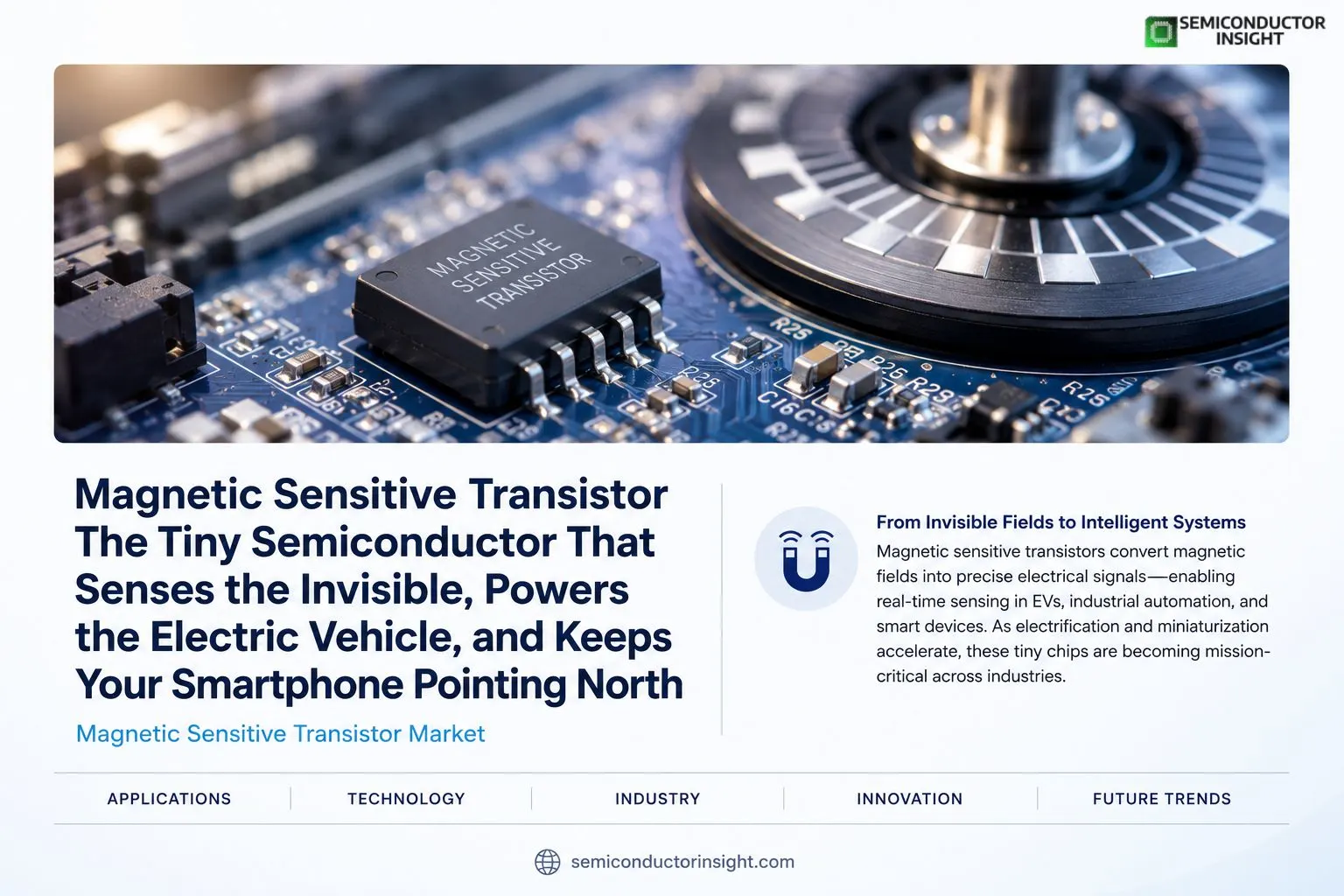
Magnetic Sensitive Transistor Market 2026: The Tiny Semiconductor That Senses the Invisible, Powers the Electric Vehicle, and Keeps Your Smartphone Pointing North
Silicon Valley’s most celebrated transistors are built to switch and amplify. They form the logic gates of processors, the memory cells of storage, the power stages of voltage regulators. But there is a quieter family of semiconductor devices that does something altogether different: it feels. Magnetic sensitive transistors-Hall-effect sensors, magnetoresistive elements, and their integrated cousins-convert magnetic fields directly into electrical signals. They are the invisible interface between the physical world of rotating shafts, moving pistons, and electric currents, and the digital world of microcontrollers and algorithms. In 2026, they are being embedded into more places than ever before, pulled by the twin megatrends of electrification and automation.
The market for these devices does not dominate headlines, but it sits at a comfortable intersection of automotive, industrial, and consumer electronics demand. Global revenue for magnetic sensor semiconductors has been growing at a pace that mirrors the expansion of electric vehicles and smart factory equipment-somewhere in the high single digits annually-and it is forecast to maintain that trajectory through the end of the decade. What makes the growth sticky is not just unit volume, but the increasing semiconductor content per sensor node, as analog front-ends, digital signal processing, and communication interfaces are integrated onto the same piece of silicon.
The physics inside the package
A magnetic sensitive transistor is not a single device type but a category that encompasses several distinct semiconductor structures. The classic Hall-effect sensor uses a thin slab of silicon, gallium arsenide, or indium antimonide. When a magnetic field penetrates the slab perpendicularly, it deflects the flow of charge carriers, creating a measurable voltage across the slab. That tiny voltage-often microvolts-is then amplified, offset-corrected, and digitised by circuitry on the same die. Modern Hall sensors can detect fields as weak as a few microteslas, enough to sense the Earth’s magnetic compass heading.
More advanced magnetoresistive devices-AMR (anisotropic magnetoresistance), GMR (giant magnetoresistance), and TMR (tunnel magnetoresistance)-exploit quantum mechanical effects in thin-film stacks. These are not transistors in the traditional three-terminal sense, but they are fabricated on semiconductor production lines using sputtering and lithography, often on silicon wafers, and are increasingly integrated with CMOS circuitry. TMR sensors, in particular, offer sensitivity orders of magnitude higher than Hall elements, and they are finding use in current sensing, angle measurement, and non-destructive testing. The chip that measures the tiny magnetic signature of a neuron firing in a brain-computer interface is likely a TMR array built on a silicon substrate.
Why the market is moving now
In 2026, three forces are converging. The first is the electric vehicle. A modern EV contains dozens of magnetic sensors. They track the rotor position in the traction motor, measure the current flowing into the battery, detect the pedal position, and monitor the charging connector lock. Many of these functions are safety-critical, which means the sensor must be accurate, redundant, and immune to the electromagnetic noise generated by a 400- or 800-volt powertrain. This pushes demand toward integrated solutions where the sensing element and the diagnostic logic are built into a single chip, often on a robust automotive-qualified process node like 180 or 130 nanometres.
The second force is the rise of Industry 4.0 and smart factories. Robots, conveyors, and CNC machines use magnetic encoders for position and speed feedback. Because magnetic sensors can work through dust, oil, and moisture, they are preferred over optical encoders in harsh environments. The trend toward predictive maintenance is adding more current sensors to motor drives, measuring the magnetic signature of the power cable to detect bearing wear before it fails.
The third force is the continued miniaturisation of consumer electronics. The tiny e-compass that tells a smartphone which direction it is pointing is often a three-axis Hall or magnetoresistive sensor integrated into a chip-scale package smaller than a grain of rice. As wearables and hearables proliferate, the demand for ultra-low-power magnetic switches that wake a device when a magnetic case is opened is rising steadily.
Where the silicon meets the supply chain
Magnetic sensitive transistors live at the intersection of two semiconductor supply chains: the mature mixed-signal fabs that can handle analog precision, and the specialty foundries that deposit the exotic thin-film layers needed for GMR and TMR stacks. This dual dependency makes the market unusually concentrated at the component level. A handful of integrated device manufacturers, mostly based in Europe, the United States, and Japan, dominate the automotive magnetic sensor market. They operate their own fabs, control the process recipes for the thin-film stacks, and sell the finished sensor ICs to tier-one automotive suppliers.
The fabrication itself ranges from standard CMOS with a post-processing magnetic layer to fully dedicated magnetoresistive processes that require ultra-clean deposition chambers. Yields on TMR stacks, which consist of layers only a few atoms thick, are notoriously sensitive to contamination and interface roughness. In 2026, this remains a barrier to entry that protects incumbents while limiting the pace of commoditisation.
A 2026 development worth noting
Earlier this year, a major European semiconductor manufacturer announced that it had qualified a new generation of 3D Hall sensors for the electric power steering systems of a global automaker. The sensor, which can measure magnetic field components in three axes simultaneously, enables more precise torque sensing and reduces the number of separate sensor chips required. The announcement, covered by an automotive electronics trade journal, is a signal that magnetic sensors are moving up the integration curve, absorbing functions that once required multiple discrete components. In the same month, a Japanese component maker introduced a TMR-based current sensor with an integrated isolation barrier capable of withstanding 1,500 volts, targeting the inverter and charging systems of 800-volt EV platforms.
These are not science-fair demonstrations; they are production-intent products that will ship in millions of units by the end of the decade.
The limits that still exist
Magnetic sensitive transistors, for all their utility, are not universal solutions. Hall sensors drift with temperature and require careful calibration. Magnetoresistive devices can be damaged by strong external fields or electrostatic discharge. The packaging, which must keep the sensing element free from mechanical stress while exposing it to the external field, is a persistent cost driver. And the competition from alternative sensing technologies-inductive position sensors, optical encoders, even the humble variable reluctance sensor-means that magnetic sensor chips must defend their value proposition on cost, accuracy, and integration in every socket.
Looking toward the end of the decade
As vehicles become more electrified and autonomous, as factories grow smarter, and as consumer devices continue to shrink, the need for precise, reliable, and increasingly intelligent magnetic field sensing will only expand. The magnetic sensitive transistor, whether it is a simple Hall plate or an elaborate TMR bridge with an on-chip DSP, is quietly becoming a foundational sensor for the electronics age. It senses position, measures current, detects proximity, and navigates the world-all without a moving part, all on a sliver of silicon smaller than a fingernail. The market for these devices is not the biggest in the semiconductor industry, but it is one of the most reliably essential, and in 2026 it is being pulled forward by technologies that cannot function without it.
Check out our report for key trends: https://semiconductorinsight.com/report/magnetic-sensitive-transistor-market/

Comments (0)