

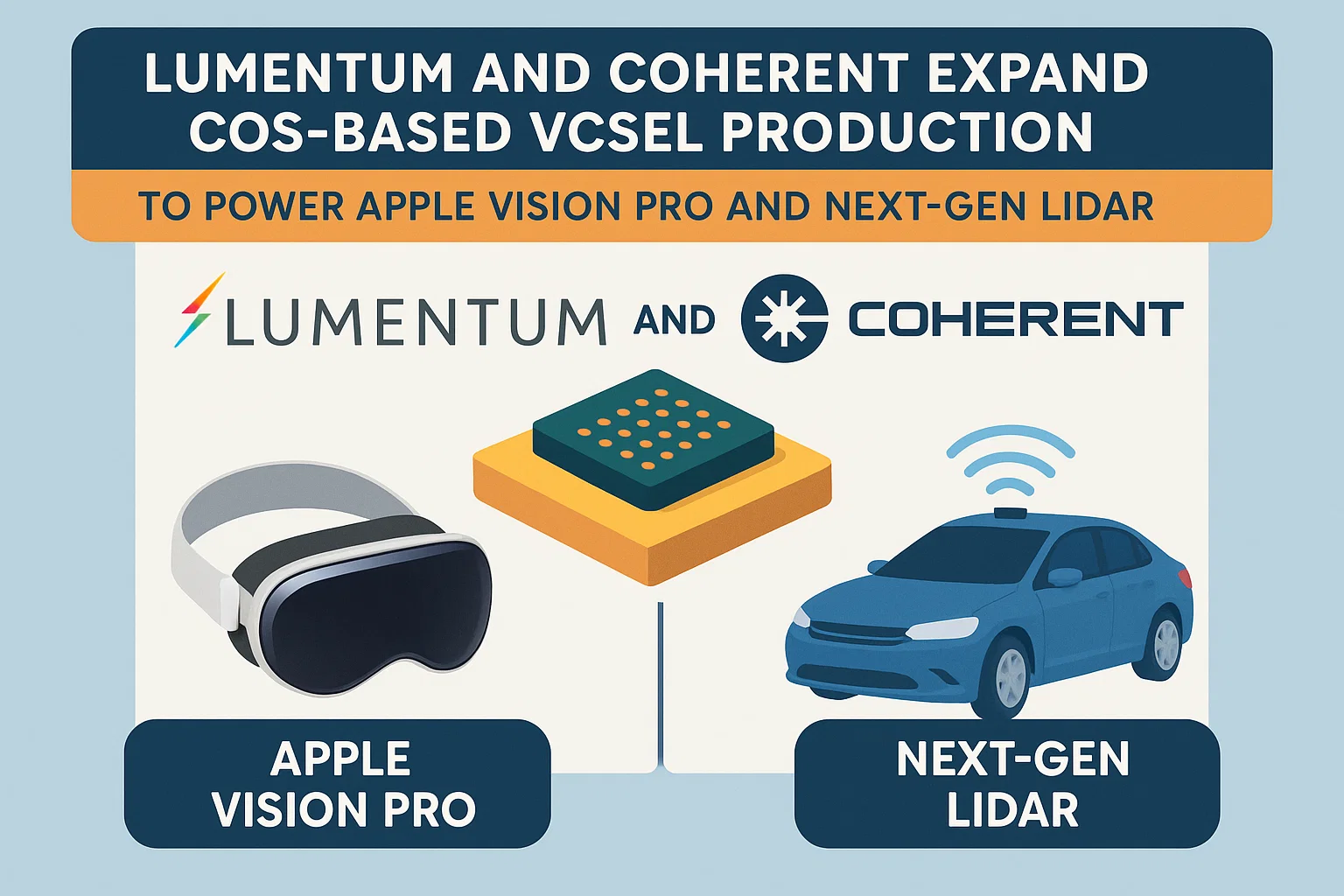
Lumentum and Coherent Expand COS-Based VCSEL Production to Power Apple Vision Pro and Next-Gen LiDAR
In an era dominated by optical communication, high-speed data transmission, and intelligent sensing, Chip on Submount (COS) technology has quietly emerged as a linchpin in next-gen electronic and photonic integration. Once relegated to niche optoelectronic applications, COS is now at the core of systems ranging from AI-driven data centers to autonomous vehicles and consumer-grade augmented reality (AR) devices.
As of 2024, the COS market size is valued at US$ 567.3 million, and is projected to double to US$ 1.14 billion by 2032, expanding at a compound annual growth rate (CAGR) of 10.6% from 2025 to 2032. This exponential growth underscores the escalating demand for precision, miniaturization, and high-performance photonic components.
Access Your Free Sample Report- Chip on Submount (COS) Market
Understanding Chip on Submount (COS) Technology
At its core, Chip on Submount (COS) refers to the direct attachment of a semiconductor chip (e.g., laser diode, VCSEL, photodiode) onto a thermally and electrically optimized submount. This configuration improves thermal dissipation, optical alignment, and electrical interconnectivity, making it ideal for applications that demand high performance and reliability in compact packages.
What’s Driving the Surge in COS Adoption?
Several macro and micro trends are converging to propel COS technology into the spotlight:
1. Explosion of AI and High-Speed Optical Interconnects
The AI revolution is data-intensive. With the rise of AI data centers, there is an urgent need for high-bandwidth, low-latency optical interconnects. COS-based packaging ensures precise optical alignment, reduced insertion losses, and efficient heat management in laser diodes and VCSELs.
Recent Insight: According to EE Times and Semiconductor Engineering, COS has become a critical component in AI hardware stacks due to its ability to handle the thermal and spatial demands of coherent transceivers and edge-emitting laser modules.
2. Advancements in AR/VR and 3D Sensing
From smartphones to headsets like the Apple Vision Pro, 3D sensing is now a default feature. COS-packaged VCSEL arrays enable accurate facial recognition, gesture control, and depth sensing in compact footprints.
Supply Chain Focus: Companies like Lumentum and Coherent are scaling up COS VCSEL production to meet Apple’s growing demand for compact optical sensors.
3. LiDAR and Autonomous Vehicles
In automotive applications, COS modules are essential for LiDAR systems that require eye-safe, high-power laser sources with compact and rugged packaging.
Industry Insight: Lightwave Online reports that Coherent Corp. and Lumentum have focused R&D on improving COS packaging techniques for thermally stable and optically precise laser modules.
4. Silicon Photonics and Optical I/O
COS is also finding a home in silicon photonics, where high-speed data transfer relies on the co-packaging of optical and electronic components.
Intel’s Innovations: In 2024, Intel unveiled new packaging strategies blending chip-on-carrier and COS technologies to enable tighter integration between laser diodes and silicon waveguides, vital for next-gen CPUs and accelerators.
Download Sample Report PDF- Chip on Submount (COS) Market
Key Industry Players and Their Strategic Moves
Lumentum Holdings Inc.
- Focus: VCSEL modules for mobile, automotive, and AR.
- Update: Expanded COS-based production lines in Q1 2024 to support Apple and other OEMs.
- Noteworthy: Leveraging COS to enhance laser power density without compromising thermal limits.
Coherent Corp. (formerly II-VI)
- Focus: High-power industrial lasers, automotive optics.
- Update: Enhanced COS platforms with improved thermal interfaces and compact form factors.
Intel
- Focus: Photonic integration in AI accelerators.
- Update: Introduced hybrid packaging solutions incorporating COS for better signal fidelity and lower power consumption.
ASE Group, Amkor, JCET (OSATs)
- Focus: Vertical integration into optical packaging.
- Update: Established new COS packaging services to cater to data center and telecom clients.
Technological Innovations in COS Packaging
- Thermal Management
- Materials such as CVD diamond, SiC, and aluminum nitride are being explored for submounts to improve heat dissipation.
- Alignment Precision
- Sub-micron optical alignment has been made possible using active alignment during bonding.
- Miniaturization
- COS enables more compact module designs, which is essential in mobile and wearable applications.
- Automation and Yield
- Enhanced automation in COS assembly has improved production yield and repeatability, bringing costs down over time.
Application Landscape: Where COS is Making an Impact
1. Datacenters & Telecom
- Optical transceivers using COS-packaged lasers reduce signal loss and power consumption.
- Used in coherent modules operating at 400G and 800G.
2. Consumer Electronics
- Apple’s iPhone and Vision Pro utilize COS-packaged VCSELs for Face ID and spatial sensing.
3. Industrial and Medical Lasers
- COS is employed in high-power laser systems used in material processing and surgical tools.
4. Automotive Sensing (LiDAR)
- Enables high-resolution, compact LiDAR modules for ADAS and autonomous driving systems.
Market Size and Forecast: 2024–2032
According to credible estimates (excluding generic market research firms):
- 2024 COS Market Size: US$ 567.3 million
- 2032 Forecast: US$ 1.14 billion
- CAGR (2025–2032):6%
This growth is attributed to:
- Proliferation of AI and 5G
- Expansion of AR/VR devices
- Automotive sensing boom
- Push toward optical I/O in cloud infrastructure
Challenges in COS Adoption
Despite its many advantages, COS technology isn’t without challenges:
- Thermal Stress: Ensuring longevity under thermal cycling.
- Material Compatibility: Matching thermal expansion coefficients of chip and submount.
- Packaging Cost: COS is still more expensive than traditional SMD components.
- Assembly Complexity: Requires precision tools and cleanroom facilities.
Click Here To Download Full Sample Report- Chip on Submount (COS) Market
The Road Ahead: Future Outlook
With innovations in wafer-level packaging, hybrid integration, and active alignment automation, COS technology is on a fast track to broader adoption.
By 2030, we can expect:
- COS becoming mainstream in edge and cloud AI infrastructure.
- Expansion into quantum photonics and biosensors.
- Mass deployment in autonomous vehicles and smart glasses.
The Chip on Submount (COS) technology revolution is well underway. From its humble beginnings in photodiode modules to powering the most advanced AI, LiDAR, and AR systems, COS is proving indispensable to the optoelectronic landscape. As market demand intensifies and technology scales, COS is poised to become the cornerstone of next-gen photonic packaging.
For businesses and developers operating in high-speed data, sensing, or optical domains, embracing COS technology is no longer a question of “if,” but “when.”

Comments (0)