
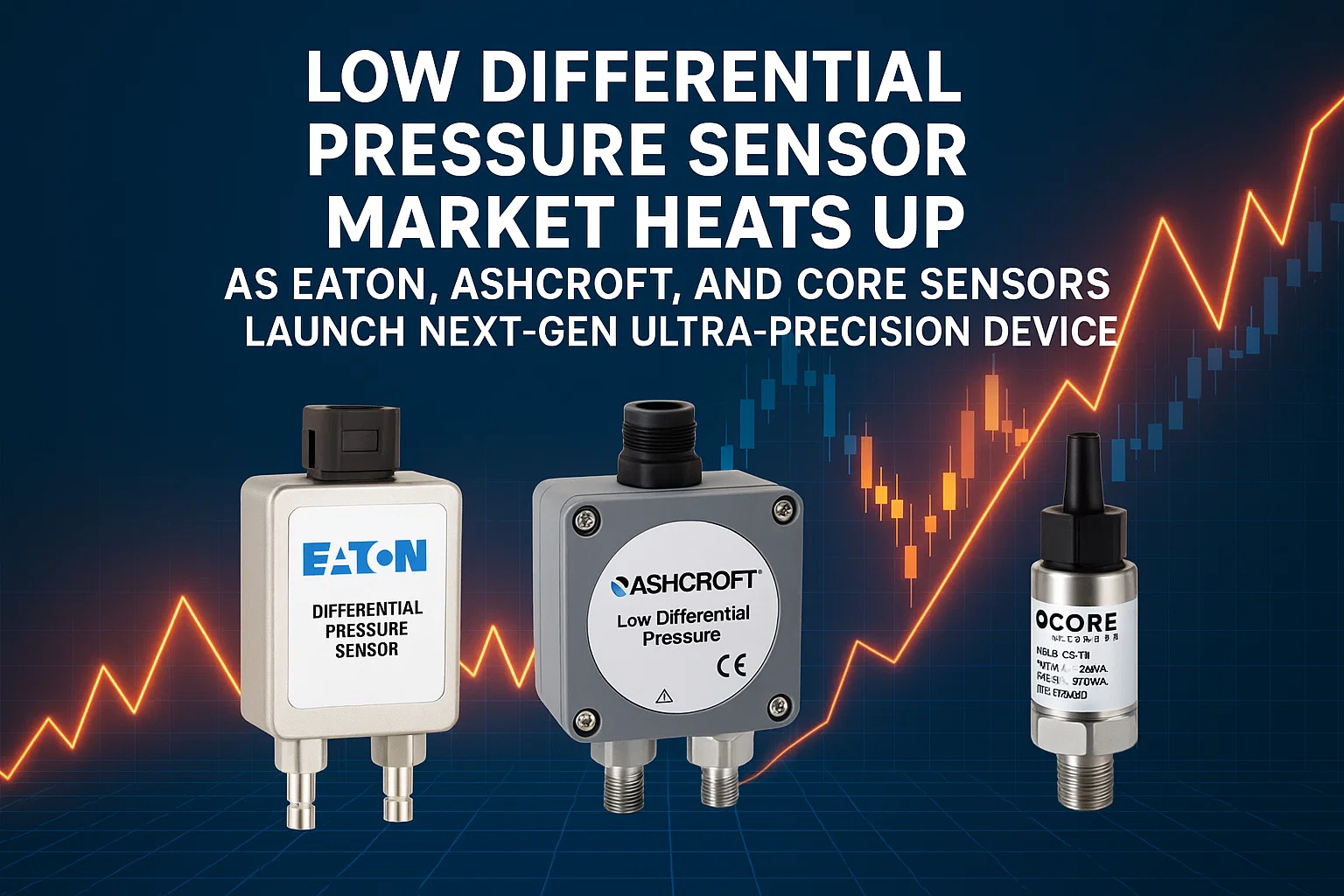
Low Differential Pressure Sensor Market Heats Up as Eaton, Ashcroft, and Core Sensors Launch Next-Gen Ultra-Precision Devices
The low differential pressure sensor industry is experiencing a remarkable phase of growth and technological innovation, fueled by advancements in MEMS technology, demand for smart industrial solutions, and the rise of IoT-enabled monitoring systems. These sensors, known for their capability to measure extremely small differences in pressure, play a crucial role in industries such as HVAC, cleanroom management, medical equipment, aerospace, energy, and industrial automation.
According to the latest projections, the global Low Differential Pressure Sensor Market was valued at USD 2,061 million in 2024 and is expected to reach USD 3,303 million by 2032, growing at a CAGR of 7.1% during the forecast period. This growth is driven by increasing demand for precision measurement, regulatory requirements for safety and emissions control, and the rapid integration of sensors into IoT and AI-powered systems.
Access Your Free Sample Report- Low Differential Pressure Sensor Market
Understanding Low Differential Pressure Sensors
Before delving into recent developments, it is essential to understand what low differential pressure sensors (LDPS) are and why they are indispensable across multiple industries.
Low differential pressure sensors measure minute differences between two pressure points. Unlike standard pressure sensors, they are designed to detect subtle variations sometimes as small as ±25 Pascals which is critical in environments where even a tiny change can indicate contamination, equipment inefficiency, or safety hazards.
Key Applications:
- HVAC Systems & Building Automation
- For monitoring airflow in cleanrooms and controlled environments.
- Ensures energy efficiency and compliance with indoor air quality regulations.
- Healthcare & Medical Devices
- Used in ventilators, anesthesia machines, and CPAP systems for precise airflow measurement.
- Crucial in maintaining patient safety during surgical and respiratory care.
- Industrial Automation
- Detecting filter blockages in oil, gas, and water systems.
- Monitoring differential pressure in pipelines and process control systems.
- Aerospace and Defense
- Measuring airflow and cabin pressure in aircraft.
- Enhancing safety systems in space exploration vehicles.
- Cleanroom Management & Pharmaceuticals
- Ensures sterile environments by maintaining constant air pressure differentials.
- Reduces contamination risk during pharmaceutical manufacturing.
Market Growth Dynamics
The 7.1% CAGR projected for the industry stems from several key factors:
1. Rising Adoption of IoT and Smart Monitoring
As industries move toward Industry 4.0, low differential pressure sensors are being integrated into IoT-enabled smart systems. These systems provide real-time monitoring of pressure data, enabling predictive maintenance and process optimization.
For instance, Core Sensors’ recent launch of low-pressure transducers optimized for IoT applications illustrates how sensor technology is evolving to meet the demand for connected, low-power devices.
2. Stricter Environmental and Safety Regulations
Governments worldwide are tightening regulations regarding air quality, emissions control, and cleanroom standards.
- Pharmaceutical and semiconductor industries must maintain precise environmental controls, making LDPS essential for compliance.
- HVAC systems must comply with stringent energy efficiency and indoor air quality rules.
3. Medical Sector Growth
The COVID-19 pandemic highlighted the need for advanced respiratory equipment, many of which rely heavily on LDPS for accurate airflow monitoring. Even post-pandemic, healthcare systems continue to demand cutting-edge sensors for diagnostic and therapeutic devices.
4. Miniaturization and MEMS Technology
The development of MEMS-based sensors has enabled manufacturers to create smaller, more sensitive, and cost-effective devices, opening new opportunities in portable medical equipment and aerospace applications.
Recent Industry Developments
The past year has seen significant advancements and product launches in the low differential pressure sensor market, reflecting a strong focus on precision, connectivity, and ruggedness.
1. Eaton Launches VS6 Electronic Differential Pressure Sensor
Eaton introduced its latest innovation, the VS6 electronic differential pressure sensor, designed specifically for hydraulic and lubrication oil filter systems. This sensor features:
- A stainless-steel housing for durability in harsh environments.
- A traffic light-style LED indicator for visual status updates.
- 4–20 mA analog output, ensuring compatibility with industrial monitoring systems.
- Cold-start suppression technology, effective in temperatures as low as 25°C.
- IP67-rated waterproofing for use in rugged outdoor applications.
This development highlights the industry’s push toward integrated diagnostics and ease of maintenance, allowing operators to quickly identify and resolve filter clogging issues.
Market Impact:
Eaton’s VS6 aligns with the rising demand in industries such as oil & gas, manufacturing, and power generation, where system reliability and uptime are critical.
Download Sample Report PDF- Low Differential Pressure Sensor Market
2. EYC-Tech Unveils Ultra-Low Differential Pressure Transmitter (PMM06-D)
EYC-Tech introduced the PMM06-D, an ultra-low differential pressure transmitter capable of measuring pressures as low as ±25 Pa, ideal for applications in cleanrooms, laboratories, and semiconductor manufacturing.
Key Features:
- High-sensitivity hot-wire sensor for exceptional accuracy.
- Built-in square-root extraction, allowing direct conversion of pressure to airflow or air velocity.
- Multiple output formats: RS-485, 4–20 mA, 0–10 V, and relay outputs.
- IP65-rated enclosure for resistance to dust and moisture.
Industry Significance:
This product reflects the miniaturization and specialization trend, catering to industries where even minor pressure fluctuations can impact production quality.
3. Core Sensors Expands DP Transducer Range to 0.5 PSI
Core Sensors has enhanced its differential pressure transducer line, now offering measurement capabilities starting at 0.5 PSI (≈14 in H₂O). Previously, their sensors began at 1 PSI.
Highlights:
- Available in uni- and bi-directional models.
- Low-power designs ideal for IoT and remote monitoring systems.
- Compatible with industrial and hazardous environments through series like:
- CS14 (Industrial)
- CS54 (Non-incendive)
- CS64 (Explosion-proof)
- CS84 (Intrinsically Safe)
Market Implications:
By catering to ultra-low pressure applications, Core Sensors is targeting the HVAC, healthcare, and semiconductor industries, where precise monitoring is essential.
4. Ashcroft GXLdp: Redefining Reliability
The Ashcroft GXLdp differential pressure transducer addresses a major pain point: drift and long-term reliability. It is built to handle:
- Extreme shock and vibration, ideal for aerospace and heavy machinery.
- Overpressure events, preventing sensor damage.
- Applications requiring low maintenance and extended lifecycle.
Impact:
This innovation is crucial for industries such as energy and utilities, where downtime translates directly into revenue loss.
5. MEMS Research and Future Trends
Recent studies published in Nature Microsystems & Nanoengineering highlight advancements in MEMS-based MDPS (Minute Differential Pressure Sensors).
Breakthroughs include:
- Beam-Membrane-Island structures, achieving sensitivity of 66 μV/V/kPa with natural frequencies of 11.3 kHz.
- Resonant pressure sensors with an accuracy of ±0.01% FS.
- Leadless packaging, enhancing sensor durability in harsh environments.
These developments point toward next-generation ultra-miniaturized sensors, opening doors for wearable devices, aerospace applications, and integrated medical systems.
Regional Market Insights
1. North America
- Driven by the United States, North America leads in adoption due to advanced healthcare systems, aerospace demand, and smart building initiatives.
- Strong presence of companies like Eaton, Core Sensors, and Ashcroft enhances regional growth.
2. Europe
- The European market is boosted by strict environmental regulations, particularly in HVAC and cleanroom industries.
- Countries like Germany and France are at the forefront of pharmaceutical and semiconductor production.
3. Asia-Pacific
- Fastest-growing region, thanks to booming semiconductor and electronics manufacturing in China, South Korea, and Japan.
- Rising investments in healthcare infrastructure further drive demand.
4. Middle East & Africa
- Growth is driven by oil and gas industries requiring rugged, explosion-proof differential pressure sensors.
Challenges in the Market
Despite growth, the industry faces certain challenges:
- High Initial Costs – Ultra-sensitive sensors with advanced features are expensive, limiting adoption among small enterprises.
- Calibration and Maintenance – Frequent calibration is needed to maintain accuracy, particularly in demanding applications.
- Competition from Low-Cost Alternatives – Emerging players in Asia offer lower-cost products, creating pricing pressure.
- Supply Chain Disruptions – Geopolitical tensions and raw material shortages can impact production timelines.
Click Here To Download Full Sample Report- Low Differential Pressure Sensor Market
Future Outlook: Where the Market is Heading
The future of the low differential pressure sensor market is promising, with trends pointing toward integration, miniaturization, and intelligence.
Key future developments include:
- AI-Powered Predictive Maintenance: Sensors integrated with machine learning algorithms to predict equipment failures.
- Wireless and Battery-Free Designs: Utilizing energy harvesting technologies for IoT deployments.
- Expanded Role in Green Technologies: As industries shift toward sustainable energy, LDPS will be critical in monitoring fuel cells, solar plants, and wind turbines.
- Healthcare Innovations: Wearable medical devices leveraging MEMS sensors for continuous patient monitoring.
By 2032, these advancements will collectively help the market achieve its projected size of USD 3.3 billion.
The low differential pressure sensor industry is undergoing a technological revolution, driven by innovation, regulatory demands, and the rise of smart systems. From Eaton’s rugged VS6 to EYC-Tech’s ultra-sensitive PMM06-D and Core Sensors’ IoT-friendly transducers, companies are pushing the boundaries of precision measurement.
As the market grows from USD 2.06 billion in 2024 to USD 3.30 billion by 2032, stakeholders across industries from healthcare and aerospace to HVAC and cleanrooms will benefit from enhanced accuracy, reliability, and efficiency.

Comments (0)