
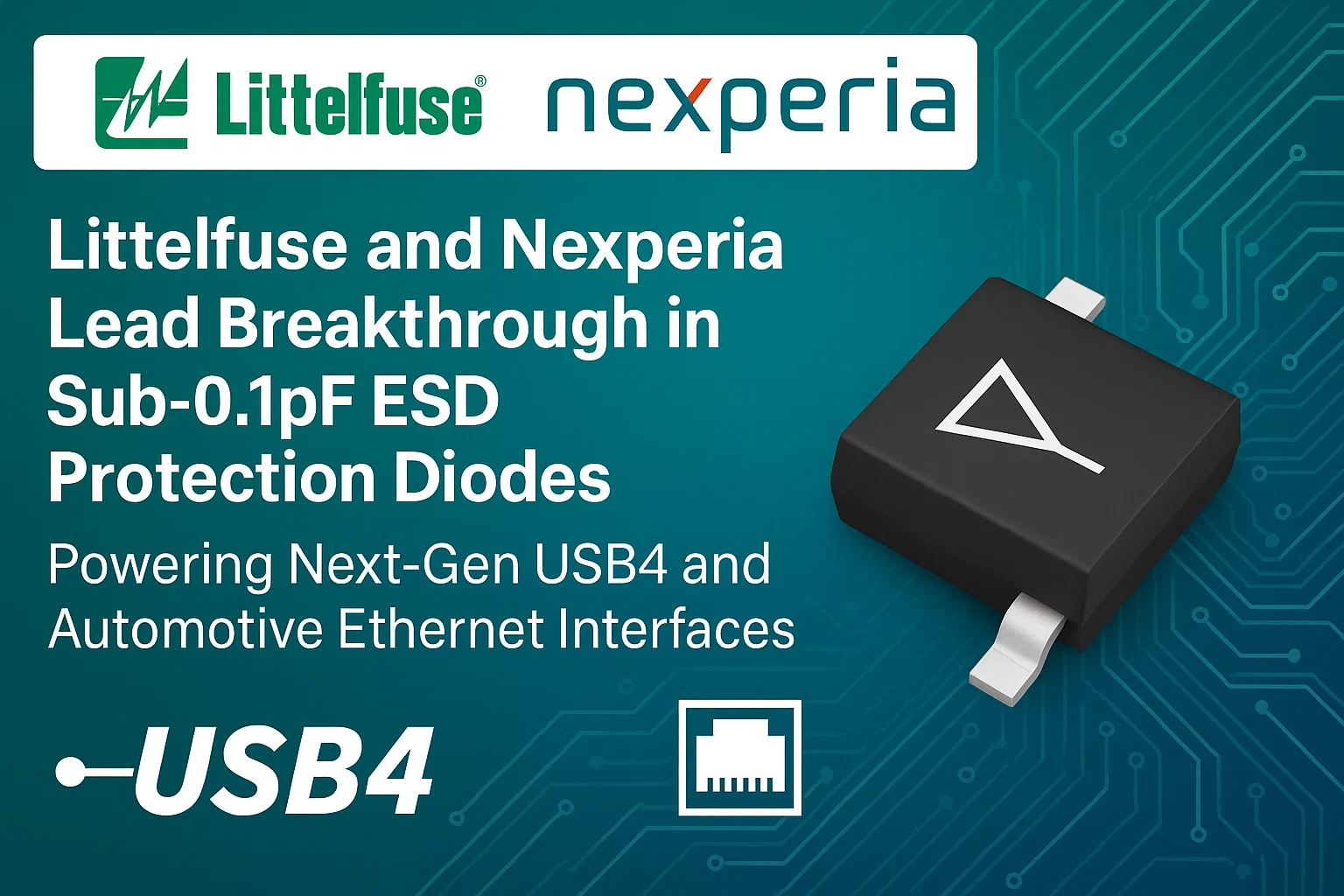
Littelfuse and Nexperia Lead Breakthrough in Sub-0.1pF ESD Protection Diodes, Powering Next-Gen USB4 and Automotive Ethernet Interfaces
In today’s fast-paced world of electronics—where devices are becoming smaller, faster, and more interconnected—the demand for robust electrostatic discharge (ESD) protection is more critical than ever. As the need for high-speed data transmission grows, low capacitance diodes for ESD protection are emerging as the go-to solution for safeguarding delicate components in high-frequency signal lines, particularly in mobile devices, automotive electronics, and consumer products.
According to recent market evaluations, the Low Capacitance Diodes for ESD Protection market was valued at USD 245.7 million in 2024. It is projected to reach USD 487.6 million by 2032, growing at a CAGR of 7.8% from 2025 to 2032. This growth is driven by technological advancements, increasing consumer electronics adoption, and heightened automotive safety standards.
Access Your Free Sample Report- Low Capacitance Diodes for ESD Protection Market
Why Low Capacitance Matters in ESD Protection
To protect sensitive semiconductor components from voltage spikes caused by ESD events, designers often integrate protection diodes near input/output ports. However, standard diodes with higher parasitic capacitance can distort high-frequency signals, leading to data errors and signal integrity issues in interfaces like USB 3.x, HDMI 2.1, Thunderbolt, DisplayPort, and high-speed automotive Ethernet.
Low capacitance diodes (typically <1 pF, and in some cases as low as 0.08 pF) solve this problem by offering:
- Minimal signal distortion
- Ultra-fast response times
- Superior compatibility with high-bandwidth systems
Market Overview: Robust Growth Trajectory
As mentioned, the global Low Capacitance Diodes for ESD Protection market is projected to nearly double in size from USD 245.7 million in 2024 to USD 487.6 million by 2032. Several trends are fueling this growth:
Key Growth Drivers:
- Expansion of high-speed digital interfaces
- Rising complexity of consumer electronics and IoT devices
- Strict ESD protection requirements in automotive environments (AEC-Q101 compliance)
- Miniaturization of electronics requiring compact protection solutions
Regional Trends:
- Asia-Pacific dominates due to heavy production of consumer electronics in China, South Korea, and Taiwan.
- North America is seeing growing demand in automotive electronics and data centers.
- Europe continues to focus on compliance, reliability, and automotive safety.
Key Industry Developments and Product Launches (2024–2025)
Several leading manufacturers have introduced game-changing technologies in the ultra-low capacitance ESD protection space.
Littelfuse: SP3208 & SP3213 Series
Overview:
In early 2025, Littelfuse unveiled the SP3208 and SP3213 diode arrays, setting a new standard for low-capacitance protection.
Highlights:
- Capacitance as low as 0.08 pF, supporting signal speeds beyond 30 GHz
- Bidirectional protection from ±12 kV ESD (air discharge) and 2 A surge (8/20 µs)
- AEC-Q101 qualification, making it ideal for automotive-grade applications
- Packaged in ultra-small DFN1006-2, allowing integration into tight PCB layouts
Applications:
- HDMI 2.1
- USB4/Thunderbolt
- DisplayPort 2.1
- Antenna protection in mobile/wireless devices
Industry Impact:
These devices represent one of the lowest capacitance values available commercially and enable ultra-high-speed data transmission without compromising ESD protection.
Nexperia: Flip-Chip LGA Ultra-High Integrity Diodes
Overview:
Nexperia launched a range of ESD protection diodes in flip-chip land grid array (FC-LGA) packages, targeting signal integrity-focused automotive applications.
Highlights:
- Capacitance < 0.25 pF
- −3 dB insertion loss point at 14.6 GHz (ideal for >10 Gbps data rates)
- Improved performance by removing bond wires, reducing parasitics
- Dual and single-line configurations available
- Automotive-qualified (AEC-Q101)
Applications:
- In-vehicle infotainment systems
- Automotive Ethernet and camera interfaces
- High-speed data transmission in ADAS
Why It Matters:
The FC-LGA architecture allows for higher signal integrity by reducing insertion loss, which is crucial for in-vehicle systems dealing with real-time data like camera feeds or LiDAR inputs.
Download Sample Report PDF- Low Capacitance Diodes for ESD Protection Market
MCC Semiconductor: Three Noteworthy Launches
1. CSPSBULC Series (Sept 2024)
Overview:
Targeting both mobile and automotive platforms, the CSPSBULC diodes bring 0.2 pF capacitance and ±15 kV ESD protection in tiny CSP0201 footprints.
Use Cases:
- USB4
- RF and antenna lines
- Mobile and tablet devices
Standout Feature:
Extremely low clamping voltage (~2.9 V) ensures sensitive nodes are fully protected without degradation.
2. Automotive ESDULC Series (Aug 2024)
Details:
- Models: ESDULC5V0LBWFHE3 & ESDULC3V3LBWFHE3
- Capacitance between 25–0.35 pF
- Side-wettable flank (SWF) DFN1006-2L packaging for auto assembly
- AEC-Q101 qualified
Use Cases:
- Advanced driver-assistance systems (ADAS)
- Automotive sensors and communication interfaces
Market Edge:
SWF packaging allows better inspection and reliability, making these devices more attractive to Tier-1 automotive manufacturers.
3. ESDSBSLC3V3LT / ESDSBSLC5V0LT Series (Dec 2024)
Specs:
- Dual-line protection
- Snapback operation with clamping voltage <10 V
- Capacitance: 65–1.0 pF
- Surge protection up to 13 A (8/20 µs)
- IEC61000-4-2 compliance up to ±30 kV
Key Markets:
- USB hubs
- Ethernet ports
- Industrial automation
Advantage:
Combines ultra-low clamping and dual-line protection—ideal for high-speed differential signal lines.
Technology Innovations: What’s Driving the Evolution?
1. Ultra-Low Capacitance Thresholds
Manufacturers are pushing capacitance values below 0.1 pF to support 40+ Gbps data rates. This trend is critical as protocols like USB4 v2.0 and DisplayPort 2.1 become mainstream.
2. Flip-Chip Packaging
By eliminating bond wires, flip-chip designs minimize ESD diode inductance and parasitic capacitance, enhancing signal performance.
3. Snapback Diode Structures
Snapback technology provides low clamping voltages at high surge currents, protecting circuits from severe transients while maintaining compact footprints.
4. Automotive-Grade Reliability
All major launches now come AEC-Q101 qualified, with temperature ratings up to 150°C, addressing the stringent standards of the automotive industry.
Use Case Spotlight: Where Are These Diodes Being Used?
Consumer Electronics
- Smartphones, laptops, tablets
- USB-C ports, HDMI, SD cards
- Gaming consoles
Automotive Electronics
- Vehicle-to-Everything (V2X) communications
- Autonomous vehicle sensors (LiDAR, radar, camera)
- Infotainment, USB charging ports
Industrial Systems
- Factory automation controllers
- Robotics
- Communication systems in harsh environments
Telecommunications
- Base station radios
- Fiber-optic modules
- Ethernet switches
Competitive Landscape: Leading the Charge
| Company | Flagship Products | Specialization |
| Littelfuse | SP3208, SP3213 | Ultra-low capacitance (<0.1 pF), high-speed I/O |
| Nexperia | FC-LGA ESD series | Automotive and signal-integrity critical paths |
| MCC Semiconductor | CSPSBULC, ESDULC, ESDSBSLC series | Auto-grade, mobile interfaces, dual-line models |
| Vishay | VESD05A1-LF, VCUT05B1-DD1-G-08 | Broad portfolio with strong automotive focus |
| Semtech | RClamp & µClamp series | Known for precision protection in small packages |
Click Here To Download Full Sample Report- Low Capacitance Diodes for ESD Protection Market
What’s Next for the Market?
Trends to Watch:
- 5G and 6G readiness: Devices will require ultra-low capacitance for mmWave frequencies.
- AI-integrated vehicles: Increasing need for data-rich automotive interfaces.
- Modular system design: More PCB density means greater need for compact ESD solutions.
- Cloud computing and edge servers: PCIe Gen 6.0 adoption will drive new ESD protection demands.
Challenges:
- Balancing low capacitance with strong clamping
- Thermal stability at miniaturized form factors
- Cost management in high-volume consumer production
The demand for low capacitance diodes for ESD protection is rising in lockstep with the world’s insatiable appetite for faster, smaller, and more connected technology. With continuous innovation from companies like Littelfuse, Nexperia, and MCC Semiconductor, engineers now have access to a wide range of high-performance, ultra-compact, and application-specific ESD solutions.
As data speeds soar and signal integrity becomes paramount, these tiny but mighty diodes are proving to be indispensable guardians of our digital infrastructure. With the market set to almost double by 2032, the future is electrified, fast—and protected.

Comments (0)