
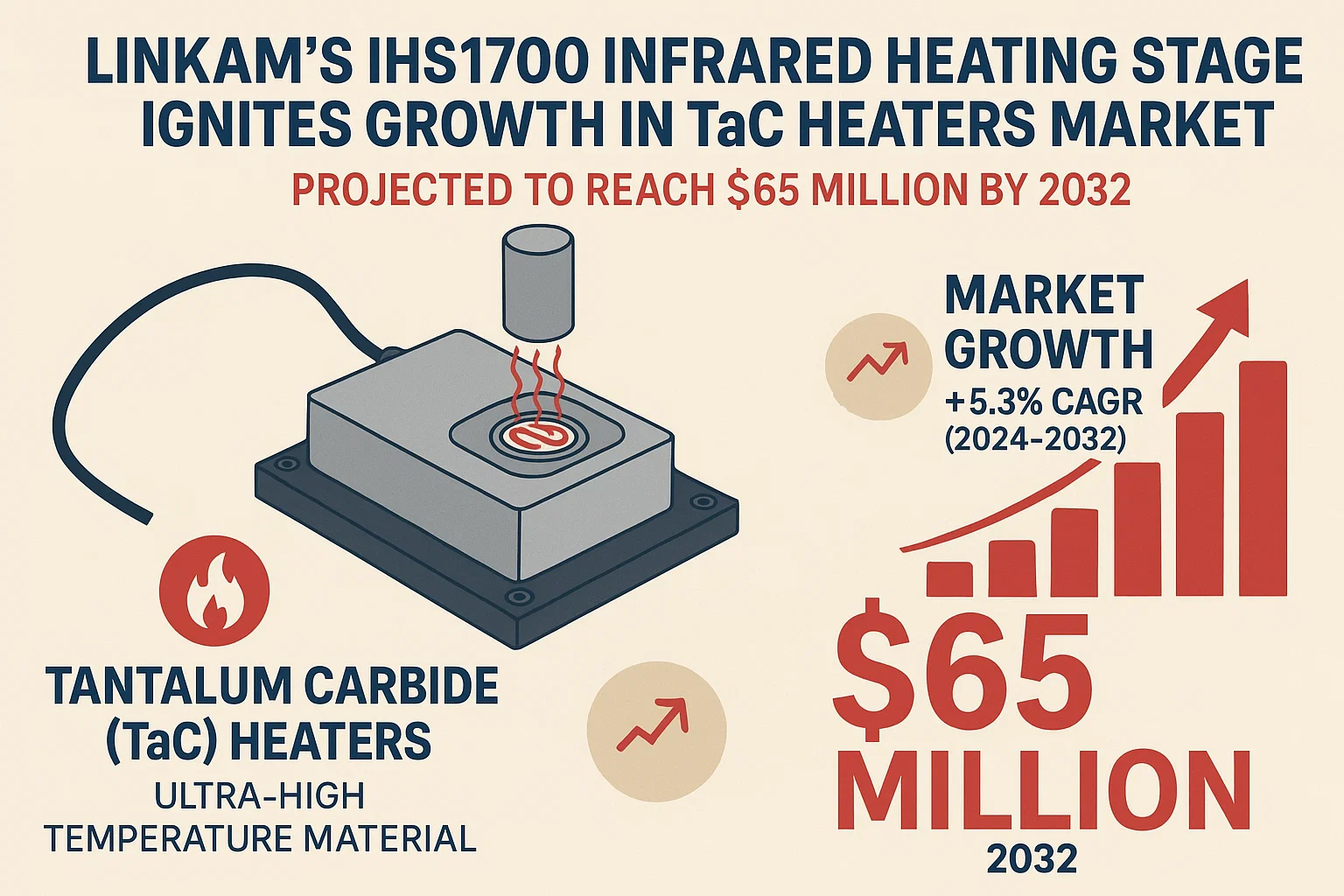
Linkam’s IHS1700 Infrared Heating Stage Ignites Growth in TaC Heaters Market, Projected to Reach $65 Million by 2032
The global thermal management industry is undergoing a significant transformation, fueled by technological advancements, materials innovation, and growing demand for high-temperature precision systems. Among the key players in this transformation is the niche but rapidly evolving Tantalum Carbide (TaC) Heaters Market, valued at USD 47 million in 2024 and projected to grow to USD 65 million by 2032, at a CAGR of 4.0% during the forecast period (2025–2032).
TaC heaters are gaining traction due to their superior performance in extreme conditions, high melting point (approx. 3880°C), excellent chemical resistance, and thermal stability. These characteristics make them ideal for applications in semiconductor fabrication, aerospace, materials science, and advanced thermal analysis systems.
Access Your Free Sample Report- TaC Heaters Market
- Understanding the Core: What Are TaC Heaters?
Tantalum carbide (TaC) is one of the most thermally stable materials known, often used in the form of coated graphite heaters. These heaters are primarily deployed in ultra-high-temperature (UHT) environments, with applications including:
- Semiconductor wafer processing
- Crystal growth systems
- Vacuum furnaces
- Thermal testing equipment
- Aerospace and defense component testing
The primary value of TaC lies in its oxidation resistance, mechanical durability, and high thermal conductivity, which ensures longer operational lifespans and consistent thermal output.
- Market Size and Growth Trajectory
According to the latest industry insights:
- Market Size in 2024: USD 47 million
- Expected Market Size by 2032: USD 65 million
- CAGR: 4.0% from 2025 to 2032
The growth is propelled by rising demand for compact, high-efficiency heating elements in cleanroom environments, next-gen semiconductor facilities, and advanced R&D laboratories.
III. Recent Developments Driving the Market
- Linkam Scientific’s IHS1700 Infrared Heating Stage
In a groundbreaking launch, Linkam Scientific Instruments, a UK-based thermal analysis instrumentation leader, introduced the IHS1700 infrared heating stage during TAC 2025 (Thermal Analysis Conference). This ultra-rapid heating stage utilizes TaC-coated elements to deliver:
- Temperature Range: RT to 1700°C
- Ramp Rates: Up to 2000°C per minute
- Application Areas: Metallurgy, energetic materials, ceramics, and mineralogy
This development, coupled with collaboration with the University of Huddersfield, marks a major milestone in bringing modular, rapid-response TaC-based systems to university labs and industrial R&D centers.
Key Takeaway: The IHS1700 exemplifies how TaC heater technology is being pushed beyond traditional furnace-based applications into precision thermal control instruments.
- University–Industry Collaborations
The University of Huddersfield’s partnership with Linkam is more than symbolic—it illustrates how academic research is becoming a catalyst for heater innovation.
By deploying the IHS1700 for real-time thermal analysis of new materials, researchers are:
- Validating the performance of TaC heaters in sensitive environments
- Studying materials decomposition, crystallization, and phase transitions at ultra-high temperatures
- Opening new frontiers in battery materials, superalloys, and energetic compounds
Implication: These partnerships are enhancing scientific reproducibility and performance benchmarking, furthering trust in TaC-based solutions across industries.
- Trends in the HVAC and Thermal Systems Sector
Although not exclusive to TaC heaters, significant macroeconomic and regulatory trends are influencing the high-temperature heater ecosystem:
- Decarbonization mandates are encouraging industries to move away from fossil-fueled heating, opening the door for electrically controlled precision heaters like those made with TaC.
- The 2025 EPA refrigerant regulation (banning high-GWP refrigerants) has increased demand for thermal systems that can integrate safely with new HVAC designs.
- The rise of digital twins, AI, and sensor feedback in thermal systems makes precise, programmable heating solutions more essential.
Opportunity: As industries digitize and decarbonize, TaC heaters may become integral in hybrid heating systems used in semiconductor fabs, labs, and industrial AI-powered process lines.
- Technical Innovations in TaC Heater Manufacturing
- Advanced Coating Techniques
Leading manufacturers are focusing on improving:
- TaC coating uniformity on graphite or ceramic cores
- Oxidation resistance through multilayer coatings
- Surface roughness and heat flux control
Innovations in chemical vapor deposition (CVD) and plasma spraying have improved the performance of these heaters under cyclic thermal stress.
- Modular Design Approaches
Companies are increasingly offering modular heater assemblies, including:
- Replaceable heating cartridges
- Plug-and-play TaC heater heads
- Integrated temperature sensors for real-time monitoring
This supports ease of maintenance and allows for rapid upgrades or repairs, minimizing system downtime.
Download Sample Report PDF- TaC Heaters Market
- Key Application Areas: Sectoral Momentum
- Semiconductors and MEMS Fabrication
The push toward smaller nodes (3nm and below) and heterogeneous integration in semiconductor manufacturing requires thermal solutions that can deliver localized heating without contamination. TaC heaters offer:
- Inert surface characteristics
- Precise thermal control
- Rapid ramp-up and cool-down
Use Case: In atomic layer deposition (ALD) and lithography resist baking stages, TaC heaters are essential for maintaining thermal integrity.
- Scientific Research & Materials Testing
In university and national labs, TaC heaters are replacing resistance wire furnaces and induction coils due to:
- Stability at extreme temperatures
- Chemical compatibility with reactive materials
- Compactness in benchtop devices
- Aerospace and Defense Testing
Testing of carbon-carbon composites, missile nose cones, and hypersonic vehicle materials demands temperatures up to 3000°C. TaC heaters are being integrated into:
- Wind tunnel preheaters
- Arc jet test stands
- Ablation simulation equipment
- Battery and Supercapacitor Material Studies
Emerging solid-state batteries and high-capacity cathodes undergo rigorous thermal tests for stability and safety. TaC heaters are suited to:
- Enable thermal cycling between -100°C and 1500°C
- Sustain inert environments (Ar, N₂, H₂ mixtures)
- Maintain long-term structural integrity during prolonged tests
- Regional Insights: Market Hotspots
United States
- Home to semiconductor giants and top-tier research universities
- Investments from Intel, Micron, and Texas Instruments into fabrication expansions increase demand
Japan
- Pioneer in precision ceramics and thermal instrumentation
- Companies like Toyo Tanso are involved in graphite-TaC hybrid systems
China
- Focus on self-reliance in semiconductor and space sectors
- Demand for localized, cost-effective ultra-high-temp solutions
Germany
- Advanced materials research (Fraunhofer Institutes, Max Planck)
- Automotive and chemical industries require high-temp testing platforms
VII. Key Manufacturers to Watch
While many suppliers operate under NDAs or in OEM arrangements, a few notable players include:
| Company | Specialty | Recent Focus |
| Linkam Scientific | Lab-scale heating stages | Launched IHS1700 TaC heater |
| Toyo Tanso | Graphite-based heaters with TaC coatings | Energy and semiconductor verticals |
| Momentive Technologies | Advanced ceramic heaters | Integration in vacuum systems |
| Thermal Technology LLC | High-temp furnaces | Aerospace applications |
| CarbideTech Inc. | Custom UHT TaC elements | R&D collaboration with defense labs |
VIII. Challenges in the TaC Heater Market
Despite its technical promise, the TaC heaters market faces hurdles:
- Cost: High material and manufacturing costs limit widespread use
- Oxidation risk: Even with coatings, exposure to oxygen at extreme temperatures degrades lifespan
- Availability: TaC material processing is niche and regionally limited
However, ongoing R&D into composite coatings, multilayer diffusion barriers, and 3D-printed heater geometries may help overcome these barriers in the coming years.
Click Here To Download Full Sample Report- TaC Heaters Market
- Future Outlook: What’s Next?
The next phase of growth in the TaC heaters market is expected to be shaped by:
- Integration with IoT-enabled platforms for predictive maintenance
- Adoption in clean energy labs, such as fusion reactor simulation and fuel cell R&D
- Cross-industry standardization, enabling interchangable modules across platforms
- Greater academic accessibility, with more universities adopting TaC-based heating systems for real-time materials discovery
By 2032, we can expect TaC heaters to be mainstay components in labs, cleanrooms, and testing facilities focused on next-generation energy, aerospace, and computing materials.
The Tantalum Carbide (TaC) Heaters Market, though relatively small in value, plays an outsized role in enabling the future of high-temperature science and technology. With its unique combination of thermal durability and chemical inertness, TaC remains unmatched for precision thermal systems in mission-critical applications.
As we move toward a $65 million market size by 2032, the fusion of material science innovations, academic research collaborations, and green engineering mandates will further accelerate the adoption of TaC heaters across advanced industries.
For manufacturers, researchers, and system integrators alike, now is the time to pay attention to this hidden powerhouse of thermal engineering.

Comments (0)