
Laser Diode Drivers Market Dynamics Accelerate Photonics Integration and Semiconductor Innovation
Laser diode drivers market represents a specialized segment within semiconductor electronics that controls the electrical current supplied to laser diodes, ensuring stable optical output, precision modulation, and device safety. These drivers function as critical interface components between electronic circuits and photonic devices, enabling accurate control of light intensity, wavelength stability, and signal transmission.
In modern semiconductor environments, laser diode drivers support applications ranging from optical communication networks and LiDAR sensing to medical devices, industrial automation, and consumer electronics. Their importance continues to grow as industries transition toward optical data transmission and high-precision sensing technologies.
The global demand for low-noise laser diode driver solutions is expanding significantly, with industry forecasts indicating strong growth in photonics-driven regions such as East Asia, North America, and Europe, where optical communication and precision measurement infrastructure are well established.
The market’s expansion reflects the increasing shift from purely electronic signal transmission toward hybrid electronic-photonic architectures.
Role in Semiconductor Manufacturing and Photonic Integration
Laser diode drivers play a decisive role in semiconductor production ecosystems by enabling stable optical systems used in wafer inspection, lithography alignment, and precision metrology. The growing integration of photonics into semiconductor chips is pushing manufacturers to develop drivers with improved current regulation and thermal management capabilities.
Advanced semiconductor devices require consistent optical output to maintain signal accuracy. Even minor current fluctuations can affect wavelength stability, making driver performance a key differentiator in high-end chip manufacturing.
Key semiconductor-driven adoption areas include:
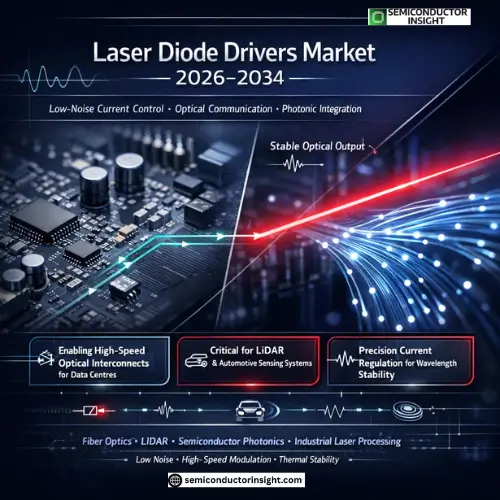
- High-speed optical interconnects for data centres
- LiDAR and automotive sensing platforms
- Optical storage and display technologies
- Industrial laser processing and micromachining
The increasing adoption of optical communication infrastructure is particularly significant, as high-bandwidth data transmission requires stable laser modulation with minimal signal noise.
To Stay Tuned with More meaningful and In-Depth Insights, Do Visit here:
https://semiconductorinsight.com/report/global-laser-diode-drivers-market/
Performance Engineering and Circuit Innovation
The competitive landscape of the laser diode drivers market is shaped by ongoing improvements in circuit architecture and power management design. Manufacturers are focusing on ultra-stable current control, reduced noise levels, and faster response times to support demanding optical applications.
Modern driver systems emphasize:
- Precision current regulation to prevent wavelength drift
- Thermal stability for continuous operation
- High-speed modulation capability for data transmission
- Protection features against overcurrent and voltage spikes
Such design enhancements improve system reliability while supporting high-performance photonic devices used in telecommunications and advanced sensing platforms.
Industrial and Commercial Deployment Landscape
The adoption of laser diode drivers extends across multiple industry verticals, reflecting the widespread use of laser technologies in modern infrastructure. Telecommunications remains the largest deployment area due to the increasing demand for fiber-optic connectivity and high-speed data transmission.
Industrial applications are also expanding rapidly. Laser processing technologies used for material cutting, engraving, and microfabrication require controlled optical output, which increases demand for high-precision driver circuits.
Additionally, medical technology applications continue to grow as laser systems are used in dermatology, diagnostics, and minimally invasive treatments. The growing preference for non-contact and high-precision procedures supports long-term market expansion.
Global Manufacturing and Supply Ecosystem
Production of laser diode drivers is concentrated in regions with strong semiconductor fabrication and analog integrated circuit design capabilities. Manufacturing clusters benefit from access to wafer fabrication facilities, calibration infrastructure, and specialized testing environments.
System architects and equipment manufacturers often drive purchasing decisions, highlighting the importance of application-specific customization rather than mass-market distribution channels.
This ecosystem creates high technical entry barriers, reinforcing the dominance of established semiconductor firms with strong research capabilities.
Competitive Technology Strategies
- Integration-focused development – embedding driver circuits within photonic modules to reduce system size and improve efficiency.
- Low-noise architecture optimization – enabling higher precision optical measurement systems.
- Energy-efficient power control systems – reducing heat generation and improving operational lifespan.
- Automotive-grade reliability design – supporting LiDAR and vehicle sensing technologies.
Emerging Applications Shaping Future Demand
Several technology trends are reshaping the long-term trajectory of the laser diode drivers market. The increasing adoption of autonomous vehicles is driving demand for LiDAR systems that require stable laser emission and high-speed modulation.
Data centre expansion is another major growth driver, as optical communication links replace traditional electrical interconnects to support higher bandwidth requirements. Meanwhile, quantum sensing and advanced photonics research continue to open new opportunities for precision optical control technologies.
Technical Challenges and System Limitations
Despite strong growth prospects, the market faces technical challenges related to system complexity and integration requirements. Achieving ultra-low noise levels and precise current control requires advanced circuit design and calibration processes.
Thermal management remains another key challenge, as laser performance is highly sensitive to temperature fluctuations. Additionally, integration with emerging photonic platforms requires compatibility with new semiconductor materials and fabrication processes.
These challenges continue to shape research and development priorities across the industry.
The laser diode drivers market is gaining strong momentum due to increasing demand for optical communication systems, precision sensing technologies, and semiconductor photonic integration. The expansion of digital infrastructure and high-speed data networks is expected to sustain long-term demand for advanced optical control solutions.
The growing convergence of electronics, optics, and semiconductor manufacturing positions laser diode drivers as a critical enabling technology in next-generation digital systems.
As industries transition toward optical data transmission and intelligent sensing platforms, the market is expected to remain a strategic focus area for semiconductor innovation and investment.

Comments (0)