
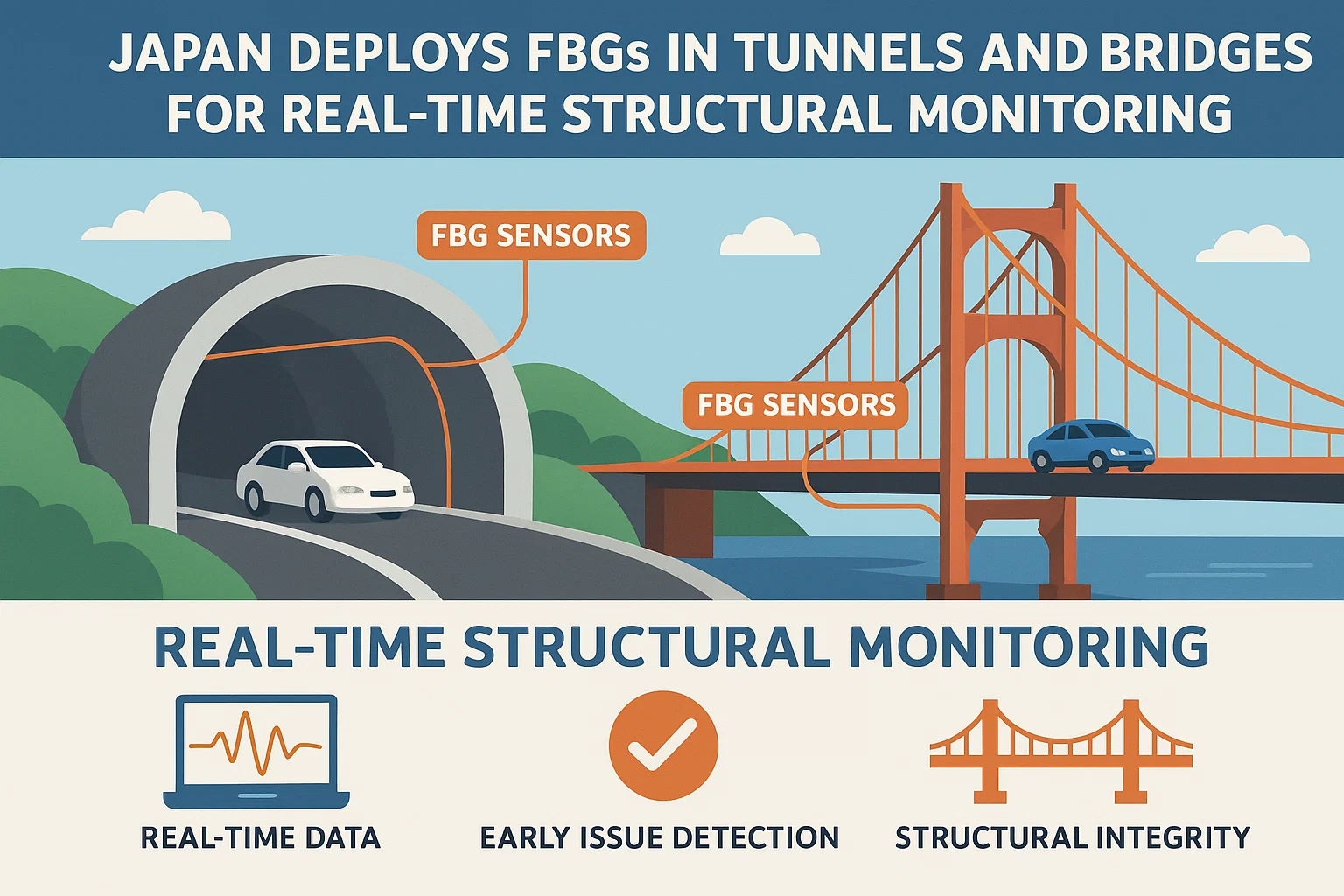
Japan Deploys FBGs in Tunnels and Bridges for Real-Time Structural Monitoring
In the sprawling landscape of photonic technology, Fiber Bragg Grating (FBG) reflectors may not always steal the spotlight, but they are certainly the quiet workhorses redefining innovation across multiple high-impact industries. From space missions to quantum communications and smart infrastructure, FBG reflectors are proving to be vital components in shaping a more connected, intelligent, and resilient future.
According to industry estimates, the FBG reflector market was valued at US$ 298 million in 2024 and is projected to reach US$ 512 million by 2032, growing at a healthy CAGR of 8.1% during the forecast period (2025-2032). This growth is not driven by market fluff but by real, tangible innovations and adoptions in some of the most demanding technological frontiers.
Access Your Free Sample Report- Fiber Bragg Grating Reflector Market
- Aerospace & Defense: Monitoring the Skies with Precision
One of the most significant breakthroughs for FBG technology is happening thousands of feet above the Earth. Major aerospace companies like Boeing and Airbus are integrating FBG-based sensors into the structural frameworks of next-generation aircraft.
Why?
- FBGs are immune to electromagnetic interference.
- They can operate across a wide temperature range and endure high levels of vibration.
- Their small size makes them ideal for embedding into composite materials.
In 2024, Aviation Week reported that Airbus collaborated with a European photonics startup to deploy FBGs across critical aircraft joints to monitor stress and fatigue in real time. This move is set to revolutionize predictive maintenance, allowing aircraft to self-report stress fractures or structural weaknesses before they become catastrophic.
Military Applications
The U.S. Department of Defense has also initiated trials for FBG sensors in stealth aircraft and missile systems, where traditional sensors fail due to harsh operational conditions. By enabling precise monitoring without signal corruption, FBGs are helping defense agencies move toward more autonomous and resilient weaponry and aircraft.
- Smart Infrastructure: Building Bridges That Think
Across Europe and Asia, smart infrastructure is no longer a futuristic ideal but a present-day imperative. Fiber Bragg Gratings are at the heart of this transformation.
Real-World Use Cases
- Japan: The Ministry of Land, Infrastructure, Transport and Tourism has deployed FBG sensors in bridges and tunnels to continuously monitor tensile stress, temperature, and vibration.
- Scandinavia: Engineers have embedded FBGs in concrete pylons and roadways, providing real-time data on load-bearing capacity and weather-induced structural shifts.
These FBG-empowered structures are designed to “feel” stress and degradation long before visible signs appear. Authorities can then initiate preventive maintenance, saving billions in emergency repairs and potential disaster recovery.
One flagship project in Norway uses FBG arrays across a suspension bridge in Oslo to detect micro-strain, stress concentration, and corrosion rate in metal joints. This has significantly extended the bridge’s operational life and set a blueprint for other smart city initiatives.
- Quantum Communications: Making the Invisible Work
The rise of quantum computing and communication has opened up new frontiers for FBG technology. As nations race to build secure quantum key distribution (QKD) networks, stable and precise signal filtration becomes essential.
Switzerland’s Photonic Breakthrough
In early 2025, researchers at ETH Zurich announced a major advancement in quantum photonic filtering using custom-fabricated FBG reflectors. These devices were able to reduce noise in photon transmission by over 20%, improving the fidelity of quantum data streams.
In China, which leads the world in QKD network implementation, FBGs are deployed in urban fiber networks to filter out undesired wavelengths and stabilize phase-encoded quantum bits. This is crucial because quantum information is incredibly fragile and can be disrupted by even the tiniest spectral noise.
As governments and institutions build out quantum networks, FBGs will become essential tools, ensuring not just speed, but security and fidelity.
Download Sample Report PDF- Fiber Bragg Grating Reflector Market
- Space Missions: Surviving the Final Frontier
Few environments are as punishing as space. High radiation, extreme temperatures, and zero maintenance make sensor reliability non-negotiable. This is where FBGs shine.
Artemis and Hera Missions
NASA’s Artemis program, aiming to return humans to the Moon, has incorporated radiation-hardened FBG arrays into various modules for monitoring:
- Thermal shifts
- Structural deformation
- Pressure variations
Similarly, the European Space Agency (ESA) is utilizing FBG technology in its Hera mission to measure impact responses from asteroids.
A key advantage is that FBGs don’t require electrical power at the sensing point, making them ideal for satellite and spacecraft instrumentation. The shift toward optical sensing in space is a game-changer for mission reliability and longevity.
- Healthcare: Sensing the Future of Medicine
FBG reflectors are making waves in the medical world, particularly in the field of minimally invasive diagnostics and surgeries.
Cardiology and Endoscopy
In early 2025, German researchers demonstrated a new generation of FBG-equipped catheters capable of detecting minute pressure changes in cardiovascular procedures. This allows surgeons to detect plaque build-up or vessel narrowing with unmatched precision.
Endoscopic tools, too, are being redesigned with embedded FBG sensors. These enable:
- Real-time feedback on tissue resistance
- Detection of micro-movements during delicate procedures
The result? Safer surgeries, quicker recoveries, and a massive reduction in surgical errors.
The integration of FBGs into wearable health devices is also being explored, particularly for elderly care. FBG sensors can be used to monitor:
- Respiration rate
- Joint movement
- Skin temperature
Driving Factors Behind FBG Reflector Growth
While innovation is the spark, several macro factors are adding fuel to the fire of FBG reflector market expansion:
- Digital Transformation of Infrastructure
Governments across the globe are pushing smart city and smart grid initiatives. Fiber Bragg Gratings are key to enabling real-time monitoring and self-diagnostic capabilities.
- Rising Need for Reliable Sensing in Harsh Environments
From aerospace to oil & gas, FBG sensors are preferred for their ability to survive conditions that destroy traditional electronics.
- Explosion in Optical Communication Demand
The push toward faster, more secure data transmission is making FBGs indispensable in next-gen communication systems, especially with the rollout of 6G and quantum internet protocols.
Click Here To Download Full Sample Report- Fiber Bragg Grating Reflector Market
Market Outlook (2025-2032)
The numbers speak for themselves. With a CAGR of 8.1%, the FBG reflector market is expected to surge from US$ 298 million in 2024 to US$ 512 million by 2032. The adoption curve suggests that we’re still in the early innings of a much broader technological revolution.
Regional Trends:
- North America: Aerospace and defense lead the charge.
- Europe: Focused on smart infrastructure and medical devices.
- Asia-Pacific: Dominated by communication technology and smart cities.
The convergence of these trends promises a robust future, not just in market size but in technological impact.
Fiber Bragg Grating reflectors are no longer niche components for labs and prototypes. They are mainstream enablers of innovation, deployed in critical infrastructure, advanced healthcare, deep space missions, and next-gen communication networks.
As industries continue to demand smarter, faster, and more resilient systems, FBG reflectors will quietly, yet powerfully, form the nervous system of our technologically advanced future.
The market is growing, yes. But more importantly, the mission-critical roles FBGs are playing are growing faster.

Comments (0)