
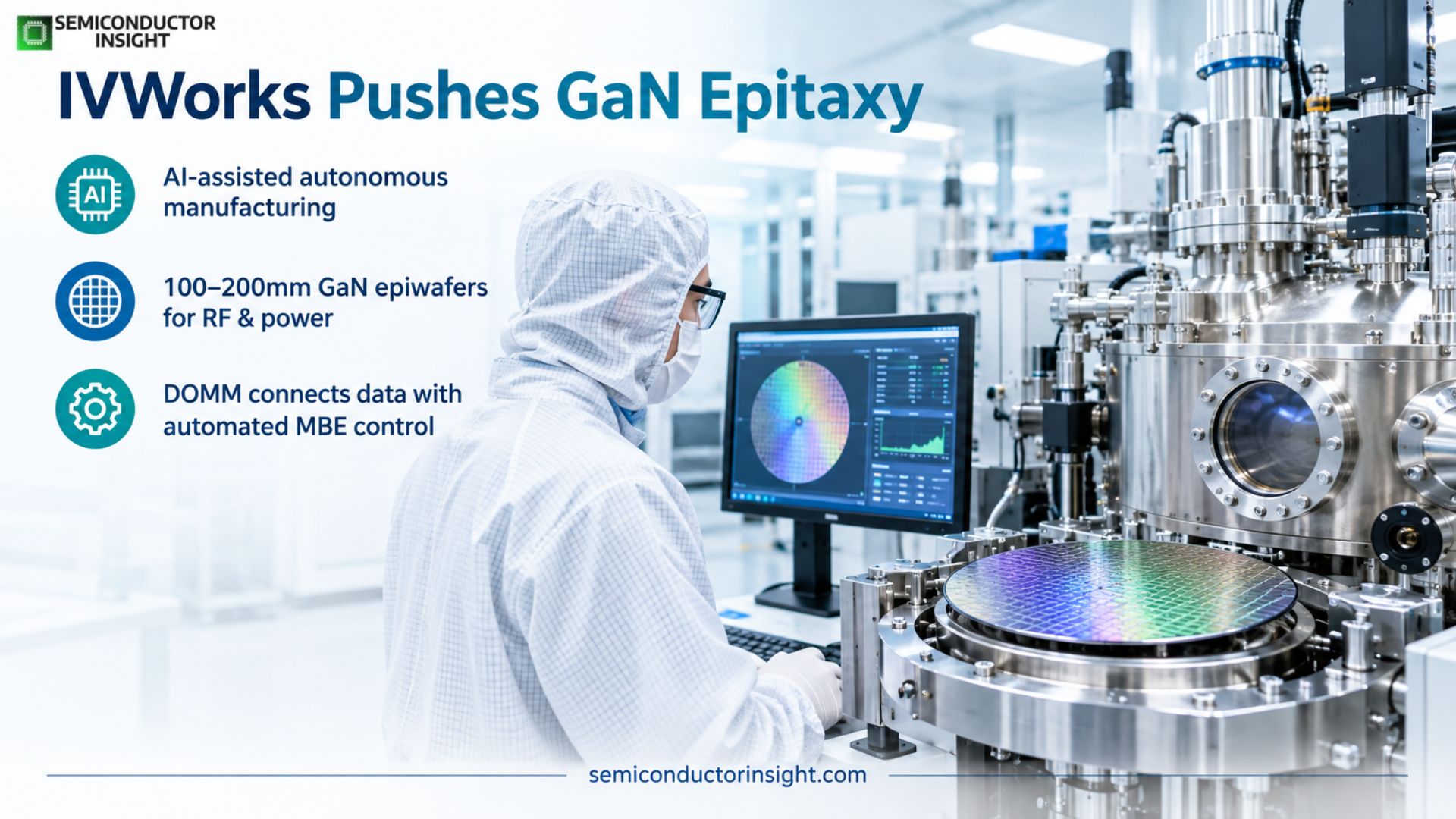
IVWorks Pushes GaN Epitaxy toward Autonomous Manufacturing With AI Upgrade
South Korea’s IVWorks is taking its gallium nitride (GaN) wafer manufacturing strategy into a more autonomous phase, using AI, production data and automated MBE controls to improve process stability, equipment uptime and manufacturing efficiency.
Daejeon-based IVWorks Co Ltd, which manufactures 100-200mm GaN epitaxial wafers for RF and power semiconductor applications, is upgrading its production model from rule-based automation toward AI-assisted autonomous manufacturing.
At the center of the initiative is DOMM, the company’s in-house AI-based smart-factory platform for compound semiconductor production. Developed progressively since 2019, the system is now deployed across IVWorks’ mass-production lines, where it combines process data with automated equipment control to reduce manual intervention.
330 Million Data Points Are Now Feeding the Production System
GaN epitaxy requires tightly controlled growth conditions, with relatively small changes in parameters such as temperature, pressure and surface conditions potentially affecting wafer quality.
To strengthen process visibility, IVWorks has been collecting reflection high-energy electron diffraction (RHEED) information from its molecular beam epitaxy (MBE) process alongside equipment time-series data since 2019.
The resulting manufacturing dataset has now grown to:
- 330+ million time-series data points
- More than 30TB of RHEED data
- Data accumulated continuously since 2019
- Deployment across all mass-production lines
This data is not being retained simply for historical analysis. IVWorks is using it directly within its production environment, allowing AI models to evaluate growth conditions, identify abnormal behavior and support real-time manufacturing decisions.
IVWorks has built its manufacturing architecture around two complementary systems.
DOMM analyzes RHEED measurements and equipment data to determine the state of the epitaxial growth process, while MRA (MBE Run Automation) handles the physical execution of production activities.
MRA automates the sequence from wafer loading and epitaxial growth through unloading, while AI provides the analytical layer needed to interpret what is happening during the process.
This separation is significant because it moves the factory away from a simple “automate the procedure” model.
Instead, the emerging architecture is closer to:
Sense → Analyze → Decide → Execute → Learn
That approach could become increasingly important for compound semiconductor manufacturers dealing with complex, highly sensitive production environments.
Uptime Target Moves From 84% Toward 89%
IVWorks has established measurable operational targets for the upgrade.
The company aims to increase equipment uptime from approximately 84% to 89%, while also reducing staffing requirements from around two operators per machine to 1.5 operators.
Those improvements could become particularly valuable as GaN adoption expands across applications requiring high-frequency, high-power and high-efficiency semiconductor performance.
Why This Matters for the Global GaN Ecosystem?
- GaN epitaxial wafers are an important upstream material for several emerging semiconductor applications, including 5G and 6G communications, AESA radar and optical interconnects.
As demand for GaN-based RF and power devices develops, wafer manufacturers face simultaneous pressure to deliver:
Higher consistency | Higher throughput | Better yield | Competitive costs | Reliable delivery
- AI-enabled epitaxy could help address these requirements by turning large volumes of process information into actionable manufacturing intelligence.
- IVWorks has also been selected to participate in a South Korean Ministry of SMEs and Startups program focused on AI-specialized smart factories, providing another pathway for the company to expand AI-based automation across its production environment.
The bigger takeaway: GaN manufacturing is moving toward a model where AI does more than monitor the fab. It increasingly helps decide what happens next.
Your Gateway to the Latest Research and Insights: https://semiconductorinsight.com/report/algainp-epitaxial-wafers-market/

Comments (0)