

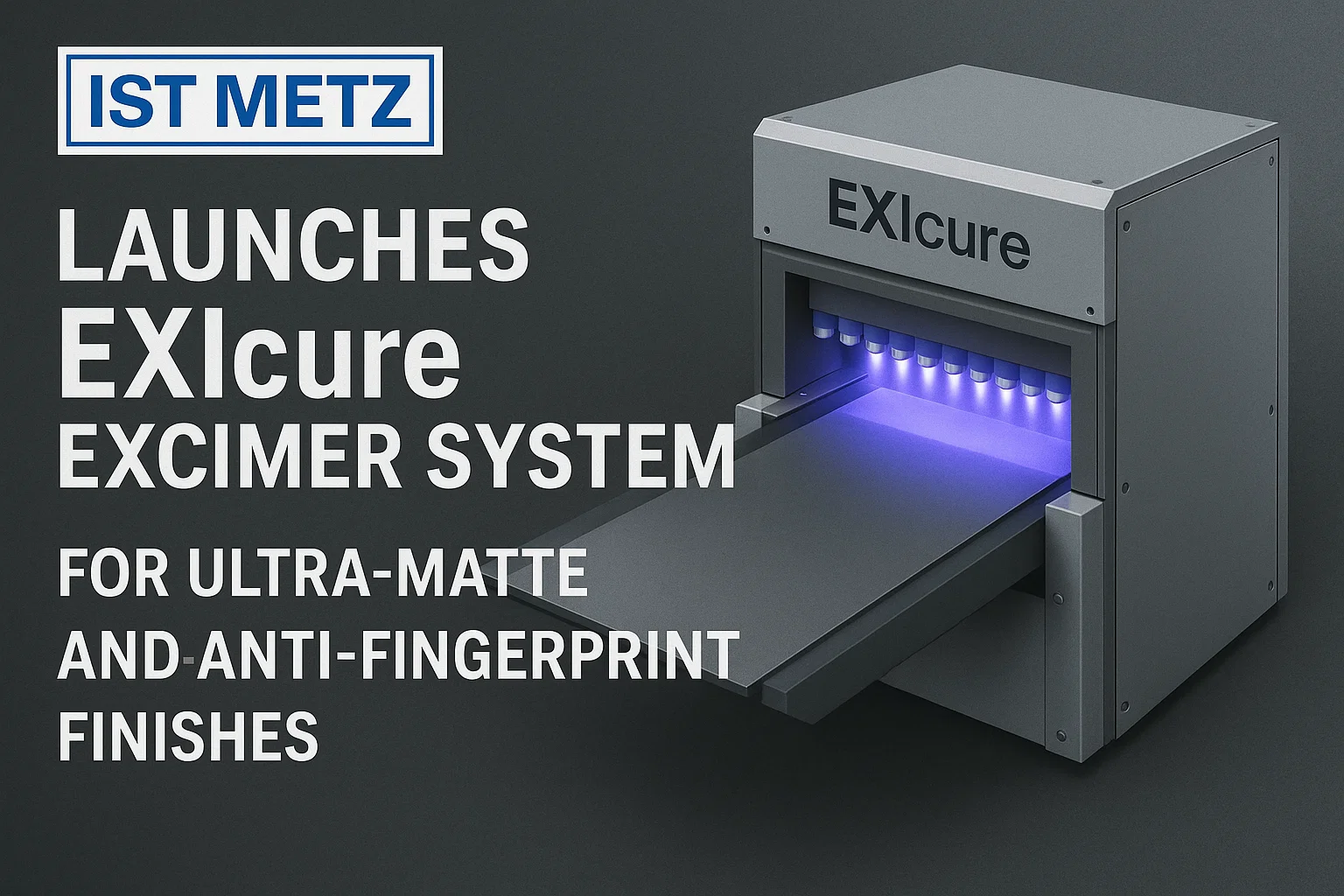
IST Metz Launches EXIcure Excimer System for Ultra-Matte and Anti-Fingerprint Finishes
The ultraviolet (UV) and vacuum ultraviolet (VUV) spectrum has long fascinated scientists, engineers, and industrial innovators for its unique ability to drive chemical reactions, alter surfaces, and sterilize environments without traditional chemical agents. Among the most promising technologies in this spectrum is the 172 nm excimer lamp, a mercury-free light source that emits powerful vacuum UV radiation.
In recent years, 172 nm excimer lamps have been attracting attention in industries ranging from semiconductor manufacturing and healthcare to water treatment and advanced materials engineering. Recent breakthroughs by leading players like Ushio Inc. and IST Metz have highlighted new applications and pushed the technology closer to widespread adoption.
The market reflects this momentum. Valued at USD 240 million in 2024, the 172 nm excimer lamp market is projected to nearly double, reaching USD 458 million by 2032, at an impressive CAGR of 8.9%. This growth is being fueled by global demand for sustainable surface treatment, stricter environmental regulations, and new opportunities in both industrial processing and environmental protection.
Access Your Free Sample Report- 172 nm Excimer Lamp Market
Understanding 172 nm Excimer Lamp Technology
Before diving into recent advancements, it is important to understand the fundamentals of excimer lamps.
- Excimer Lamps Defined: An excimer lamp is a gas-discharge device that emits UV or VUV light when rare gases (like xenon) or halogens form short-lived excited dimers (“excimers”).
- 172 nm Wavelength: The 172 nm emission from xenon excimer lamps falls into the vacuum ultraviolet region. This energy level is particularly effective at breaking strong chemical bonds, such as carbon-fluorine (C–F) and carbon-carbon double bonds (C=C).
- Advantages Over Alternatives:
- Mercury-free (environmentally compliant with Minamata Convention regulations).
- Instant-on/off with no warm-up required.
- Ability to generate reactive oxygen species and radicals, aiding advanced oxidation processes.
- Low heat load, making it suitable for delicate materials.
This unique combination of features makes 172 nm excimer lamps a preferred choice in emerging sectors such as PFAS decomposition, surface cleaning, microelectronics, and biomedical engineering.
Recent Developments in the 172 nm Excimer Lamp Industry
1. Ushio’s Breakthrough in PFAS Decomposition
In January 2025, Ushio Inc., a global leader in specialty lighting, announced a major breakthrough in using 172 nm excimer lamps to decompose PFAS (per- and polyfluoroalkyl substances) often called “forever chemicals.” PFAS are notoriously persistent and resistant to degradation due to the strength of the C–F bond.
- How It Works:
Ushio’s process combines 172 nm excimer irradiation with OH radicals and hydrated electrons, achieving a powerful decomposition effect. - Performance:
Laboratory tests demonstrated 99% decomposition rates for PFOS and PFOA in mg/L concentrations. - Benefits:
- No catalysts required.
- No chemical additives needed.
- Operates at ambient temperature and pressure.
- Commercial Outlook:
Ushio plans to conduct verification testing in FY2025, with the aim of commercial deployment by 2027.
This development has massive implications for environmental technology markets, especially in water purification, as regulators worldwide tighten controls on PFAS contamination.
2. Surface Treatment of PTFE Using 172 nm Excimer Lamps
Another exciting breakthrough by Ushio involves the surface modification of PTFE (polytetrafluoroethylene), commonly known as Teflon.
- Challenge: PTFE is chemically inert, non-adhesive, and hydrophobic, making it difficult to bond or coat.
- Solution: Exposing PTFE to 172 nm excimer light in the presence of ethanol vapor breaks down C–F bonds and introduces hydrophilic groups.
- Results:
- The water contact angle dropped from 115° to 52° in just 2 minutes, drastically improving wettability.
- Enhanced adhesion properties enable PTFE to be used in more demanding industrial and biomedical applications.
This innovation opens new opportunities in medical devices, automotive engineering, and electronics, where PTFE’s unique properties are valuable but traditionally hard to exploit.
3. IST Metz’s EXIcure Technology for Industrial Surface Finishing
IST Metz, a German UV system specialist, has been pioneering excimer lamp-based surface treatment systems. Its EXIcure technology leverages 172 nm excimer lamps for mattification and texturing of surfaces.
- Applications:
- Produces ultra-matte finishes (gloss <5).
- Creates anti-fingerprint and soft-touch coatings.
- Enables surface functionalization without adding chemical matting agents.
- Scale:
The system can handle working widths up to 4 meters, making it suitable for flooring, furniture, and decorative panels.
This represents a paradigm shift in the coatings industry, replacing traditional mechanical or chemical processes with a cleaner, more consistent light-based approach.
Download Sample Report PDF- 172 nm Excimer Lamp Market
4. Expansion of Excimer Lamp Facilities in Arizona
In June 2025, Ushio announced the opening of a new branch in Chandler, Arizona, strengthening its presence in North America.
- Focus:
The site will support the marketing, sales, and technical development of excimer lamp-based exposure systems, especially for semiconductor lithography and advanced manufacturing. - Implications:
This strategic move positions Ushio closer to the U.S. semiconductor hub, supporting the industry’s shift toward domestic chip manufacturing and aligning with initiatives like the CHIPS and Science Act.
5. Excimer Irradiation Units for Adhesion and Cleaning
At SEMICON West 2025, Ushio unveiled an excimer irradiation unit that uses 172 nm lamps with radicals for organic cleaning and surface reformulation.
- Features:
- Removes organic residues.
- Improves adhesion of coatings and adhesives.
- Does not roughen delicate substrates.
- Target Sectors:
Semiconductor wafer processing, display manufacturing, and optics.
This represents a move toward turnkey excimer-based systems, not just standalone lamps, indicating a maturing ecosystem.
Market Outlook and Forecast
The strong momentum in research and commercial deployment is mirrored in the market’s growth trajectory.
- Market Size:
- 2024: USD 240 million
- 2032: USD 458 million
- CAGR: 9% (2024–2032)
Key Growth Drivers:
- Environmental Regulations
- Ban on mercury lamps drives demand for mercury-free excimer alternatives.
- Regulations targeting PFAS, VOCs, and greenhouse gases create new applications.
- Semiconductor Industry
- The need for precise, damage-free cleaning and surface activation in lithography processes.
- S. and Asian semiconductor expansion projects.
- Healthcare & Biomedical Applications
- Sterilization, surface modification for implants, and biocompatibility improvements.
- Advanced Materials & Manufacturing
- Surface activation of plastics, composites, and polymers.
- Mattification and decorative coatings for consumer products.
Regional Insights
- North America:
Growth supported by semiconductor manufacturing investments and environmental initiatives. - Europe:
Home to key players like IST Metz; strong focus on sustainable surface finishing. - Asia-Pacific:
Largest manufacturing base; rapid adoption in electronics, displays, and water treatment. - Middle East & Latin America:
Emerging adoption in industrial processing and environmental remediation.
Challenges Facing the Industry
Despite exciting progress, some challenges remain:
- Short Penetration Depth
- 172 nm radiation only affects the top few nanometers of a material’s surface.
- Deeper curing requires complementary methods.
- Ozone Generation
- Strong absorption by oxygen produces ozone, which can be both beneficial (oxidizing agent) and problematic (requires ventilation).
- System Costs
- Excimer lamps are more expensive than conventional UV lamps, though costs are falling as adoption increases.
- Lamp Lifespan and Maintenance
- Operational lifetimes need to improve further for continuous industrial applications.
Click Here To Download Full Sample Report- 172 nm Excimer Lamp Market
Future Directions and Opportunities
Looking ahead, the 172 nm excimer lamp market is poised for further innovation and broader adoption. Key opportunities include:
- Water and Air Purification: PFAS decomposition, VOC removal, pathogen sterilization.
- Next-Gen Electronics: Surface treatment of flexible electronics, displays, and printed circuit boards.
- Green Manufacturing: Mercury-free and chemical-free processing.
- Medical Engineering: Biocompatible implants, sterilization of surgical tools, and microfluidic devices.
- Nanotechnology: Ultra-precise surface modification for sensors and microdevices.
With the market expected to nearly double in size by 2032, and with global focus on sustainability, semiconductor innovation, and healthcare applications, the excimer lamp is no longer a niche technology it is becoming a mainstream enabler of the next industrial revolution in clean and precise processing.

Comments (0)