
IoT Wireless Communication Chip Market Growth Accelerates with Smart Industry and Edge Connectivity Demand
Most people never see the chip that connects their smartwatch to their phone, or the tiny module inside a smart meter that quietly reports energy usage every hour. Yet these small pieces of silicon are doing some of the most important work in the modern economy keeping billions of devices linked, responsive, and intelligent.
That is exactly where the IoT wireless communication chip market comes in.
IoT Wireless Communication Chip Market is not just about faster networks. It is about creating reliable, low-power, cost-efficient connectivity for everything from industrial robots and medical wearable to smart agriculture systems and connected cars. As the world builds more things that communicate, the semiconductor demand behind those connections is rising sharply.
Market Definition: What IoT Wireless Communication Chips Actually Do
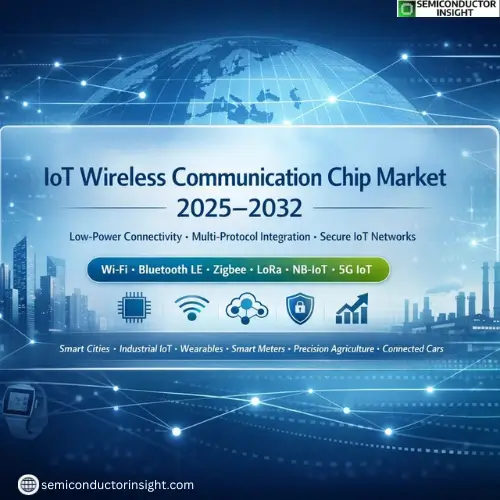
IoT wireless communication chips are semiconductor components that enable devices to send and receive data without physical wiring. They support connectivity standards such as Wi-Fi, Bluetooth, Zigbee, LoRa, NB-IoT, and increasingly, 5G-based IoT solutions.
These chips are designed differently from traditional smartphone processors because IoT devices often require:
- Ultra-low power consumption
- Compact integration for small hardware footprints
- Long operational life in remote environments
- Secure communication protocols
In short, these chips serve as the digital voice of connected devices, allowing machines and sensors to interact continuously across networks.
Why This Market Is Expanding So Quickly?
The growth of the IoT wireless communication chip market is directly tied to how industries are digitizing operations. Connectivity is no longer a premium feature it is becoming standard infrastructure.
Smart factories rely on wireless sensors for predictive maintenance. Cities are deploying connected lighting and traffic systems. Healthcare providers are using remote monitoring devices. Even everyday appliances are being redesigned as connected platforms.
The market is gaining momentum because IoT is shifting from experimentation to large-scale deployment, and every deployment requires chips that can deliver stable connectivity at low cost.
The number of connected IoT devices worldwide is climbing steadily, and each one adds to semiconductor demand.
Key Technology Shifts Reshaping Chip Development
One of the most important trends in this market is the move toward multi-protocol and highly integrated chipsets. Instead of using separate components for Wi-Fi, Bluetooth, and security, manufacturers are building unified platforms.
Modern IoT communication chips increasingly combine:
- RF front-end modules
- Microcontrollers for edge processing
- Power management systems
- Embedded cyber security functions
This integration reduces device size, improves battery life, and simplifies manufacturing critical advantages in high-volume IoT markets.
Low-Power Networking Becomes a Competitive Battleground
Many IoT devices, in contrast to consumer electronics, need to run for years without regularly changing their batteries. This has made low-power connectivity one of the most important design priorities.
LPWAN technologies such as LoRa and NB-IoT are expanding because they enable long-range communication with minimal energy use. At the same time, Wi-Fi 6 and Bluetooth Low Energy are evolving to serve higher-performance smart home and wearable applications.
Chipmakers that can deliver both power efficiency and strong signal reliability are gaining an edge in this competitive landscape.
Industrial IoT Demand Driving Higher-Value Applications
While consumer IoT products generate volume, industrial IoT generates long-term value. Industrial deployments require chips that meet higher standards for durability, security, and performance.
Major industrial demand areas include:
- Smart manufacturing automation
- Connected logistics and asset tracking
- Energy grid monitoring
- Oil and gas remote sensing
- Precision agriculture systems
These environments often involve harsh conditions, which means wireless chips must be engineered for stability and long lifecycle support.
Security and Regulation Are Becoming Central Market Themes
As more critical systems become connected, cybersecurity is no longer optional. IoT wireless communication chips are increasingly expected to include built-in protection features such as encryption engines, secure boot, and authentication support.
Regulators and industry frameworks are also tightening around device security, especially for healthcare and smart infrastructure deployments.
This is pushing the market toward security-by-design semiconductor development, where connectivity chips must deliver both communication and protection in one package.
At Last before Moving Ahead, Don’t Forget to Browse Our Recent Exclusive Report for Detailed Insights:
https://semiconductorinsight.com/report/iot-wireless-communication-chip-market/
Global Supply Chain and Trade Considerations
The IoT wireless chip ecosystem is deeply global, involving wafer fabrication, module assembly, and OEM device production across multiple regions.
Asia-Pacific remains a major manufacturing hub, while North America and Europe continue to lead in advanced wireless IP development and industrial IoT adoption.
Supply chain disruptions in recent years have encouraged companies to rethink sourcing strategies, diversify manufacturing partners, and invest in localized semiconductor ecosystems.
Trade dynamics and semiconductor policy initiatives are expected to influence where future IoT chip capacity is built.

Comments (0)