
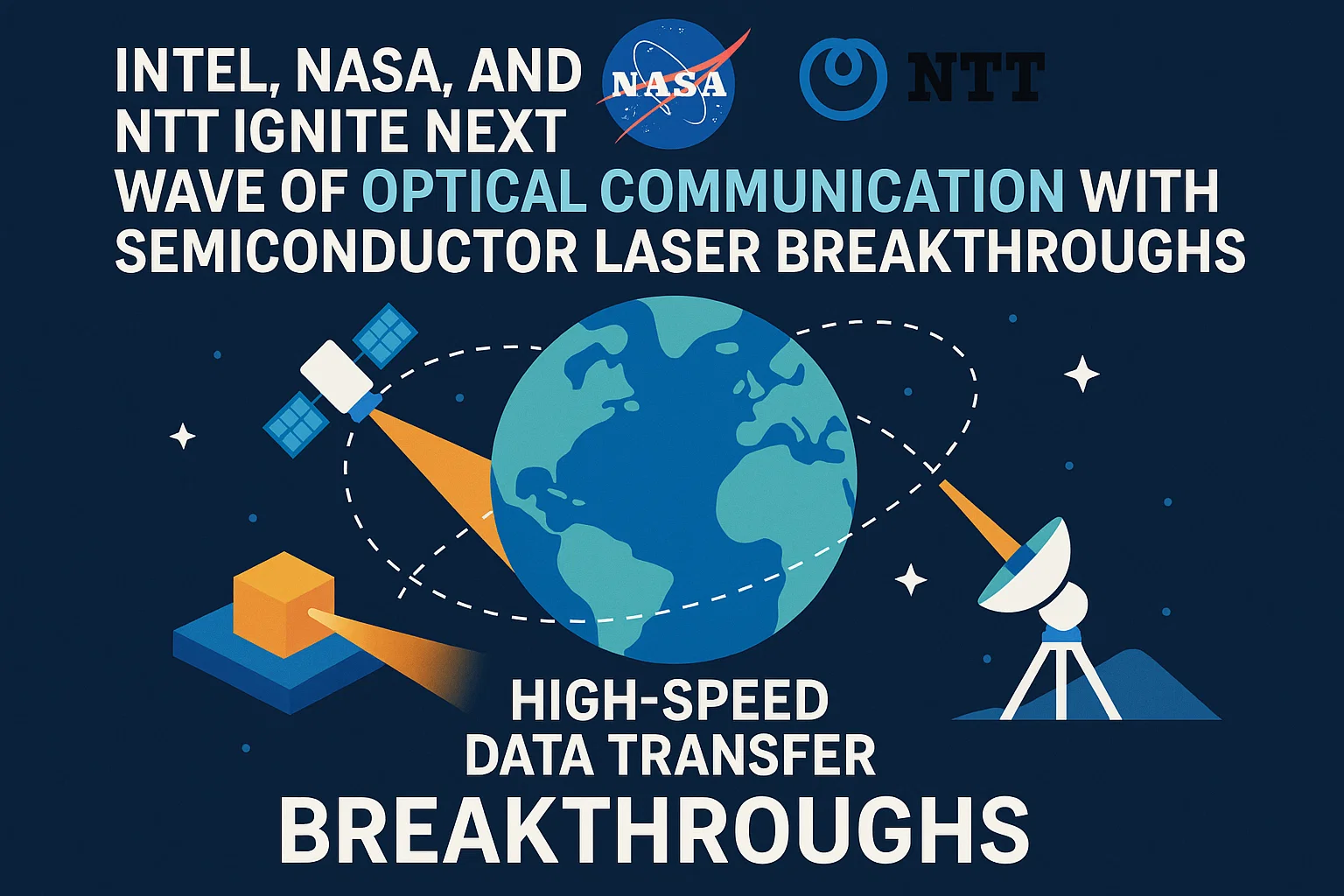
Intel, NASA, and NTT Ignite Next Wave of Optical Communication with Semiconductor Laser Breakthroughs
In the ever-accelerating digital age, the demand for faster, more efficient, and scalable data transmission continues to surge. At the heart of this transformation lies a crucial technology: semiconductor lasers for optical communications. These tiny yet powerful devices form the backbone of high-speed fiber-optic networks, enabling everything from real-time video streaming to the growth of AI-driven data centers.
As of 2024, the global semiconductor laser market for optical communications is valued at US$ 4,730 million, with forecasts predicting a robust growth to US$ 8,940 million by 2032, driven by a CAGR of 9.3% during the 2025–2032 period. This blog explores the recent technological breakthroughs, industry updates, and market insights shaping the future of this pivotal sector.
Access Your Free Sample Report- Semiconductor Lasers for Optical Communications Market
The Backbone of Data: Understanding Semiconductor Lasers in Optical Communications
Semiconductor lasers, or laser diodes, are integral to optical communication systems. Operating by emitting coherent light through electron-hole recombination in a semiconductor material, they form the light source in fiber-optic communication systems. With their compact size, high modulation speed, and low power consumption, they are ideal for:
- Long-haul fiber optic transmission
- Data center interconnects
- Metro and access networks
- Consumer electronics and emerging edge devices
Modern optical networks are migrating to wavelength-division multiplexing (WDM) and photonic integrated circuits (PICs), both of which require stable, tunable, and efficient lasers. Let’s explore how the top players are responding with innovation.
Intel and Broadcom Lead with Co-Packaged Optics (CPO)
In May 2025, Intel and Broadcom made headlines with their demonstration of next-generation co-packaged optics (CPO)—a game-changing integration of semiconductor lasers directly onto ASICs (Application-Specific Integrated Circuits).
Key Highlights:
- Integration Efficiency: Lasers are mounted directly onto the same substrate as switching chips, reducing electrical interconnect lengths.
- Power Savings: CPO can slash power consumption by up to 30%, a critical advancement given the heat limitations of modern data centers.
- Latency Reduction: By eliminating discrete optical transceivers, signal latency is significantly minimized.
Industry Impact:
This innovation is expected to revolutionize data center architectures. As AI workloads and cloud computing demand massive bandwidth, CPOs offer the scalability and performance needed to keep up. Intel’s adoption of silicon photonics in this framework also enhances compatibility with existing CMOS fabrication techniques.
NASA’s Quantum Leap: Semiconductor Lasers in Deep-Space Optical Communications
NASA is no stranger to cutting-edge technology, and its Deep Space Optical Communications (DSOC) project just got a major boost through the use of quantum-dot-based semiconductor lasers.
What’s New:
- Quantum-Dot Technology: Unlike traditional bulk semiconductor lasers, quantum-dot lasers offer superior temperature stability, lower threshold currents, and narrower linewidths.
- Deep-Space Viability: These lasers can maintain beam quality and coherence over astronomical distances.
- Higher Data Rates: DSOC aims to increase downlink data rates by 10 to 100 times compared to traditional RF systems.
Potential Commercial Spinoffs:
As satellite-based internet (like Starlink or Amazon’s Kuiper) continues to grow, technologies developed for space can trickle down to commercial satellite communication systems. We may see quantum-dot lasers in future LEO satellite constellations or global broadband infrastructure.
Download Sample Report PDF- Semiconductor Lasers for Optical Communications Market
NTT’s Ultrafast Laser-Powered Optical Switches
Japan’s telecom behemoth NTT (Nippon Telegraph and Telephone) is pioneering ultrafast semiconductor laser-based switching technology for next-generation networking.
Breakthroughs:
- Mode-Locked Semiconductor Lasers: These enable the generation of optical frequency combs—precisely spaced laser lines suitable for WDM applications.
- Photonic Integrated Circuits (PICs): NTT has embedded these lasers into PICs, allowing sub-picosecond switching speeds.
- Use Cases: High-frequency trading, AI data processing, and edge computing networks.
Why This Matters:
Reducing latency in optical switching has immense value for real-time applications like algorithmic trading, autonomous vehicles, and AR/VR systems. NTT’s innovation strengthens the trend toward all-optical networking, minimizing electronic bottlenecks.
Google Cloud Embraces Silicon Photonics for Scalable AI Interconnects
While not exclusively about lasers, Google Cloud’s recent deployment of silicon photonic interconnects deserves mention. At its 2025 I/O event, Google revealed a plan to migrate its data center infrastructure toward optical-based TPU interlinks, which utilize laser-based PICs.
Details:
- Photonics + AI: Each optical module integrates semiconductor lasers with photodetectors and multiplexers.
- Bandwidth Leap: Enables intra-rack communication at speeds exceeding 2 Tbps, crucial for AI training.
- Energy Efficiency: Silicon photonics reduces energy per bit compared to copper interconnects.
Strategic Implication:
This move confirms a growing trend: Big Tech is all-in on optics. With AI training models ballooning in size, optical laser solutions offer a sustainable path forward in both speed and power consumption.
Market Size & Future Growth (2025-2032)
The combination of technological innovation and rising demand is creating a fertile ground for growth.
Key Metrics:
- 2024 Valuation: US$ 4,730 million
- 2032 Projection: US$ 8,940 million
- CAGR (2025–2032):3%
Drivers of Growth:
- 5G and Beyond: Higher data requirements for mobile and IoT networks.
- AI & Machine Learning: Massive data throughput needs in model training.
- Edge Computing: Low-latency and high-bandwidth solutions.
- Government and Defense: Secure, high-speed communication systems.
Regional Insights:
- North America: Dominated by hyperscalers like Amazon, Meta, and Google.
- Asia-Pacific: Driven by investments from China, Japan, and South Korea in photonics.
- Europe: Focused on research-intensive initiatives, especially around quantum communications.
Emerging Technologies to Watch
Several upcoming innovations are poised to shape the next generation of semiconductor lasers:
a. Hybrid Lasers (III-V on Silicon):
Combining high-performance III-V materials with silicon platforms is unlocking higher integration at lower costs.
b. VCSEL Arrays:
Vertical-Cavity Surface-Emitting Lasers (VCSELs) are becoming common in short-reach data applications and 3D sensing.
c. Quantum Cascade Lasers:
These offer potential in the mid-infrared region for specialized military and environmental monitoring communications.
d. AI-Optimized Laser Control:
Machine learning models are being trained to optimize laser tuning and stability in real-time.
Click Here To Download Full Sample Report- Semiconductor Lasers for Optical Communications Market
Lighting the Way Forward
From deep-space missions to the guts of hyperscale data centers, semiconductor lasers for optical communications are no longer a niche technology—they are a linchpin of global connectivity. The strides made by industry leaders like Intel, Broadcom, NTT, NASA, and Google underscore a clear direction: integrated, scalable, and high-performance laser systems are essential for the next digital frontier.
With a strong CAGR of 9.3% projected through 2032 and innovations arriving at a breakneck pace, this sector offers both technological fascination and substantial investment opportunities.
As the global demand for data continues to surge, one thing is certain: the future will be bright—and powered by light.

Comments (0)