
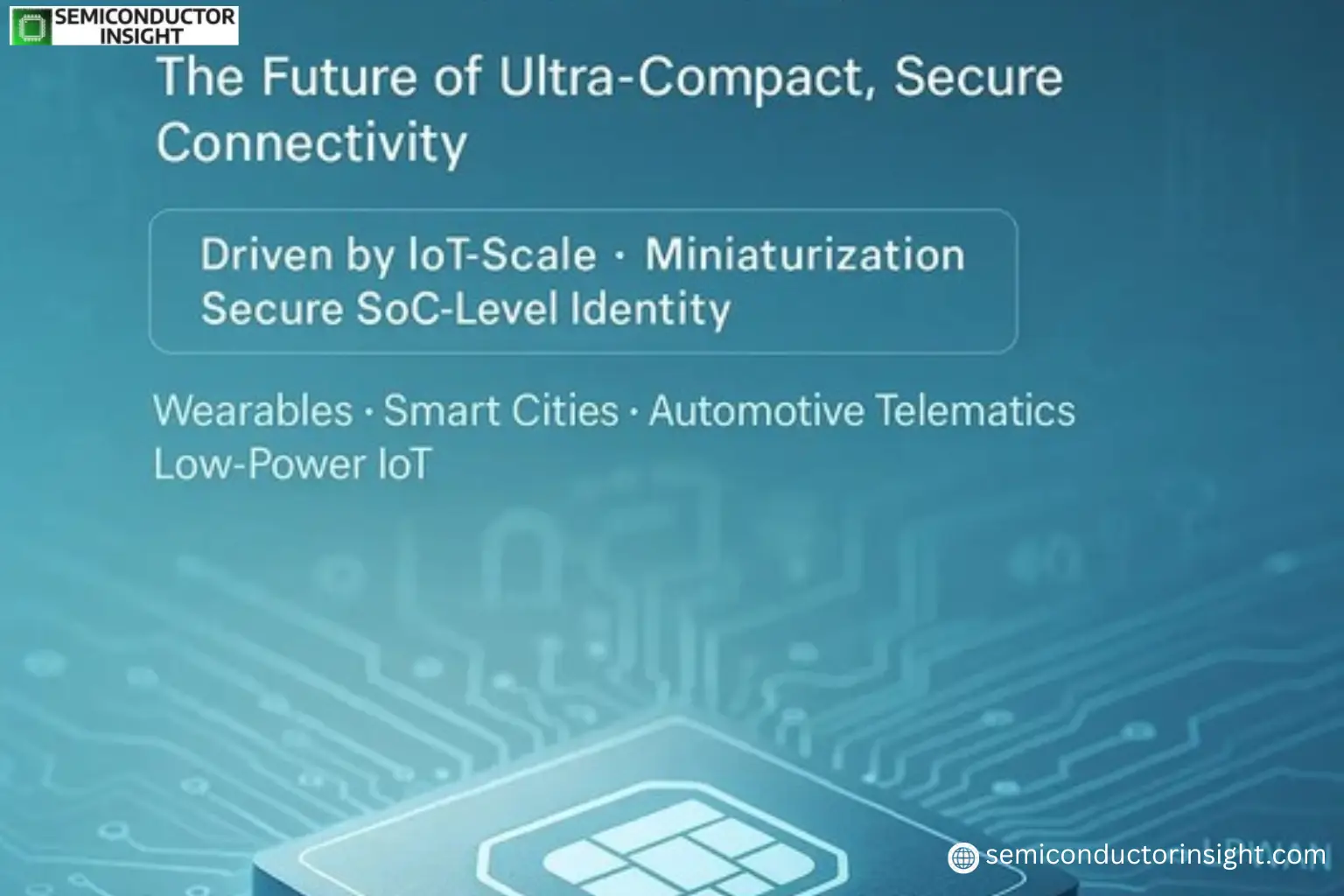
Integrated SIM (iSIM) Market: The Next Silent Revolution Powering Connected Devices
Integrated SIM (iSIM) Market is rapidly shifting from a niche innovation to a core enabler of secure, energy-efficient, and ultra-compact connectivity across consumer electronics, automotive, and industrial IoT ecosystems.
A New Era of Connectivity Begins
As devices get smaller, faster, and more interconnected, the traditional SIM card once the identity backbone of mobile networks has reached its evolutionary limit. Enter Integrated SIM (iSIM), a breakthrough that embeds SIM functionality directly into the device’s main system-on-chip (SoC).
This shift isn’t just a hardware upgrade it’s a structural leap that simplifies manufacturing, reduces power consumption, and enhances security. And in markets where millions of sensors, wearable, and edge devices are deployed, these advantages are no longer optional. They are essential.
What’s driving the Rapid Growth of the iSIM Market?
- Ultra-Miniaturization is now a Mandate, Not a Trend
iSIM eliminates separate SIM components entirely, giving manufacturers more board space for sensors, added battery capacity, or slimmer industrial design.
Example: Next-gen smart watches and health bands are pivoting to iSIM to stay compact while supporting 4G/5G connectivity.
- Telcos & OEMs Want Low-Cost, High-Scale Deployment
iSIM reduces assembly steps and cuts logistics costs tied to physical SIM cards. For telecom operators rolling out mass IoT networks, this is a game-changer.
Industry instance: Smart utility meters deployed in Europe are increasingly using iSIM to streamline provisioning across millions of units.
- Embedded Security That Meets Global Certification Standards
With the SIM inside the SoC, the secure element gains deeper hardware isolation and tamper-resistant behavior.
Manufacturers highlight that iSIM supports GSMA eSIM + remote provisioning standards, ensuring global interoperability with zero physical access.
- Better Battery Efficiency for Always-On IoT
Power savings of up to 25 to30% in always-connected devices have positioned iSIM as the preferred choice for applications like:
- Asset trackers
- Environmental monitoring nodes
- Logistics tags
- Smart agriculture sensors
For IoT fleets deployed in the field for years, these savings directly translate into lower replacement cycles and operational costs.
You Can Go Through Our Detailed Insights: https://semiconductorinsight.com/report/integrated-sim-isim-market/
Where is iSIM making the Biggest Impact?
- Consumer Electronics
Smart watches, kids’ trackers, hear ables, and AR glasses are adopting iSIM to meet design and battery constraints without compromising connectivity.
- Automotive & Mobility
EVs, telematics units, and predictive-maintenance modules use iSIM for secure, continuous data flow critical for OTA updates and vehicle-to-cloud communication.
- Industrial IoT & Smart Cities
iSIM enables seamless, remotely managed connectivity across smart streetlights, meters, infrastructure monitoring devices, and automation equipment.
- Healthcare & Medical Devices
Portable diagnostics, remote patient monitoring gear, and emergency alert devices need compact and tamper-proof connectivity an ideal iSIM use case.
Market Challenges: The Other Side of the Story
Even with soaring adoption, the market faces a few structural barriers:
- Dependence on SoC manufacturers: Only leading chip vendors have the scale to embed iSIM at production level.
- Certification delays: iSIM’s integrated nature demands more extensive security testing.
- Telco readiness gaps: Not all global carriers have fully optimized infrastructure for mass iSIM adoption.
These challenges are transitional and expected to ease as ecosystem alignment improves.
Upcoming Opportunities: iSIM will be present everywhere, even in places you don’t see it.
By 2030, analysts expect iSIM to become the default connectivity identity for most IoT devices worldwide. Its seamless provisioning, strong security, and cost efficiency fit perfectly with the rising demand for autonomous connected systems.
In simpler words: iSIM is not just replacing SIM cards it’s redefining how devices join the global digital network.

Comments (0)