
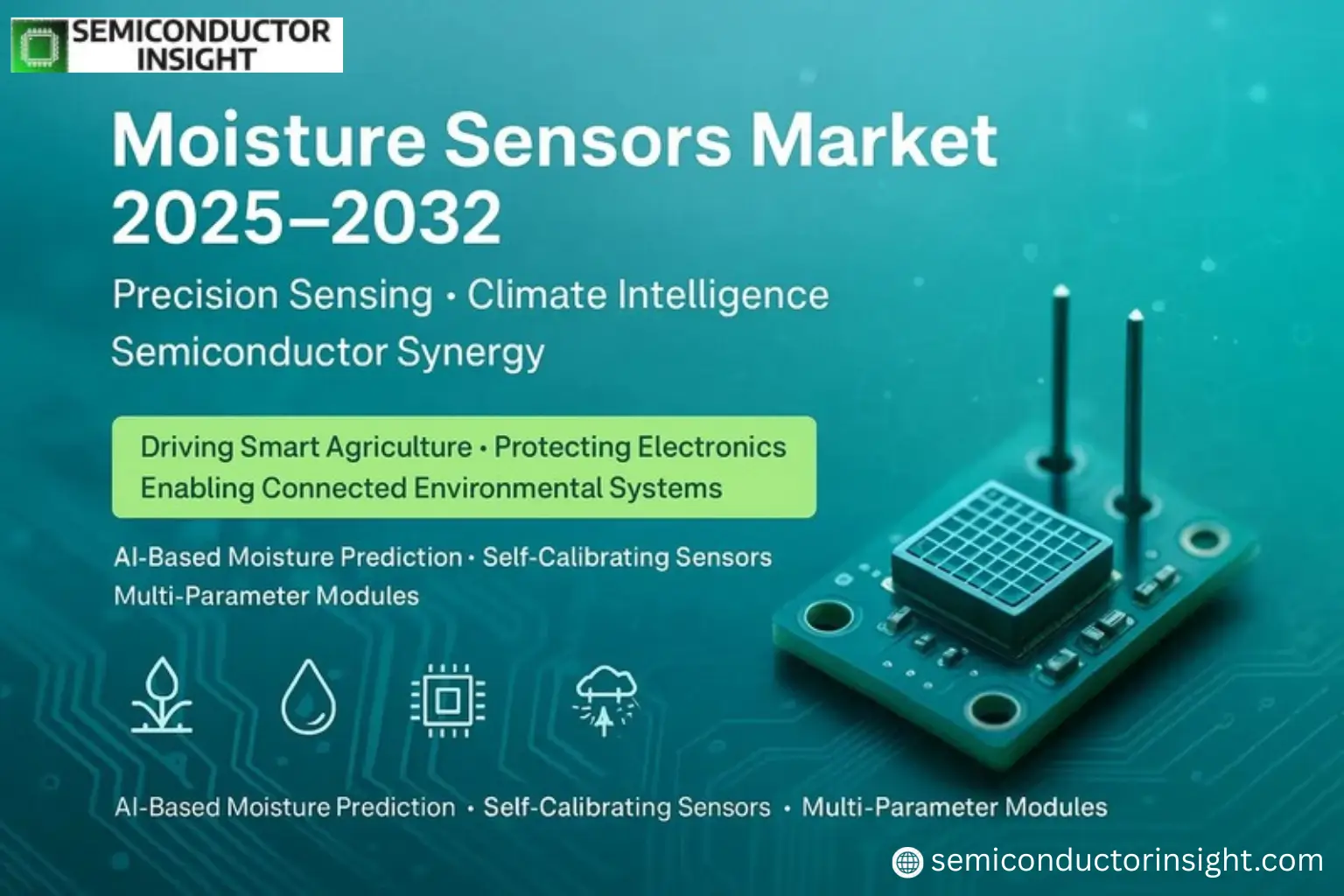
Inside the Moisture Sensors Market: Where Precision Meets Smart Monitoring
Moisture may be invisible, but in the world of semiconductors, agriculture, pharmaceuticals, and electronics, it is one of the most disruptive elements. In the same way, Moisture Sensors Market sits right at this intersection making sure machines stay efficient, crops stay healthy, food stays safe, and electronics stay protected.
Today, as industries digitize and environmental variables become harder to predict, moisture sensing is no longer a supporting tool it’s becoming a critical system input.
This blog unwraps the evolving ecosystem of moisture-sensing technologies, the intelligence behind modern sensors, and the market’s shift toward connected, self-calibrating, and industry-specific solutions.
The Quiet Technology That Powers a Connected World
Moisture sensors are no longer simple probes. They’ve evolved into miniature semiconductor-driven systems capable of detecting humidity, soil moisture, vapor presence, and even micro-level condensation inside sealed devices.
Their usefulness spans across:
- Smart agriculture optimizing irrigation
- Consumer electronics preventing moisture damage
- HVAC systems improving environmental control
- Pharma manufacturing requiring precise humidity
- Construction ensuring material integrity
- Automotive electronics controlling in-cabin environment
A New Lens: Where the Market Is Surging
Instead of repeating standard market outlooks, here’s a systems-style view of what’s accelerating growth:
- Hyper-Precision Agriculture
Satellite-linked irrigation controllers now rely on soil moisture nodes to calculate per-acre water distribution. According to FAO, digitally monitored farms can improve water efficiency by up to 20–30%, pushing massive adoption in Asia and North America.
- Moisture Intelligence for Electronics
Smartphones, wearables, and EV battery packs increasingly integrate condensation sensors that trigger auto-shutdown or alerts critical as devices move into rugged or waterproof categories.
- Industrial Automation Needs Micro-Accuracy
In factories, even a trace of humidity can derail semiconductor lithography or degrade adhesives. High-stability ceramic-based and capacitive sensors are now standard in automated lines.
- Climate Volatility Makes Sensing Mandatory
Unpredictable rainfall, heat waves, and air moisture fluctuations are driving governments and enterprises to deploy environmental sensing networks, expanding demand for outdoor-grade modules.
Category Deep Dive: Three Technologies Rewriting the Market
- Capacitive Sensors (The Workhorses)
They offer fast response, compact size, and are ideal for consumer electronics, HVAC, and IoT devices.
- Resistive Sensors (Cost-Effective Performers)
Preferred for agriculture and environments with higher moisture variability.
- Optical Sensors (Emerging High-Precision Class)
Increasingly used in industrial settings where micro-condensation or vapor intrusion must be detected before equipment failure.
Industry Momentum: What’s Trending in 2024–2025
- Self-Calibrating Modules: Reduce drift and maintenance costs.
- Nano-Coated Sensor Surfaces: Improve corrosion resistance in chemical plants and coastal areas.
- AI-Based Moisture Prediction: Used in irrigation platforms and preventive maintenance systems.
- Multi-Parameter Sensing: Combining humidity, temperature, and VOC sensing in a single chip.
- Miniaturization for Wearables: Ultra-thin modules enabling waterproof fitness devices and medical patches.
Design Priorities Shifting Across Industries
Not all industries want the same features. Here’s how requirements differ:
- Agriculture: Long-range wireless, durable probes, solar-powered nodes
- Electronics: Ultra-small, precision at ±2% RH, condensation prediction
- Industrial: High-temperature stability, chemical resistance
- Healthcare: Sterile-grade sensors for drug storage and packaging
These diverse needs are creating niche product categories and specialized sensor families.
For More In-Depth Insights, Feel Free To Overlook Our Recent Report:
https://semiconductorinsight.com/report/moisture-sensors-market/
The New Frontier: Sustainability + Sensor Longevity
Manufacturers are focusing on:
- Energy-efficient ASICs
- Low-power sleep modes
- Recyclable sensor packaging
- Solar-run agricultural networks
Closing Insight: Moisture Sensors Are Becoming System Architects
Moisture sensors started as simple helpersbut today, they shape decisions across automation, farming, electronics, and smart buildings. Their evolution mirrors the broader semiconductor journey: miniaturization, intelligence, connectivity, and application-specific engineering.
As climate patterns shift and industries depend on accuracy more than ever, these sensors won’t just detect moisturethey’ll define performance, prevent failures, and drive smarter system design.

Comments (0)