

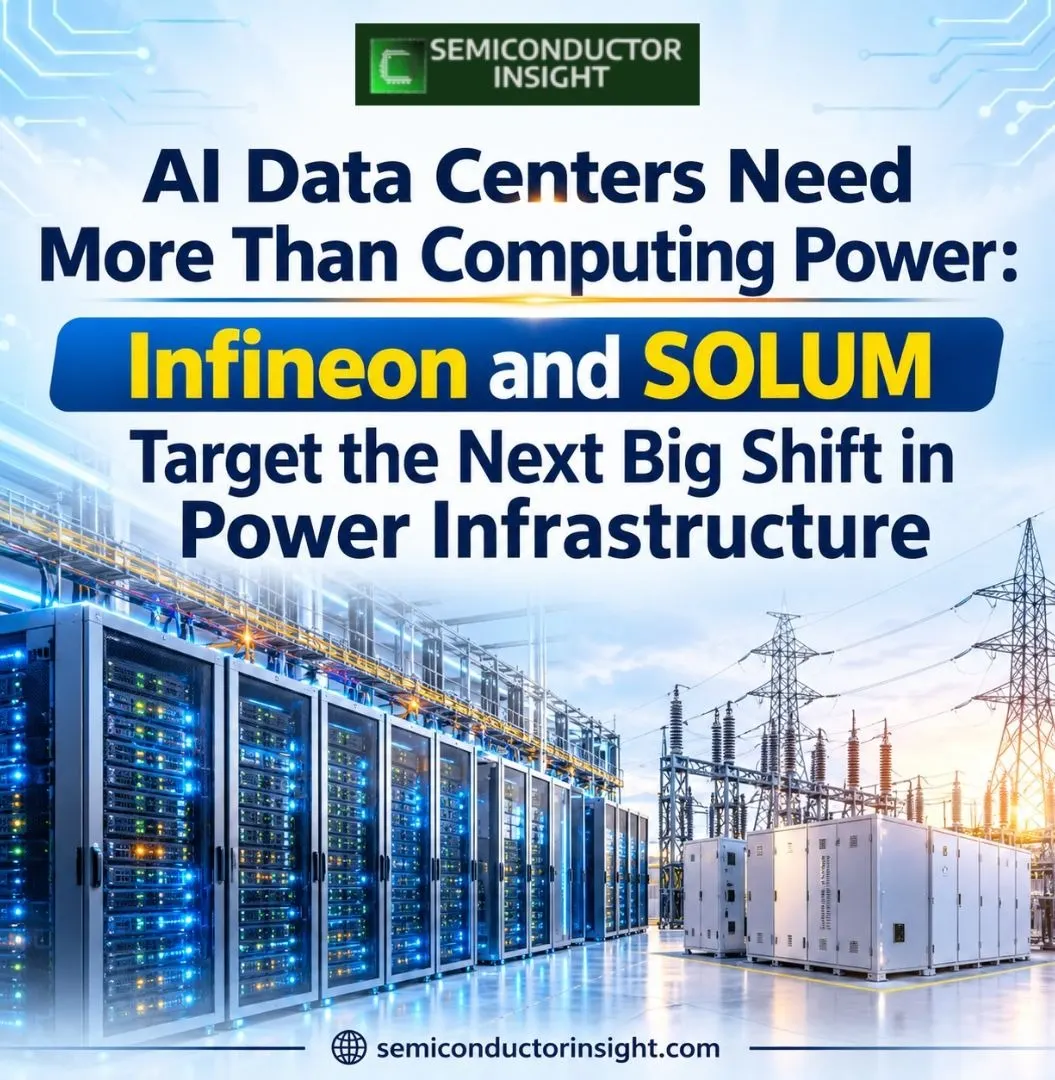
Infineon’s Partnership with SOLUM Puts HVDC Power Technology at the Centre of Next-Generation AI Data Centers
As AI computing infrastructure scales up, two semiconductor and power technology players are strengthening their collaboration to address one of the industry’s biggest engineering priorities: efficient, high-density and reliable power delivery.
The rapid expansion of generative artificial intelligence (AI), high-performance computing (HPC) and cloud infrastructure is reshaping the semiconductor industry’s priorities. While advanced processors, accelerators and memory technologies continue to attract attention, the power infrastructure supporting these systems is becoming an equally important area of innovation.
Against this backdrop, Infineon Technologies AG and South Korea-based SOLUM have signed a Memorandum of Understanding (MoU) to strengthen their existing collaboration on high-voltage direct current (HVDC) power solutions for AI data centers.
The agreement establishes a broader framework for technical cooperation, bringing together Infineon’s power semiconductor expertise and SOLUM’s capabilities in server power solutions, power module engineering and manufacturing.
Rather than focusing on a single component category, the collaboration targets three interconnected elements of AI data-center power infrastructure: intermediate bus converters (IBCs), battery backup units (BBUs) and power supply units (PSUs).
The Power Infrastructure Challenge behind the AI Boom
AI data centers are fundamentally different from conventional computing environments in terms of their power requirements. High-performance accelerators and increasingly sophisticated server configurations are creating greater demands on electrical distribution, thermal management and power conversion systems.
For infrastructure developers, supplying electricity is no longer the only consideration. The challenge is delivering it with minimal conversion losses, high power density and dependable operation across increasingly complex server environments.
This is where HVDC-based power architectures are gaining attention.
By enabling more efficient power conversion and distribution, HVDC solutions offer opportunities to reduce electrical losses and improve the reliability of next-generation data-center infrastructure. Their development is particularly relevant as operators seek to accommodate growing AI workloads without allowing power delivery constraints to limit computing expansion.
The Infineon–SOLUM collaboration reflects this changing industry priority: improving the electrical infrastructure that supports AI computing rather than concentrating exclusively on computational performance.
Three Technology Areas Driving the Collaboration
The companies plan to expand their technical cooperation across three major power applications, each addressing a different requirement within AI data-center infrastructure.
- Intermediate Bus Converters: Improving Power Conversion Efficiency
Intermediate bus converters play an important role in server power architectures by converting electrical power into suitable voltage levels for downstream systems.
As server configurations become more demanding, converter efficiency, power density and thermal performance are increasingly important engineering considerations. The collaboration will explore solutions designed to support these requirements within HVDC-based infrastructure.
- Battery Backup Units: Supporting Infrastructure Continuity
Power interruptions can create operational challenges for data centers running critical AI workloads. Battery backup units provide an important layer of protection by supporting power continuity when the primary supply is disrupted.
Developing suitable power solutions for BBUs is therefore an essential part of building reliable AI infrastructure, particularly as data-center operators seek greater operational resilience.
- Power Supply Units: Meeting Higher Server Power Requirements
Power supply units remain central to the electrical architecture of servers. With AI systems requiring increasingly sophisticated power delivery, improvements in conversion efficiency, thermal performance and system integration are becoming important product-development priorities.
Through the partnership, Infineon and SOLUM intend to explore high-efficiency PSU solutions suitable for next-generation AI data centers.
Silicon, SiC and GaN: Infineon’s Semiconductor Portfolio Enters the Picture
A major element of the collaboration is Infineon’s extensive power semiconductor portfolio, covering multiple material technologies and application requirements.
The company will contribute solutions based on:
- Silicon (Si): Established power semiconductor technology supporting a wide range of conversion and power management applications.
- Silicon Carbide (SiC): A wide-bandgap semiconductor technology offering advantages in high-voltage and high-efficiency power conversion applications.
- Gallium Nitride (GaN): A wide-bandgap technology attracting interest in high-frequency, compact and high-efficiency power electronics.
Infineon’s relevant product portfolio includes CoolMOS, OptiMOS, CoolSiC and CoolGaN devices, alongside PSOC microcontrollers and sensors.
The company will also provide reference designs, technical support and assistance with technology and product selection from the early stages of relevant projects.
This early-stage engagement could help SOLUM evaluate suitable semiconductor solutions while developing power modules and system architectures for emerging AI data-center requirements.
South Korea’s AI Infrastructure Ecosystem Gains Strategic Importance
The agreement also highlights South Korea’s growing relevance within the global AI infrastructure landscape.
The country has an established technology and electronics manufacturing ecosystem, with companies developing hardware and components that support advanced computing applications.
For Infineon, deeper cooperation with SOLUM provides an opportunity to strengthen its engagement with South Korean technology partners and participate in the development of next-generation AI data-center power architectures.
SOLUM, meanwhile, can build on Infineon’s semiconductor technologies to further strengthen its high-voltage and high-efficiency power design capabilities.
Both companies see opportunities to develop new business activities as demand for advanced data-center power solutions evolves.
What This Collaboration Signals for the Global Semiconductor Industry
The partnership reflects a broader shift in semiconductor innovation. As AI computing expands, the competitive landscape is increasingly influenced by technologies operating beyond the processor itself.
Power semiconductors, advanced conversion systems, high-efficiency components and integrated power modules are becoming essential to the performance of modern computing infrastructure.
Three important industry implications emerge from this development:
- Power efficiency becomes a strategic differentiator: Data-center developers are increasingly concerned with reducing energy losses while supporting higher computing capacity.
- Wide-bandgap semiconductors gain greater application relevance: SiC and GaN technologies offer important opportunities in advanced power conversion and high-density systems.
- System-level partnerships become more valuable: Semiconductor suppliers and power solution manufacturers are increasingly collaborating to address complete infrastructure requirements rather than individual component needs.
The companies will maintain regular technical discussions on future developments, with the objective of accelerating HVDC power solutions for next-generation AI data centers.
The Bigger Picture: AI Infrastructure Is Creating a New Semiconductor Opportunity
The AI boom is expanding the semiconductor industry’s addressable opportunities beyond processors, GPUs and memory devices. The supporting power ecosystem is emerging as another important area where semiconductor innovation can influence system performance and infrastructure efficiency.
Infineon and SOLUM’s strengthened collaboration illustrates how semiconductor manufacturers and power system specialists are aligning their capabilities to address this shift.
As AI data centers continue to evolve, the ability to deliver efficient, reliable and high-density power will become increasingly important to infrastructure design.
The next generation of AI data centers will depend not only on how fast they can compute, but also on how intelligently and efficiently they can manage power.
Access the Latest Insights from Our Newly Released Related Study: https://semiconductorinsight.com/report/high-voltage-direct-current-polypropylene-hvdc-pp-film-capacitors-market/
#SemiconductorIndustry #InfineonTechnologies #SOLUM #ArtificialIntelligence #AIDataCenters #HVDC #PowerSemiconductors #PowerElectronics #SiliconCarbide #GalliumNitride #SiC #GaN #DataCenterTechnology #HighPerformanceComputing #AIInfrastructure #SemiconductorInnovation #EnergyEfficiency

Comments (0)