
Industrial Wireless Chipsets Market Redefining Industrial Networking Standards
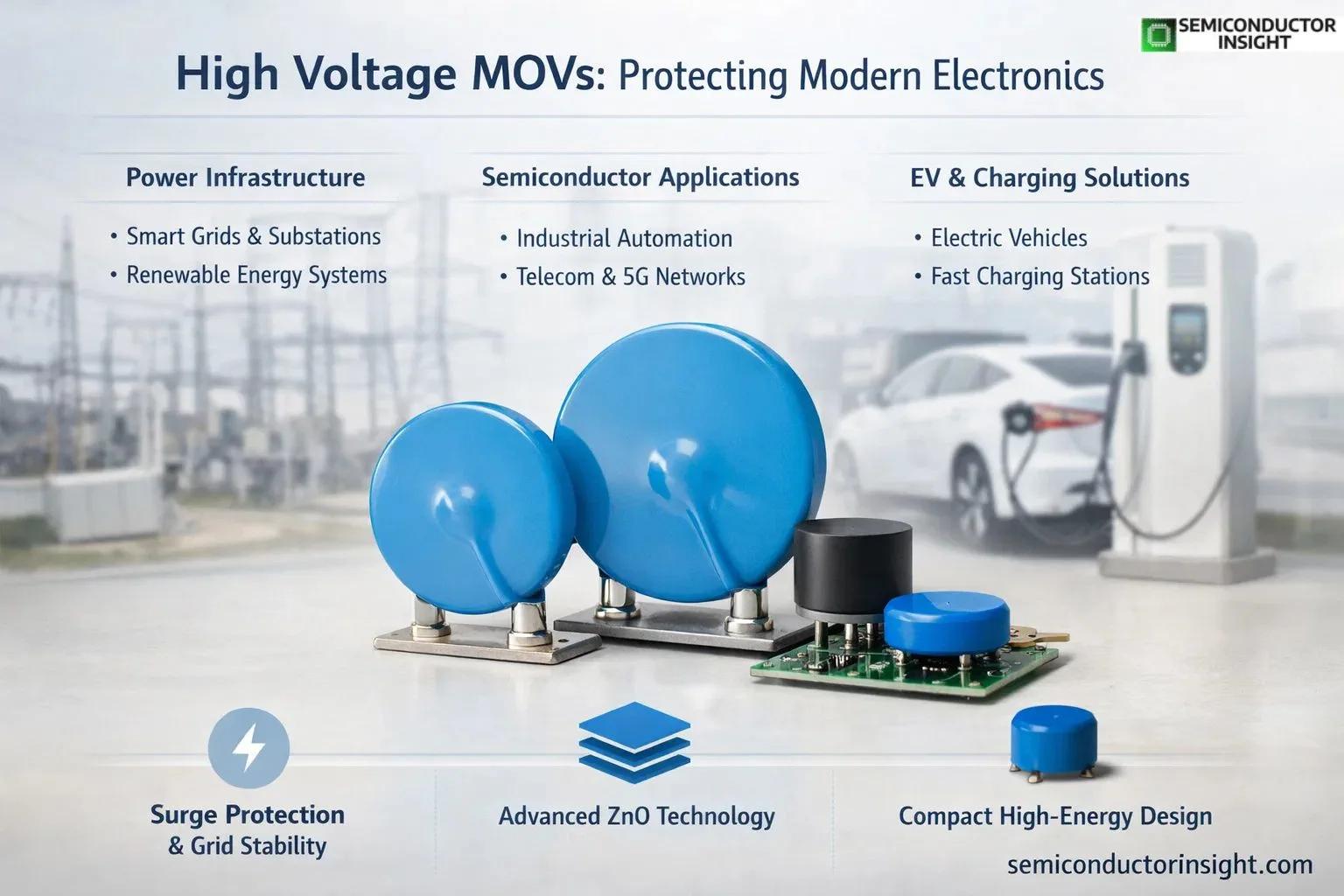
High Voltage Metal Oxide Varistors (MOVs) sit at the heart of modern surge protection architecture, acting as silent guardians for sensitive semiconductor systems. Built primarily from zinc oxide grains, these components behave as non-linear resistors that instantly clamp excessive voltage spikes before they damage circuits.
In high-voltage environments, MOVs are designed to handle extreme transient conditions, particularly in power transmission lines, substations, and industrial converters. MOVs react in nanoseconds, diverting surge currents and preserving operational continuity, in contrast to conventional components. MOVs may limit voltage to almost three to four times the nominal circuit level, guaranteeing equipment reliability during lightning or switching surges, according to technical data from component makers.
Expanding Role in Power Infrastructure and Grid Modernization
- The rapid transformation of electrical infrastructure is significantly influencing the adoption of high-voltage MOVs.
- With increasing investments in smart grids and high-voltage transmission, surge protection is no longer optional it is foundational.
- Utilities integrating renewable energy sources such as solar and wind are witnessing higher instances of voltage instability.
- MOV-based surge arresters are now widely deployed in substations and transmission systems to mitigate these fluctuations.
- Industry data indicates that power system applications dominate MOV usage, particularly in surge arresters used across grid networks.
- In Asia-Pacific alone, large-scale industrialization and infrastructure expansion have pushed adoption levels significantly, with the region accounting for over 45% share in MOV demand within power and electronics systems.
Growing Reliance in Semiconductor-Driven Sectors
High voltage MOVs are becoming indispensable across industries where semiconductor reliability is critical. From industrial automation systems to telecom base stations, the integration of electronics has increased vulnerability to transient voltage spikes.
Modern factories, powered by industrial automation and robotics, rely heavily on stable power electronics. Even a minor surge can lead to downtime or component failure. This has accelerated MOV deployment in motor drives, PLC systems, and power converters.
Similarly, in telecommunications, MOVs protect base station infrastructure and data transmission hardware, ensuring uninterrupted connectivity. With the expansion of 5G and IoT ecosystems, the number of surge-sensitive nodes has grown exponentially, further strengthening the need for high-voltage protection components.
You may view our most recent report here for more in-depth insights: https://semiconductorinsight.com/report/high-voltage-metal-oxide-varistors-mov-market/
Material Innovation and Performance Engineering
One of the most interesting developments in this space is the evolution of ZnO material engineering. Manufacturers are refining grain structures and doping techniques to enhance energy absorption capacity and lifespan.
High-voltage MOVs today are designed to handle repeated surge events while maintaining stable electrical characteristics. However, it is important to note that MOVs naturally degrade over time with repeated exposure to surges, leading to gradual reduction in threshold voltage.
This has led to innovation in thermal protection integration and multi-layer varistor designs, particularly for high-reliability applications such as railways, defense electronics, and power substations.
Growing Importance in Renewable Energy and EV Ecosystems
- The shift toward electrification is opening new frontiers for high-voltage MOV adoption.
- Renewable energy installations, especially solar farms and wind turbines, are highly exposed to lightning strikes and switching surges.
- MOV-based protection systems are now standard in inverters, transformers, and energy storage systems, ensuring long-term system durability.
- At the same time, electric vehicles and charging infrastructure require robust surge suppression due to high-voltage battery systems and fast-charging networks.
- This transition is not just technological it is structural.
- As electrification expands, the number of high-voltage nodes requiring protection continues to rise, creating sustained demand for MOV solutions across energy ecosystems.
Industrial Shift toward Compact High-Energy Components
A noticeable trend is the push toward miniaturization with high energy density. As electronic systems become more compact, MOV manufacturers are under pressure to deliver smaller components without compromising surge handling capability.
This has driven advancements in surface-mount MOVs and compact high-voltage modules, particularly for use in advanced electronics and embedded systems. At the same time, competition from alternative technologies like transient voltage suppressors is pushing continuous innovation in performance and cost efficiency.
Real-World Industry Momentum and Market Scale
The scale of this industry reflects its critical importance. The global MOV ecosystem has already crossed multi-billion-dollar valuation levels, supported by rising adoption across electronics, power systems, and infrastructure.
What makes high-voltage MOVs particularly significant is their presence in mission-critical systems from grid protection to industrial manufacturing lines where failure is not an option.
High Voltage Metal Oxide Varistors are no longer just passive components; they are essential to the reliability of modern semiconductor ecosystems. As industries move toward electrification, automation, and digital infrastructure, the importance of surge resilience will only intensify.
From power grids to electric vehicles, MOVs continue to evolve quietly in the background ensuring that the world’s increasingly complex electronic systems remain protected, stable, and operational.

Comments (0)