
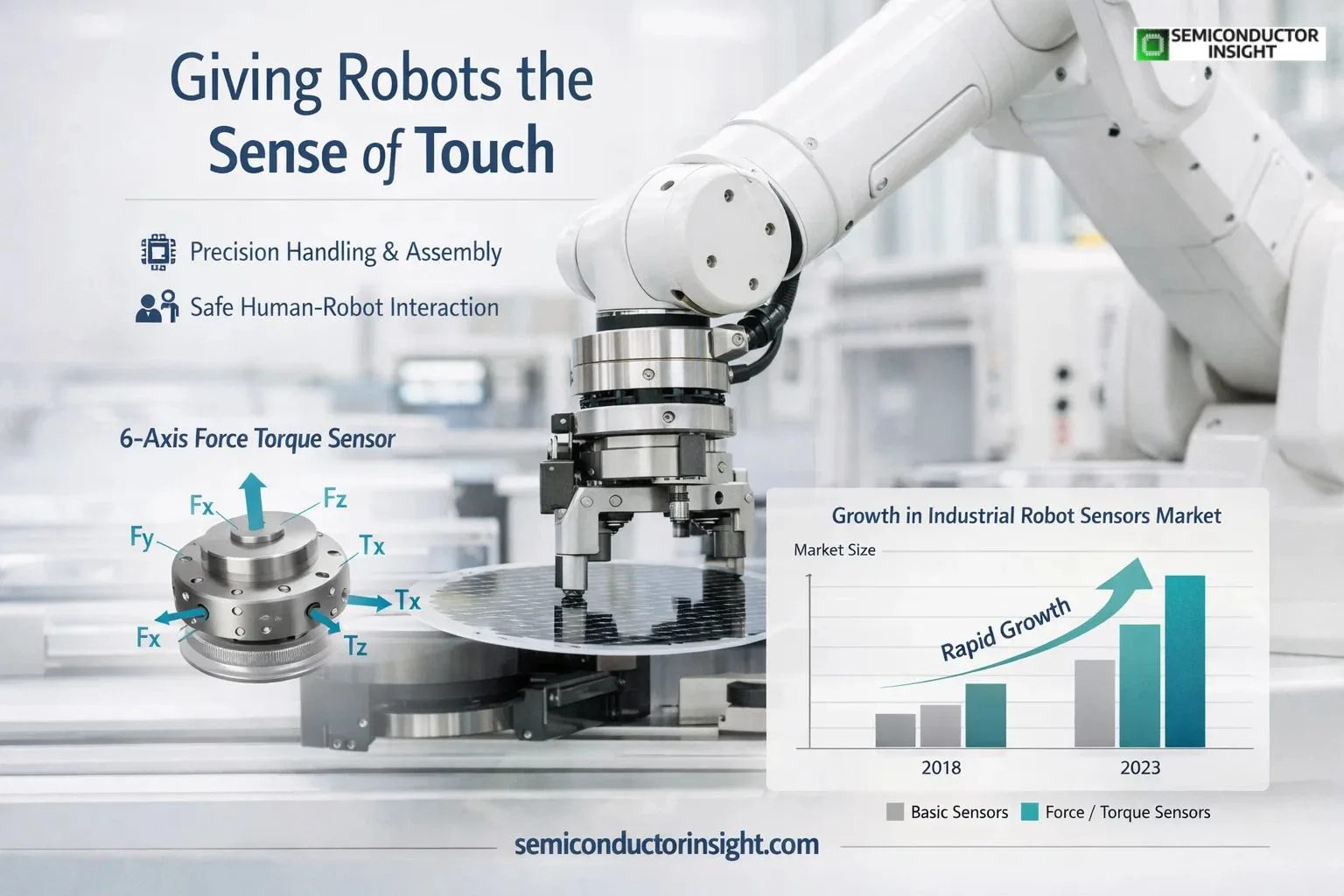
Industrial Sensing Evolves Inside the Robot 6‑axis Force Torque Sensor Market
Robot 6‑axis force torque sensors are quietly becoming the nervous system that lets industrial robots feel and respond to their environment, not just follow preprogramed paths.
In global industrial‑robot‑sensors revenue, MEMS‑based and multi‑axis sensing technologies are now a multi‑billion‑dollar slice of the automation stack, with force‑torque packages growing notably faster than basic position‑only sensors. Across car plants, electronics factories, and semiconductor fabs, these sensors are no longer a luxury add‑on but a core enabler of precision, yield, and safer human–machine interaction.
When robots need to feel more than just move
- Modern robots are asked to assemble fragile electronics, handle brittle wafers, and perform micro‑contact tasks where even a fraction of excess force can scrap a part or damage a tool.
- A six‑axis force torque sensor captures forces along X, Y, Z and torques around each of those axes, effectively giving the robot a tactile sense of how hard it is pressing, twisting, or sliding. This is very different from simply relying on motor current or encoder data, which can only infer force indirectly and with much higher latency.
- In semiconductor manufacturing, wafer‑handling robots that move 300 mm or 450 mm silicon discs through vacuum chambers must operate with near‑zero vibration and shock; torque and force data along the arm help engineers detect subtle misalignments, bearing drag, or contact anomalies before they turn into broken wafers or costly downtime.
- Academic and technical papers on MEMS‑style six‑axis force‑torque sensors cite sub‑newton and sub‑newton‑meter ranges, which are exactly what is needed for nanoscale handling and delicate polishing or probing steps.
How six‑axis sensing shapes advanced automation?
In the broader industrial‑robot‑sensors space, estimates compiled from industry snapshots place the total industrial robot sensor market in the several‑billion‑dollar range, with sensors beyond simple encoders and proximity switches taking an increasing share. Force, torque, and tactile sensing modules are among the fastest‑growing sub‑segments, driven by the rise of collaborative robots (cobots), high‑precision assembly, and condition‑monitoring systems.
One indication of demand comes from the way equipment makers and OEMs are integrating these sensors into their designs rather than leaving them as after‑market options. MEMS‑based force‑torque solutions from major component manufacturers are now being mounted directly on robot wrists or end‑effectors, enabling human‑like grip and insertion feel in pick‑and‑place, screw‑driving, and edge‑guiding tasks. Case‑study‑style reports from MEMS‑technology providers show how these sensors can detect imbalances, slipping, or abnormal contact in real time, which both improves process reliability and reduces mechanical wear on the robot and tooling.
Feel Free to Reach Our Most Recent Updates of the Report: https://semiconductorinsight.com/report/robot-6-axis-force-torque-sensor-market/
Why the semiconductor sector leans on force torque control
- Within the semiconductor ecosystem, torque‑sensing and force‑feedback systems are increasingly embedded into wafer‑handling robots, CMP (chemical‑mechanical polishing) tools, and related automation.
For example, articles describing torque‑sensing in semiconductor equipment highlight that real‑time torque monitoring at robot joints or drive shafts allows fabs to detect excessive mechanical resistance, misalignment, or early‑stage bearing degradation before they impact yield or tool uptime.
- In wafer‑handling cells, a six‑axis force‑torque sensor can help the robot adjust its path if the robot arm encounters unexpected friction or if the wafer edge slightly contacts a chamber wall. This fine‑grained control reduces the risk of particle shedding, micro‑cracks, or wafer‑breakage events, all of which can trigger yield dips and costly clean‑room interruptions. S
- ome technical write‑ups on torque sensors in semiconductor contexts also point to energy‑use and maintenance benefits: by keeping torque profiles within optimal bands, fabs can extend the life of motors, actuators, and vacuum pumps, while also improving process traceability for advanced diagnostics and machine‑learning‑based monitoring.
Where the technology is headed in robotics
Miniaturised silicon‑based and MEMS‑like six‑axis force‑torque sensors are opening new doors for smaller‑scale automation, medical robotics, and micro‑assembly systems. Research articles on capacitive six‑axis designs describe sensors that can resolve forces at the newton level and torques in the millinewton‑meter range, fabricated on silicon‑on‑insulator wafers using deep‑etching and comb‑capacitor structures. These are being explored for applications such as robotic tactile sensing, minimally invasive surgery tools, and other compact robotic systems where space and weight are critical.
At the same time, the broader industrial‑robot‑sensors ecosystem is seeing a steady push toward higher‑resolution, lower‑noise signals and tighter integration with control software. Instead of treating force‑torque data as a separate diagnostic stream, manufacturers are folding it into the motion‑control loop, enabling adaptive gripping, compliant assembly, and smoother human‑collaborative workflows. Regulatory and safety‑management articles in the robotics and automation space increasingly reference the need for fine‑grained force feedback when robots operate near people or in shared workspaces, which further incentivises the adoption of six‑axis sensing rather than simpler, single‑axis or inferred‑force approaches.

Comments (0)