

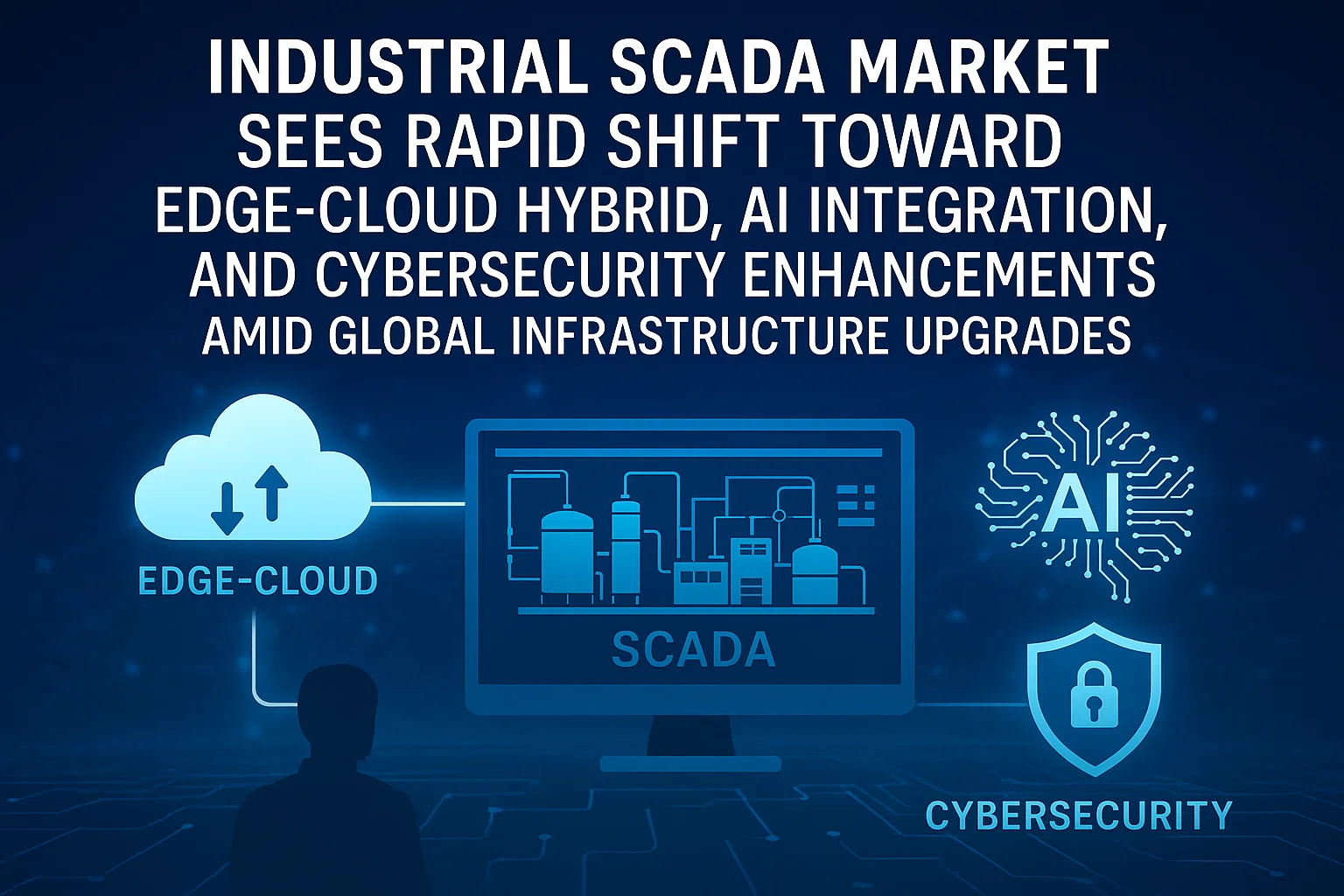
Industrial SCADA Market Sees Rapid Shift Toward Edge-Cloud Hybrid, AI Integration, and Cybersecurity Enhancements Amid Global Infrastructure Upgrades
The Industrial SCADA market was valued at US$ 5,715 million in 2024 and according to market forecasts is projected to reach US$ 8,178 million by 2032, expanding at a CAGR of 5.3% during the forecast period. But the numbers alone only hint at a bigger story: SCADA is quietly transforming from a monitoring-and-control workhorse into an intelligent, distributed, and security‑first platform that bridges OT and IT.
If you’ve visited a modern power substation, water treatment plant, or refinery in the last two years, you might not notice the revolution right away. The HMI screens still show process variables, alarms still blink, and engineers still tune PID loops. But beneath the surface the architecture, incentives and risk model of SCADA systems are changing fast.
Access Your Free Sample Report- Industrial SCADA Market
Market context: growth, drivers and what the numbers mean
The headline forecast US$5,715 million in 2024 growing to US$8,178 million by 2032 at a 5.3% CAGR is a signal that demand for SCADA remains robust. Growth is being driven by several structural forces:
- Modernization of legacy infrastructure. Utilities, oil & gas operators and manufacturers continue to modernize decades‑old control systems to improve reliability and to meet regulatory and ESG expectations. Replacing or augmenting aging SCADA installations is a long‑running capital program in many regions.
- Decentralized assets and distributed operations. Renewables, microgrids, distributed water assets, and geographically dispersed production facilities require scalable, networked SCADA architectures that weren’t necessary 20 years ago.
- Data monetization and operational efficiency. Organizations now expect SCADA data to feed predictive maintenance, energy optimization and supply‑chain integration projects adding value beyond core control functions.
- Regulatory and resilience demands. Governments and large customers demand higher resilience, outage visibility and cyber‑incident reporting, which drives SCADA upgrades with security built in.
Put simply: the market isn’t just for replacement HMIs anymore it’s for distributed data platforms that support control, analytics and regulatory compliance.
Recent Developments The Headline Moves
Below I expand on the main shifts observed across vendor announcements, deployments and security disclosures over the most recent 12–18 months.
1) Edge + cloud hybrid architectures: distributed intelligence
Vendors and integrators are rapidly adopting hybrid architectures that split responsibilities between edge devices and centralized/cloud services. The reasons are practical:
- Latency and reliability: control loops and safety functions must run locally; edges keep deterministic behavior even when connectivity is intermittent.
- Bandwidth and cost: streaming all raw telemetry to the cloud is wasteful. Edge preprocessing (filtering, aggregation, event detection) reduces volumes and lowers costs.
- Security posture: a well‑designed edge can act as a gatekeeper and isolate critical control domains from broader networks.
Recent product launches explicitly reflect this model: vendors are shipping preconfigured edge appliances that connect directly to PLCs and RTUs and bridge to cloud SCADA backends making it easier for operators to deploy hybrid systems without extensive systems engineering.
Practical implications: If you manage a plant or distribution network, expect hybrid deployments to become the default approach. When evaluating vendors, insist on clear delineation of which functions run on the edge, how data is synchronized, and what the failure modes look like.
2) Security Disclosures and the Hard Lessons
As SCADA systems have become more connected, security researchers and vendors have uncovered serious vulnerabilities in widely deployed platforms from privilege escalation and DLL hijacking to insecure default configurations. The headlines are a healthy reminder that connectivity without hardening is dangerous.
Operators should treat these announcements as catalysts for action. Patch management, network segmentation, least‑privilege configurations, asset inventories, and incident response drills are no longer optional.
Practical implications: Adopt a multi‑layered defense model: secure the perimeter, segment ICS networks, regularly patch and test, and run tabletop exercises for incident response. Consider partnering with specialist OT security providers when in‑house skills are limited.
3) SCADA as a Service and Consumption Models
Historically SCADA projects were large, capex‑heavy and bespoke. Today a growing set of vendors and integrators are offering subscription, managed‑service or consumption‑based models turning SCADA into an operational expense with predictable pricing and faster cadence for feature updates.
This shift lowers the barrier for small and medium operators or remote sites, letting them adopt modern SCADA features (historian, alarm management, mobile clients) without lengthy procurement cycles.
Practical implications: Smaller utilities and brownfield operators should evaluate SaaS/managed options carefully. While total cost of ownership can be attractive, pay close attention to data ownership, SLAs, offline access, and cybersecurity responsibilities.
4) AI, Analytics and The Rise Of The Digital Twin
SCADA data is now the raw material for AI‑driven use cases: anomaly detection, predictive maintenance, process optimization and even intent‑based automation where high‑level goals are translated into coordinated actions.
Digital twins – virtual mirrors of physical assets are increasingly integrated with SCADA data, enabling ‘what‑if’ simulations and safer testing of configuration changes. Vendors are embedding ML toolkits and prebuilt analytics modules into their platforms to reduce friction for operators.
Practical implications: Start small with pilot projects that have clear KPIs (e.g., reduce pump downtime by X% or improve energy efficiency by Y%). Make sure your data quality, timestamping, and historian coverage are reliable before trusting ML outputs. Invest in explainability operators must be able to understand why a model recommended an action.
Download Sample Report PDF- Industrial SCADA Market
5) Incremental Upgrades to Legacy Platforms
Not every site is ripping and replacing SCADA. Many vendors continue to ship incremental upgrades improved data modeling, unified namespaces (OPC UA), web HMIs, and enhanced historian features allowing operators to modernize in place.
Practical implications: If your plant is conservative, incremental modernization may be the lower‑risk path. Prioritize improvements that unlock analytics (better timestamps, contextual metadata) and those that reduce attack surface (modern authentication, encryption).
6) Anchor Projects and Regional Deployments
Large infrastructure projects utilities upgrading distribution networks, oil & gas SCADA deployments in basins, and water authorities rolling out remote monitoring serve as practical anchors for vendor roadmaps. These projects show real adoption of hybrid architectures and SaaS models in production conditions.
Practical implications: Follow anchor projects in your sector they often reveal what integration patterns, cybersecurity practices, and commercial terms are becoming market standard.
Two Short Case Vignettes
- SaaS-style SCADA in upstream oil & gas. A midstream operator in a major U.S. basin deployed a subscription SCADA platform to monitor well pads, pipelines and tank farms. The operator cited reduced setup time, lower capital outlay, and rapid access to built‑in analytics as key benefits. The adoption shows how flexible licensing can accelerate modernization in asset‑heavy fields.
- Distribution automation upgrade in a major Indian state. A state government sanctioned capital to upgrade distribution networks that included SCADA integration for substations. The project emphasized not just telemetry but demand‑side visibility and outage response highlighting the expanding role of SCADA in grid resilience.
Challenges and Friction Points
Adoption isn’t frictionless. Expect the following challenges in the real world:
- Legacy heterogeneity. Plants often host dozens of PLC and RTU vendors and a babel of field protocols. Achieving reliable, consistent data requires careful engineering and protocol gateways.
- Migration risk. Moving control logic, historian backfill and alarm settings without creating operational disruption is nontrivial.
- Skill gaps. OT teams may lack cloud and cybersecurity experience while IT teams may lack industrial process knowledge. Bridging that gap is harder than installing software.
- Regulatory and contractual complexity. Outsourced or subscription SCADA raises questions about liability, uptime SLAs and data sovereignty.
- Vendor lock‑in concerns. Some cloud‑oriented SCADA offerings make it easy to ingest data but harder to extract it in a usable archive format.
Addressing these requires a combination of phased migration strategies, vendor governance, and investment in people and processes.
Practical Playbook For SCADA Modernization
If you’re responsible for a modernization program, here’s a pragmatic checklist to keep projects on track.
- Define clear business outcomes. Don’t modernize for the sake of technology. Tie projects to quantifiable goals: reduced downtime, faster fault detection, regulatory compliance, or lower operating cost.
- Inventory assets and protocols. Build an authoritative inventory of PLCs, RTUs, HMIs, communication links and field protocols. Include firmware versions and patch status.
- Map data and latency needs. Decide which functions must remain local (control loops, safety), which require near‑real‑time edge processing (anomaly detection), and which can be centralized for analytics.
- Choose a migration strategy. Cold replacement rarely works. Use a layered approach: integrate the historian first, then add visualization, then move nonsafety automation to the new platform.
- Harden security from day one. Enforce network segmentation, use modern authentication, disable unused services, and implement a patch cadence.
- Pilot AI use cases. Pick one or two high‑value pilots with strong data coverage and amenable processes (pumps, compressors, seals). Measure outcomes and iterate.
- Plan for vendor interoperability & extractability. Ensure your data is not trapped behind proprietary formats; insist on open interfaces and regular exports.
- Skill and process investments. Cross‑train OT and IT teams; define runbooks and incident response processes; set up regular tabletop exercises.
Investment Priorities And ROI Considerations
Operators often ask: where should we invest first? My pragmatic prioritization is:
- Reliable historian & timestamps. If your data isn’t trustworthy, analytics won’t be useful. Good historians pay for themselves by enabling predictive maintenance and reducing false alarms.
- Edge compute for preprocessing & resilience. A modest investment in edge appliances will reduce cloud costs and improve availability during network outages.
- Cybersecurity basics. Network segmentation, IAM, patching and endpoint monitoring provide outsized benefits relative to cost and reduce catastrophic risk.
- Pilot analytics with clear KPIs. Use small bets on AI that can be measured within months (e.g., reduce mean time to repair by X%).
- User experience & operator workflows. Better HMIs, unified alarm management and mobile apps reduce human error and speed reaction times.
ROI math should include reduced unplanned downtime, deferred capital expenditures through smarter maintenance, and lower incident response costs. For regulated industries, improved compliance and auditability also have material value.
Click Here To Download Full Sample Report- Industrial SCADA Market
Where The Technology Is Likely To Head Next
- Agentic workflows and intent‑based automation. Expect more platforms to offer higher‑level operators’ interfaces where goals (not scripts) drive distributed agents that orchestrate actions across PLCs, MES and logistics.
- Stronger standardization around OPC UA + MQTT. These protocols will increasingly be the lingua franca for hybrid SCADA systems.
- Embedded explainable AI. Vendors will ship models with explainability controls to win operator trust and meet auditing needs.
- Integrated OT security services. Managed detection and response for OT, tailored threat intel feeds, and automated patch orchestration will become mainstream.
The market numbers US$5,715 million in 2024 growing to US$8,178 million by 2032 at 5.3% CAGR show there’s steady commercial momentum. But the true value for operators will come from systems that not only collect data but turn it into reliable, safe, and accountable decisions.

Comments (0)