
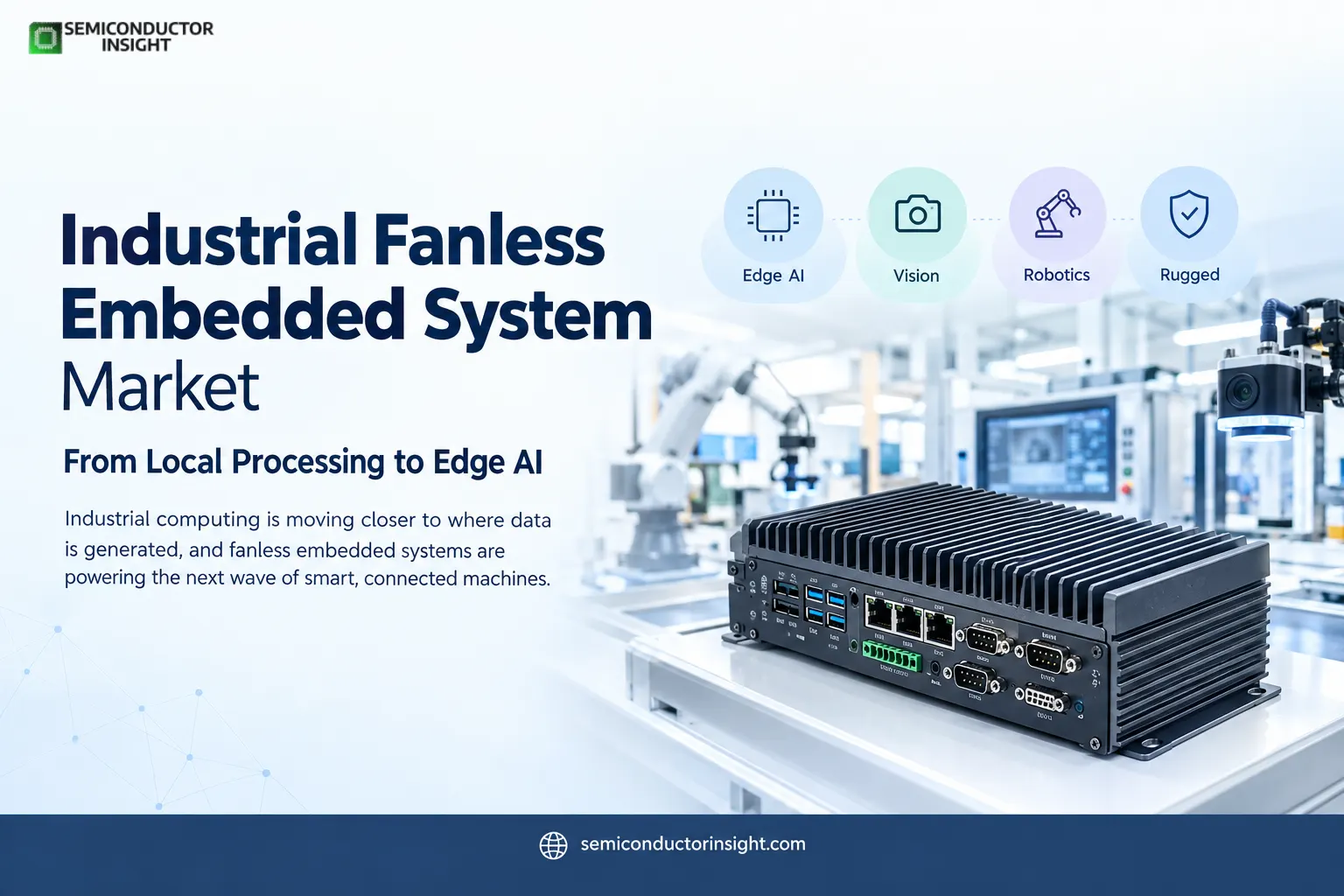
Industrial Fanless Embedded System Market 2026 with 180 TOPS AI Systems Entering Factory Automation
Industrial computing is changing from centralized control toward distributed intelligence. Machines, cameras, robots, sensors and automated production lines increasingly need computing capability close to where data is generated. The European Commission identifies edge computing as an important part of next-generation digital infrastructure and has set a target of 10,000 climate-neutral edge nodes across Europe. This shift creates a strong application environment for industrial fanless embedded systems, particularly where continuous operation, compact dimensions and local processing are required.
Unlike conventional desktop-style industrial PCs, fanless systems remove mechanical cooling fans and instead rely on passive thermal designs. This can reduce moving components and make the computer more suitable for environments containing dust, vibration or restricted airflow.
The New Architecture Is Built Around Local Intelligence
The industrial fanless embedded system is increasingly becoming an edge AI device rather than simply an industrial controller.
Machine sensors → Local data acquisition → Fanless embedded computer → AI inference → Machine decision → Cloud or control system
This architecture matters for applications such as machine vision, predictive maintenance, robotics, automated inspection and intelligent transportation because data can be processed locally rather than continuously transferred to a remote server.
Intel’s March 2026 IES-4430 example illustrates this transition. The fanless industrial edge AI system uses 13th Gen Intel Core processors and is designed for real-time analytics, machine vision and industrial automation. Its industrial I/O includes CAN Bus, RS-485, digital input and digital output interfaces.
Fanless Does Not Mean Low Performance Anymore
The most interesting development in this market is the disappearance of the traditional trade-off between ruggedness and computing performance. Current platforms are incorporating CPUs, GPUs and dedicated neural processing units into compact fanless systems.
A particularly notable 2026 example is Supermicro’s SYS-E103-14P. The system uses Intel Core Ultra Series 3 processors and offers up to 180 platform TOPS, including up to 50 dedicated NPU TOPS. It can support up to 128GB of DDR5-5600 memory and PCIe 5.0 storage. These specifications position fanless industrial computers for workloads such as object detection, safety monitoring and quality inspection.
For More Detailed Insights, You Can Surf Our Latest Report Here: https://semiconductorinsight.com/report/industrial-fanless-embedded-system-market/
The Numbers Show How Compact Edge AI Is Becoming
NVIDIA’s current Jetson portfolio demonstrates another route toward embedded AI. Jetson Orin NX delivers up to 157 TOPS within a 10–25W power envelope and uses a 70 × 45 mm module. Jetson Orin Nano reaches up to 67 TOPS at 7–15W. These power and physical dimensions make embedded AI increasingly practical for machines where space and thermal capacity are constrained.
Advantech’s EPC-R7300 provides another current example. Its fanless industrial edge AI PC supports Jetson Orin NX and Orin Nano modules, delivers 20–100 TOPS depending on configuration, measures 152 × 173 × 50 mm and supports operation from -20°C to 60°C.
Wide Temperature Operation Is Becoming a Design Requirement
Industrial fanless systems are being designed around environmental conditions that conventional office computers cannot easily tolerate. The ASUS IoT EBS-S110W, for example, operates between -20°C and 60°C and accepts 9–36V input while providing six COM ports, six USB ports and dual LAN connectivity.
At the higher ruggedness end, Vecow’s ECX-3200/3100 series supports -40°C to 75°C operation, 9–50V input and multiple 2.5GbE PoE+ connections. The platform is positioned for machine vision, autonomous mobile robots, vehicle computing and other industrial AIoT applications.
Connectivity Is Becoming as Important as Processing
The modern industrial embedded computer is effectively a communication hub. Multiple Ethernet ports, CAN, RS-232/422/485, USB, PoE, wireless modules and digital I/O allow one system to connect machines, sensors and network infrastructure.
The August 2026 Advantech ARK-2252 illustrates this trend with up to four 2.5GbE LAN ports, six serial ports, dual CANBus, programmable digital I/O, three 4K displays and support for up to 128GB DDR5 memory. Its 12–24VDC input and extended-temperature design are intended for automation, machine vision and edge applications.
Industrial AI Is Changing What Goes Inside the Box
The next generation of fanless systems is increasingly being designed around AI inference from the beginning rather than adding an accelerator later. Intel’s Embedded World 2026 ecosystem examples include fanless systems combining CPU, integrated GPU and NPU resources for industrial AI workloads. One showcased platform used Intel Core Ultra processors with a 9–60V DC input range for industrial deployment.
This creates a new product equation for manufacturers:
Compact enclosure + passive thermal design + AI accelerator + industrial I/O + wide power input + extended temperature support = intelligent edge controller
Where the Market Is Finding Its Next Applications
The application landscape is expanding beyond conventional factory automation. Fanless embedded systems are increasingly being positioned for machine vision, autonomous robots, smart transportation, energy systems, industrial gateways, retail automation and mobile equipment.
The June 2026 Vecow example specifically identifies rolling stock, autonomous mobile robots, machine vision and vehicle computing among its target applications. Meanwhile, Intel’s September 2026 ecosystem listing highlights compact fanless systems for edge controllers and AIoT gateways, reinforcing the movement toward processing data directly at industrial endpoints.
The Industrial Computer Is Becoming an AI Endpoint
The defining change in the industrial fanless embedded system market is therefore not simply the removal of a cooling fan. It is the convergence of passive thermal engineering, industrial connectivity, compact semiconductor architectures and local AI processing.
As factories and machines generate more data, the value of an embedded computer increasingly comes from what it can interpret locally, how reliably it can operate in difficult environments and how easily it can connect intelligence to the physical equipment. The 2026 product launches and ecosystem developments show that fanless industrial computing is moving steadily from basic control hardware toward a core platform for real-time edge intelligence.

Comments (0)