
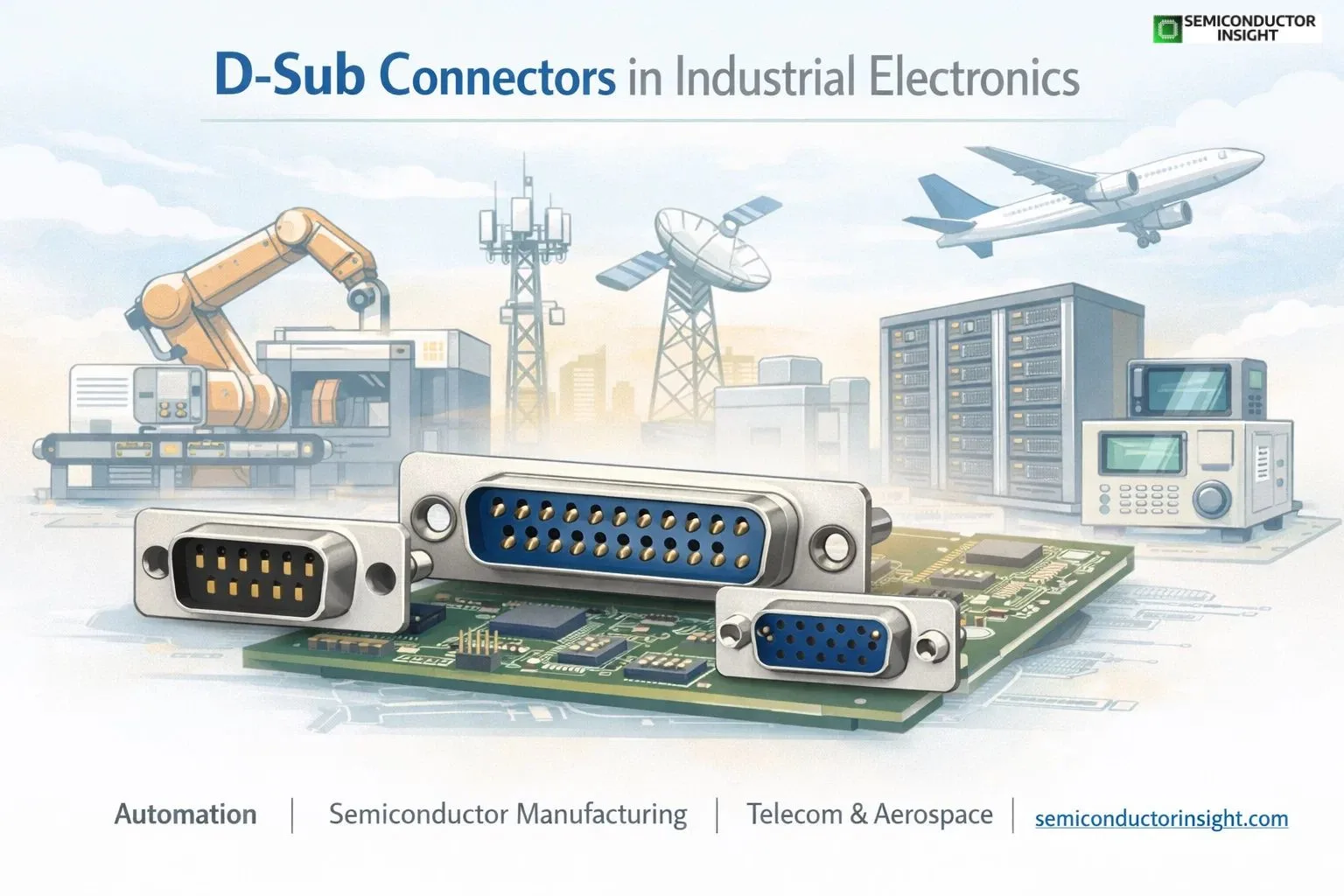
Industrial Electronics Expansion Strengthening the D-Sub Standard Connectors Market
In the world of semiconductor electronics, connectivity components play a crucial role in ensuring stable communication between devices, boards, and systems. Among these essential components, D-Sub standard connectors remain widely used across industrial electronics, computing equipment, telecommunications hardware, and aerospace systems. Known for their distinctive D-shaped metal shell and durable design, these connectors provide secure electrical connections that maintain signal integrity even in demanding environments.
Despite the rapid emergence of high-speed digital connectors, D-Sub connectors continue to hold a strong position in several mission-critical electronic systems. Their proven reliability, cost-efficiency, and compatibility with legacy systems make them a preferred choice for engineers designing semiconductor-based equipment that requires stable connectivity and long operational life.
As semiconductor devices become increasingly integrated into industrial automation, robotics, and embedded computing platforms, the D-Sub Standard Connectors Market is witnessing renewed demand from sectors where durability and consistent performance remain essential.
Before Proceeding, Feel Free to Overlook Our Updated Report: https://semiconductorinsight.com/report/d-sub-standard-connectors-market/
Where Semiconductor Systems Depend on D-Sub Connectivity
D-Sub connectors are deeply integrated within semiconductor-powered electronic architectures. These connectors are frequently used in printed circuit board assemblies, industrial control units, and high-performance computing interfaces where robust electrical links are required.
In semiconductor manufacturing environments, equipment such as wafer inspection systems, lithography machines, and automated test platforms rely on D-Sub connectors for reliable signal transmission. Their mechanical locking design helps maintain secure connections even under vibration or high-temperature operating conditions.
In addition to semiconductor fabrication equipment, these connectors are also used in instrumentation systems, measurement devices, and data communication modules. Their compatibility with multiple pin configurations allows engineers to integrate them into complex semiconductor hardware platforms without compromising performance.
Integration across Advanced Electronic Infrastructure
The expansion of digital infrastructure has broadened the scope of applications for D-Sub connectors. From industrial automation networks to communication hardware, these connectors continue to serve as reliable interfaces between semiconductor chips, processors, and peripheral systems.
Many industrial machines still depend on D-Sub connectors for serial communication interfaces such as RS 232 and RS 485. These communication standards remain widely used in factory automation systems, programmable logic controllers, and industrial monitoring equipment.
In modern semiconductor-driven electronics, connectors must deliver signal stability, mechanical durability, and long operational reliability. D-Sub connectors meet these requirements through robust shielding and precision contact alignment, which help reduce signal interference and maintain consistent electrical performance.
The Role of Miniaturization in Connector Innovation
- As semiconductor devices become smaller and more powerful, connector manufacturers are developing compact versions of traditional D-Sub connectors. High-density D-Sub variants are now available with increased pin counts while maintaining smaller footprints on circuit boards.
- These high-density connectors allow semiconductor equipment manufacturers to optimize space within electronic assemblies while still providing high-capacity signal transmission pathways. This capability is particularly valuable in embedded systems, aerospace electronics, and defense communication equipment where space optimization is critical.
- Miniaturization efforts are also accompanied by improvements in materials, including corrosion-resistant metals and enhanced insulation materials that extend connector lifespan and reliability.
Industrial Automation Accelerating Connector Adoption
The global rise of industrial automation has significantly expanded the application scope of D-Sub connectors. Automated manufacturing systems rely on large networks of sensors, controllers, and communication devices powered by semiconductor chips.
D-Sub connectors are widely used in robotic controllers, machine vision systems, and factory automation modules that require stable electrical connections over long operating cycles. Their rugged construction makes them particularly suitable for industrial environments where vibration, temperature fluctuations, and dust exposure are common.
Automation equipment manufacturers continue to integrate these connectors into motion control systems and programmable logic controllers, ensuring seamless communication between semiconductor-driven hardware components.
Leading Electronics Manufacturers Shaping the Market
Several global electronics companies are actively involved in the development and manufacturing of D-Sub standard connectors. These companies focus on improving connector durability, signal integrity, and compatibility with evolving semiconductor technologies.
Major industry participants include companies such as TE Connectivity, Amphenol Corporation, Molex, Hirose Electric, and ITT Cannon. These manufacturers supply connectors for industries ranging from aerospace and defense to telecommunications and semiconductor manufacturing equipment.
Many of these companies are investing in advanced connector engineering, including high-speed shielding technologies and improved contact materials that support next-generation semiconductor systems.
Emerging Technology Ecosystems Expanding Connector Demand
- The next wave of semiconductor innovation is creating new opportunities for connector technologies. Rapid growth in areas such as artificial intelligence hardware, industrial robotics, smart infrastructure, and edge computing systems is increasing demand for reliable electronic interfaces.
- Semiconductor devices used in these advanced systems often require secure hardware interconnections capable of supporting continuous data transmission and long-term operational stability. D-Sub connectors remain relevant in these environments due to their reliability and compatibility with complex electronic assemblies.
- As digital infrastructure continues to evolve, connectors that deliver precision connectivity, strong mechanical performance, and consistent signal quality will remain essential components within semiconductor ecosystems.
- The future of the D-Sub Standard Connectors Market will be closely linked to the growth of semiconductor manufacturing equipment, industrial electronics, and automation technologies. Although newer connector formats are emerging for ultra-high-speed applications, D-Sub connectors maintain a strong presence in systems where durability and long-term reliability are more critical than extreme bandwidth.
- Advancements in materials, miniaturization, and high-density configurations are helping modernize these connectors while preserving their core mechanical design. As industries continue to deploy semiconductor-based devices across manufacturing, transportation, aerospace, and communication infrastructure, D-Sub connectors will remain an important part of the electronic connectivity landscape.
Further, in a rapidly evolving electronics industry, technologies that combine reliability, proven engineering, and adaptability often endure the longest—and D-Sub connectors are a clear example of this enduring relevance.

Comments (0)