

Industrial Data Acquisition Module Market Transforming Sensor Data into Actionable Insight
Industrial Data Acquisition (DAQ) Module Market sits at the intersection of hardware precision and digital intelligence, playing a crucial role in how modern industries capture, interpret, and act on real-world signals.
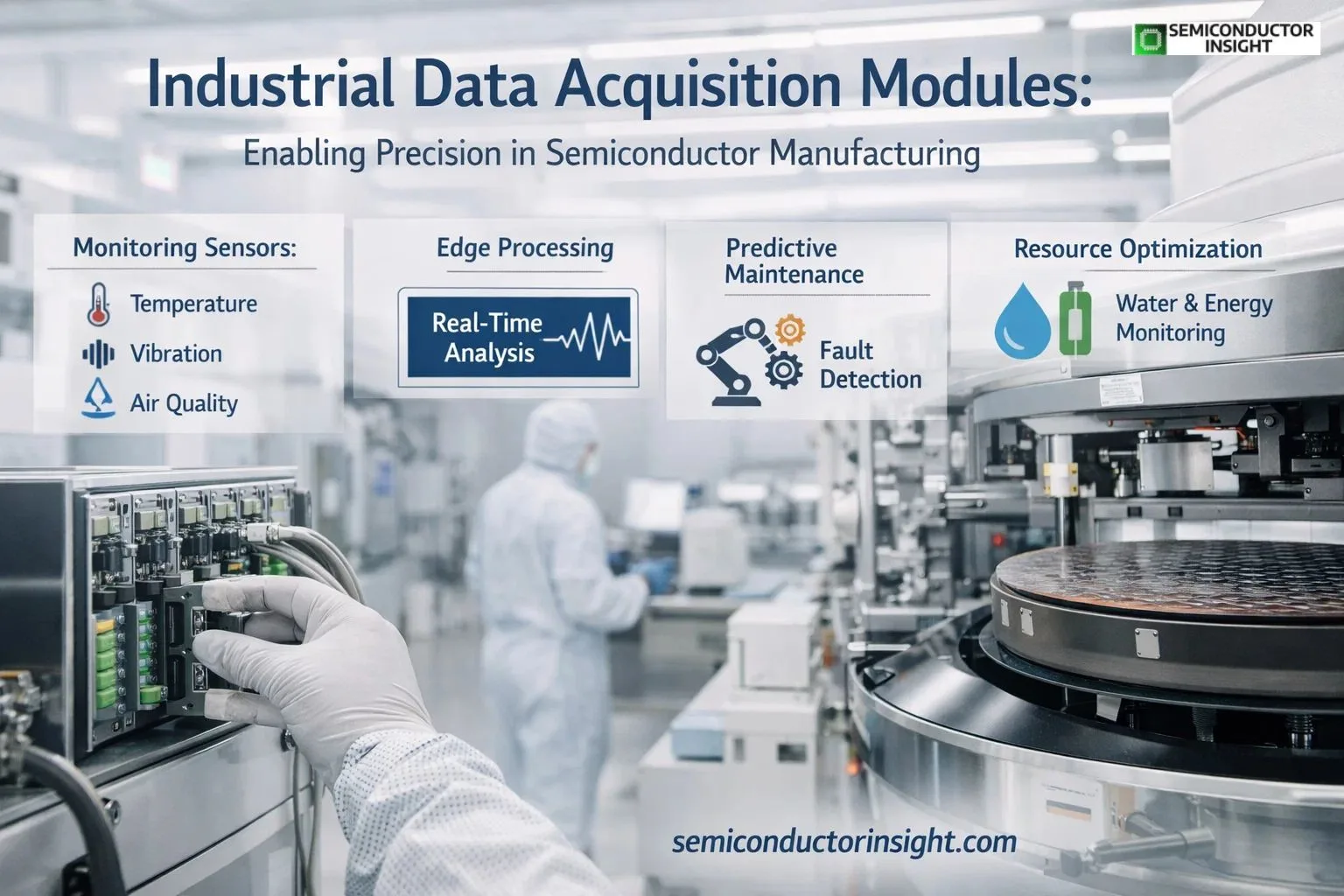
Walk into a modern semiconductor fabrication facility and what stands out isn’t just the complexity of lithography machines or wafer handling robots it’s the invisible web of data constantly flowing behind the scenes. Industrial data acquisition modules have quietly become essential components, collecting signals from temperature sensors, pressure gauges, vibration monitors, and chemical flow systems.
· In advanced fabs producing nodes below 10 nm, even micro-level environmental deviations can lead to wafer defects.
· Facilities in regions like Taiwan and South Korea now deploy thousands of data points per production line, capturing real-time signals every few milliseconds.
· These modules are not just recording data they are enabling continuous calibration of tools like EUV lithography systems, ensuring yield stability in high-value chip production.
Please Take a Look at Our Updated Report here below Before Continuing: https://semiconductorinsight.com/report/industrial-data-acquisition-module-market/
Common Types of DAQ Modules
- Analog Input Modules: Designed for measuring continuous variables such as voltage (±10V), current (4-20mA), and temperature via RTDs or thermocouples.
- Digital Input/Output Modules: Interface with on/off signals from switches, relays, and proximity sensors to detect state changes.
- Pulse Counter Modules: Specialized for high-speed counting of digital pulses from flow meters, encoders, or gas meters to measure RPM and frequency.
- Modular Systems: Scalable platforms that allow users to mix and match different input types (e.g., vibration, sound, strain) within a single chassis.
Cleanroom intelligence is becoming data-driven
Cleanrooms are the heart of semiconductor manufacturing, and maintaining their integrity requires constant vigilance. Industrial data acquisition modules now monitor particulate levels, humidity, airflow velocity, and even electrostatic discharge conditions.
In India, government-supported semiconductor initiatives have begun incorporating centralized monitoring systems where acquisition modules feed data into control dashboards. These systems can trigger immediate alerts if particle counts exceed acceptable thresholds, preventing contamination before it spreads across wafers. The integration of such modules has reduced manual inspections and improved response times significantly.
Edge computing finds a natural partner
· One of the most interesting shifts is the convergence of data acquisition modules with edge computing.
· Instead of sending all collected data to centralized servers, modern modules can pre-process information locally.
· This is particularly useful in fabs where latency matters. For instance, in high-speed deposition processes, a delay of even a few seconds in detecting anomalies can impact entire batches.
· Edge-enabled acquisition modules analyse signals on-site and trigger instant corrections.
· Some systems are now capable of filtering terabytes of sensor data daily, transmitting only actionable insights rather than raw streams.
Retrofitting legacy equipment with modern intelligence
Not all semiconductor facilities are built from scratch. Many still operate legacy equipment that lacks native digital connectivity. Industrial data acquisition modules are playing a crucial role in bridging this gap.
Older diffusion furnaces and testing equipment can be upgraded with external modules that capture operational data without altering the core machinery. In Japan, several mid-sized fabs have extended the lifespan of legacy tools by integrating acquisition modules, avoiding the cost of complete system replacement while still achieving digital visibility.
The role in predictive maintenance and uptime control
Unplanned downtime is one of the costliest challenges in semiconductor manufacturing. Industrial data acquisition modules contribute directly to predictive maintenance by continuously monitoring machine health indicators.
For example, vibration data from wafer handling robots can indicate early signs of mechanical wear. When combined with historical datasets, acquisition systems help engineers predict failures before they occur. In one North American facility, predictive maintenance supported by these modules reduced equipment downtime by several hours per month, translating into significant production gains.
Supporting sustainability and resource efficiency
Semiconductor manufacturing is resource-intensive, consuming large volumes of water, chemicals, and energy. Industrial data acquisition modules are now being used to track and optimize resource usage in real time.
Water recycling systems in fabs rely on continuous monitoring of flow rates and contamination levels. Acquisition modules ensure that recycled water meets stringent purity standards before reuse. Similarly, energy monitoring across fabrication units helps identify inefficiencies, enabling operators to adjust load distribution and reduce overall consumption.
A quiet enabler of next-generation chips
As semiconductor technologies push toward smaller nodes and more complex architectures, the margin for error continues to shrink. Industrial data acquisition modules may not be the most visible components in this ecosystem, but they are among the most critical.
They ensure that every signal, every fluctuation, and every micro-condition is captured, analyzed, and acted upon. In a world where a single defect can impact thousands of chips, the role of precise, reliable data acquisition is only becoming more central to the industry’s evolution.

Comments (0)