

Industrial Automation Trends Boosting CPCI Chassis Market Demand in 2026
The digital economy is generating data at an unprecedented scale, and this shift is directly shaping demand for large capacity mechanical hard drives. These drives, typically exceeding 20TB in enterprise environments, are no longer legacy hardware they are critical infrastructure for hyperscale storage.
Modern data centers process exabytes of information daily, and mechanical HDDs remain the most cost-efficient solution for bulk storage. Industry data indicates that cloud storage capacity demand is growing at nearly 25% annually, reinforcing the relevance of high-capacity drives in long-term storage architecture.
What’s more striking is the structural shift in usage. Consumer demand for HDDs has declined sharply, while enterprise adoption continues to expand, driven by AI workloads, surveillance data, and large-scale backups.
Capacity Evolution from Gigabytes to Multi-Terabyte Scale
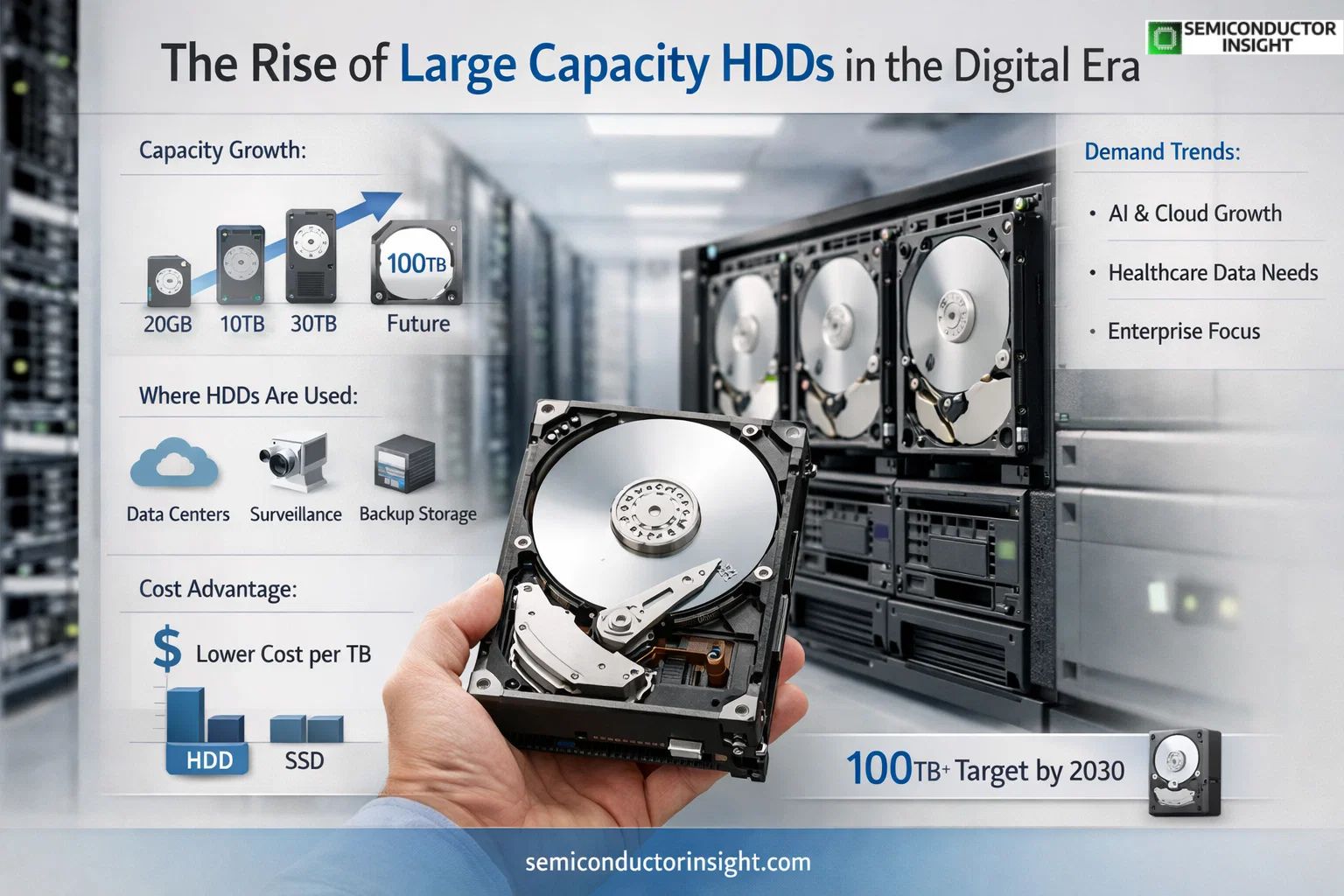
The journey from early 20GB drives to today’s 30TB+ systems reflects a massive leap in storage engineering. Recent developments show that enterprise HDDs now exceed 30TB capacity, with roadmaps targeting 100TB drives by 2030, signalling continuous innovation in areal density and recording technologies.
At the same time, 3.5-inch form factors dominate high-capacity deployments, offering better thermal performance and storage density, making them ideal for always-on data center environments.
This transition highlights a key insight: while SSDs dominate speed, HDDs dominate scale.
Where Large Capacity HDDs Are Actively Used Today
- Large capacity mechanical hard drives are widely utilized across multiple high-volume data environments, reflecting their critical role in modern storage infrastructure.
- In data centres, they handle massive volumes of bulk storage, particularly for AI datasets and cloud-based archives where scalability is essential.
- Surveillance systems rely heavily on these drives to store continuous video feeds, ensuring uninterrupted recording for security and monitoring purposes.
- Within enterprises, HDDs are extensively used for backup solutions, enabling long-term data archiving at a significantly lower cost per terabyte compared to alternative storage technologies.
- Network Attached Storage (NAS) systems also benefit from large capacity HDDs, offering scalable and efficient storage solutions for both large enterprises and small to medium-sized businesses.
- Meanwhile, personal backup usage is gradually declining as consumers increasingly shift toward faster SSD options. Overall, this distribution highlights a clear transition in HDD demand, moving away from individual consumers and becoming more concentrated in enterprise-driven, high-volume data environments.
Economic Advantage That Keeps HDDs Relevant
One of the strongest advantages of mechanical drives is cost efficiency. Compared to SSDs, HDDs offer significantly lower cost per terabyte, making them indispensable for storing non-critical or “cold” data.
- Average cost per TB for HDDs has been declining by ~15% annually
- Enterprise storage architectures now follow a tiered model, where HDDs store bulk data while SSDs handle high-speed operations
- Price gaps between SSDs and HDDs have widened significantly due to AI-driven demand and supply constraints
This economic positioning ensures that HDDs remain foundational to scalable storage strategies.
Technology Advancements Reshaping Mechanical Drives
Innovation in mechanical hard drives is far from stagnant. Technologies such as:
- Shingled Magnetic Recording (SMR) improving storage density
- Heat-Assisted Magnetic Recording (HAMR) enabling next-gen capacities
- Advanced vibration control systems for dense server environments
are pushing the boundaries of what mechanical drives can achieve.
These innovations are not just incremental they are enabling HDDs to remain competitive even as semiconductor-based storage evolves.
To Know More about the Report, You Can Freely Browse Our Latest Updated Report: https://semiconductorinsight.com/report/large-capacity-mechanical-hard-drive-above-20-gb-market/
Enterprise Demand Outpacing Supply Dynamics
Recent industry developments reveal a sharp increase in demand for high-capacity drives:
- HDD prices saw a ~4% increase in late 2025, the highest in two years
- Major manufacturers are operating at near full capacity due to enterprise and AI demand
- Enterprise-grade drives now account for a significant portion of available HDD models, reflecting a strong shift away from consumer markets
In fact, enterprise and cloud segments now dominate HDD consumption, while consumer usage has reduced to minimal levels in comparison.
Healthcare and Data Sensitivity Driving Storage Needs
Healthcare systems are emerging as a critical demand segment for large capacity HDDs. Hospitals and research institutions generate massive datasets from imaging scans to patient records that require secure, long-term storage.
Studies highlight that healthcare data storage needs are growing rapidly due to digitization, with increasing reliance on predictive analytics and AI-based diagnostics. Mechanical drives play a key role in:
- Archiving medical imaging data
- Supporting electronic health record systems
- Enabling cost-effective long-term data retention
Given the sensitivity and volume of healthcare data, HDDs offer a balance between reliability, scalability, and affordability.
Market Structure Concentrated Among Key Manufacturers
The industry remains highly consolidated, with three major players controlling a dominant share:
- Seagate Technology
- Western Digital
- Toshiba
Together, they account for over 80% of global market share, leveraging advanced technologies and large-scale manufacturing capabilities.
This concentration allows for faster innovation cycles but also creates supply dependencies in global storage infrastructure.

Comments (0)