
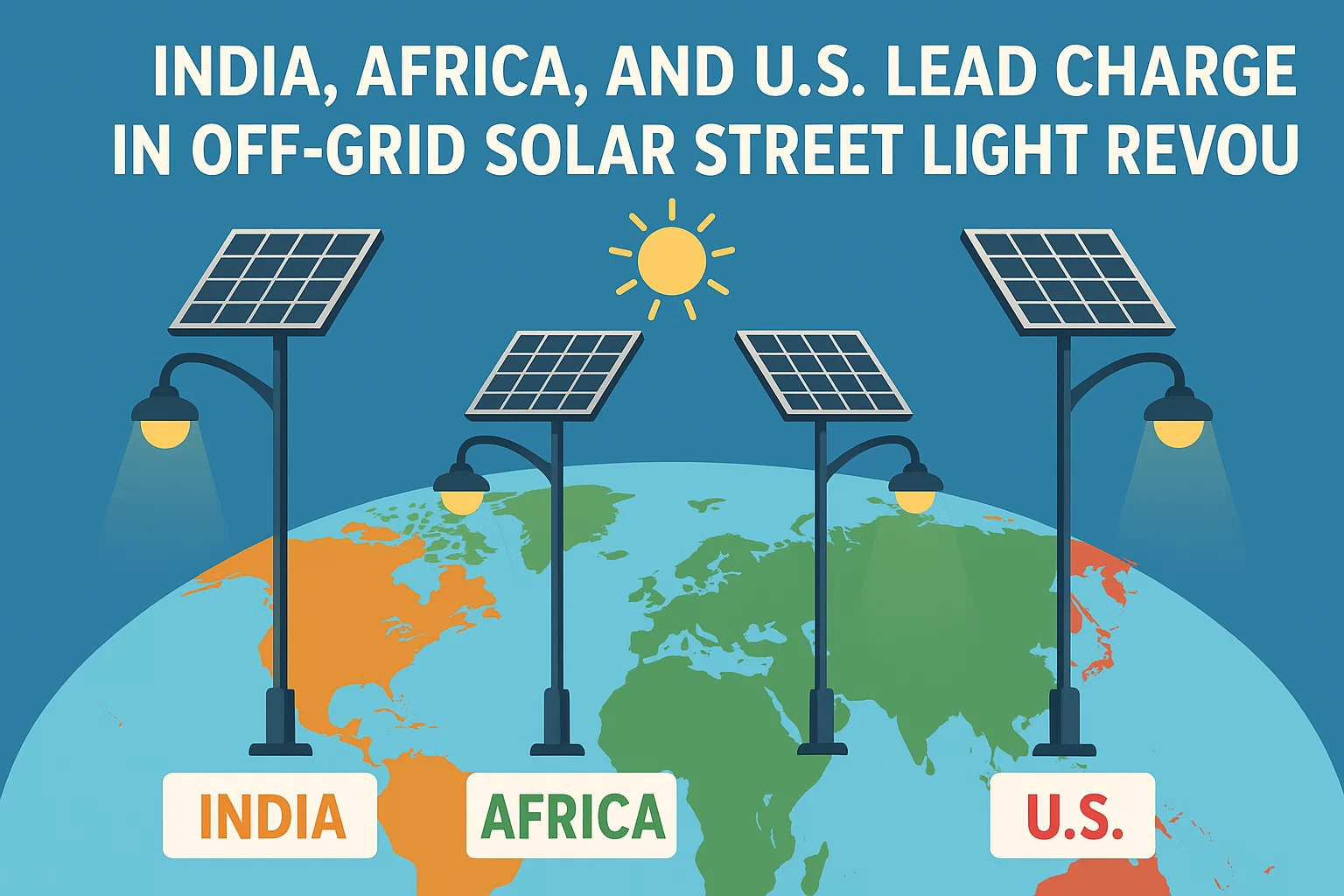
India, Africa, and U.S. Lead Charge in Off-Grid Solar Street Light Revolution
In a world increasingly conscious of sustainability and energy resilience, off-grid solar street lights are proving to be a beacon of hope. These standalone lighting systems, powered by renewable solar energy and independent of conventional power grids, are transforming how communities illuminate public spaces. As urban centers and remote regions alike adopt these eco-friendly solutions, the market for off-grid solar street lighting is undergoing a dynamic evolution.
According to recent data, the off-grid solar street light market was valued at US$ 1.67 billion in 2024 and is expected to reach US$ 2.89 billion by 2032, growing at a CAGR of 8.2% during the forecast period from 2025 to 2032. This surge is driven by a confluence of factors: growing environmental concerns, the push for energy independence, the need for rural electrification, and increasing resilience in the face of disasters.
Access Your Free Sample Report- Off Grid Solar Street Light Market
India: Illuminating Rural Futures
India, home to over 1.4 billion people, has always faced a dual challenge: electrifying its rural heartland and reducing its carbon footprint. The Indian government, under its Saubhagya Yojana 2.0, is making substantial strides by incorporating off-grid solar street lights into its rural development strategies.
In 2025, the Ministry of New and Renewable Energy (MNRE) launched an initiative to deploy over 500,000 solar-powered street lights in underserved regions of Uttar Pradesh, Bihar, and Assam. The objective is twofold: provide safer roads and public spaces while reducing dependency on fossil fuels and strained electric grids.
Public-private partnerships are playing a pivotal role here. Companies like Tata Power Solar and Havells are partnering with local governments to provide robust, cost-effective solar lighting systems. These lights, equipped with LEDs and lithium-ion battery packs, offer up to 12 hours of illumination on a full charge and have lifespans exceeding 10 years.
In addition to environmental benefits, the project has become a source of local employment and micro-entrepreneurship. Installation, maintenance, and manufacturing processes are being localized, empowering thousands of workers and artisans.
Africa: Solar Solutions for a Continent in Transition
Africa, with its abundant sunlight and energy access challenges, stands as a fertile ground for solar innovation. In June 2025, the World Bank and the European Union partnered with African nations like Nigeria, Senegal, and Rwanda to roll out off-grid solar lighting solutions aimed at rural and peri-urban development.
The initiative, titled “Light for All”, focuses on:
- Enhancing nighttime security in communities.
- Powering economic activity by enabling marketplaces to function beyond daylight hours.
- Reducing carbon emissions and environmental degradation.
In Nigeria, the city of Kano has already seen the installation of over 15,000 solar-powered street lights, reducing electricity costs and incidents of vandalism. In Rwanda, the government is integrating these lights with smart city infrastructure, using motion sensors and automated brightness controls to optimize energy use.
The broader goal is not merely electrification but a holistic social upliftment—empowering women vendors, reducing gender-based violence, and improving access to education and healthcare after dark.
United States: Building Resilience Through Smart Lighting
In the United States, the focus is increasingly on resilience and smart infrastructure. In May 2025, Los Angeles initiated a pilot project to test smart off-grid solar street lights in neighborhoods prone to wildfires and power outages.
These new-age street lights are not just illumination devices. They are equipped with:
- IoT sensors to monitor traffic and pollution.
- Motion detectors for energy-efficient lighting.
- EV charging ports for electric vehicles.
- Emergency communication modules for disaster response.
Developed in partnership with Siemens USA and local startups, these systems can operate autonomously for up to five days without sunlight, ensuring that public spaces remain lit during grid failures. The city plans to expand this model across California in wildfire-prone regions.
The integration of solar lighting into broader smart city initiatives signals a paradigm shift. It transforms street lights from passive utilities to active components of urban management.
Download Sample Report PDF- Off Grid Solar Street Light Market
UAE: Lighting the Desert with Innovation
The United Arab Emirates (UAE), long at the forefront of renewable energy development, is pushing the envelope in off-grid solar street lighting. In April 2025, Abu Dhabi’s clean energy firm Masdar completed a massive deployment of 10,000+ solar street lights in remote desert regions.
These units are engineered to withstand extreme temperatures and sandstorms, featuring:
- High-durability polycrystalline solar panels.
- Heat-resistant lithium-ion batteries.
- Anti-glare, UV-protected LED fixtures.
Part of the UAE’s “Green Spine Initiative,” the project aligns with national goals to reduce greenhouse gas emissions by 40% by 2030. The initiative has also become a model for other Gulf countries, including Saudi Arabia and Oman, who are launching similar programs in remote and underdeveloped regions.
These efforts reflect a broader commitment to sustainability, energy diversification, and infrastructure modernization in the Middle East.
Disaster Zones: Solar Lights as First Responders
Perhaps the most emotionally resonant application of off-grid solar street lights is in disaster response. In early 2025, after a series of devastating earthquakes in Turkey and typhoons in the Philippines, international aid agencies deployed portable solar street lights in refugee camps and medical outposts.
Unlike conventional systems that require grid connections, these modular lighting units can be set up in under 30 minutes, providing critical lighting for:
- Medical operations.
- Distribution points.
- Temporary shelters.
Organizations like Doctors Without Borders (MSF) and UNHCR now list solar lighting as essential emergency equipment. These innovations are proving vital in preserving safety, security, and dignity in post-disaster environments.
Additional Insights: Market Drivers and Trends
The global push toward solar street lighting is underpinned by several macroeconomic and environmental drivers:
1. Energy Access and Equity
Approximately 770 million people globally still lack access to electricity. Off-grid solar street lights offer a scalable and affordable interim solution, especially in areas where traditional grid expansion is economically unviable.
2. Technological Advancements
New battery technologies, such as lithium iron phosphate (LiFePO4) and graphene supercapacitors, are increasing the efficiency and lifespan of solar lighting systems. Integrated smart controls, GPS modules, and real-time diagnostics are now common in higher-end models.
3. Environmental Sustainability
Cities and nations are aggressively pursuing carbon neutrality. By replacing traditional sodium or halogen-based street lights with solar LED systems, municipalities can cut down emissions and save on energy costs by over 60%.
4. Government Policies and Incentives
Subsidies, tax rebates, and green bonds are making solar projects more financially viable. The Indian government, for example, offers 30-50% subsidies for solar lighting installations under MNRE programs.
Click Here To Download Full Sample Report- Off Grid Solar Street Light Market
Future Outlook: Where We’re Headed
As the market marches toward its projected US$ 2.89 billion valuation by 2032, several trends are poised to define the future:
- Hybrid systems combining wind and solar for improved performance.
- Modular plug-and-play units for rapid deployment.
- Blockchain-enabled energy tracking to monitor usage and performance.
- Localized manufacturing to drive down costs and create jobs.
Innovators, policymakers, and communities around the world are embracing off-grid solar street lighting not just as a product, but as a platform for change. Whether it’s lighting up a rural village in India, ensuring safety in African marketplaces, or responding to natural disasters, these systems symbolize a new era of accessible, reliable, and sustainable lighting.
Off-grid solar street lights are more than an engineering marvel—they’re a catalyst for equitable development, climate resilience, and social progress. As the world navigates the dual crises of climate change and energy inequality, these luminous sentinels are quietly but powerfully illuminating the path forward.
With substantial investment, supportive policy, and technological breakthroughs, off-grid solar street lighting is not just an industry on the rise—it’s a movement gaining unstoppable momentum.

Comments (0)