
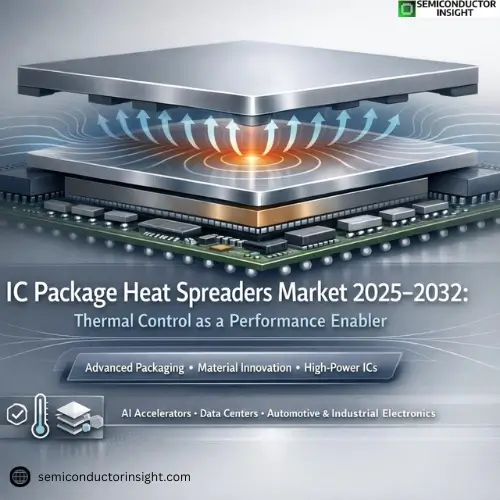
IC Package Heat Spreaders Market Analysis: Supporting Next-Generation Chip Reliability
As semiconductor devices become smaller, faster, and more power-dense, heat is no longer a secondary concern it has become a defining design constraint. Inside every advanced chip package, heat spreaders quietly perform a critical role: distributing thermal load evenly, protecting sensitive components, and allowing integrated circuits to operate at peak efficiency without degradation.
IC Package Heat Spreaders Market sits at the intersection of materials science, semiconductor packaging, and thermal engineering. This blog explores how heat spreaders are shaping modern chip performance, influencing packaging choices, and responding to evolving industry demands.
This blog examines how IC package heat spreaders enable thermal stability, performance scaling, and reliability across advanced semiconductor applications.
Key Takeaways from the Market
- Heat spreaders are now central to semiconductor performance strategy, not just thermal protection
- Material innovation is accelerating to support denser and more powerful ICs
- Advanced packaging trends are increasing demand for precision-engineered heat spreaders
- High-reliability applications are shaping quality and compliance expectations
Where Heat Spreaders Fit Inside Modern IC Packages?
Heat spreaders are thin, thermally conductive layers placed within or above IC packages to draw heat away from active silicon areas and distribute it across a wider surface. Their function is subtle but essential without effective heat spreading, high-performance chips would throttle, age prematurely, or fail outright.
Today’s heat spreaders are integrated across multiple package architectures, including flip-chip, system-in-package (SiP), advanced ball grid arrays, and heterogeneous multi-die modules. As packaging complexity increases, the thermal role of these components becomes more demanding and more valuable.
Material Evolution: From Metals to Engineered Composites
Traditional heat spreaders relied heavily on copper and aluminum for their balance of thermal conductivity and cost. While these materials remain widely used, the market is moving toward engineered solutions that offer improved performance under tighter constraints.
Modern heat spreader materials increasingly focus on:
- Enhanced thermal conductivity with reduced thickness
- Improved coefficient of thermal expansion (CTE) matching with silicon
- Compatibility with fine-pitch packaging and advanced assembly processes
A Look at How Heat Spreaders Influence Package Design
Rather than being an afterthought, heat spreaders now shape packaging decisions early in the design phase. Their dimensions, placement, and material properties affect everything from die stacking strategies to lid attachment methods.
Design influence pathway:
Package power profile → Heat density mapping → Heat spreader material selection → Mechanical integration → System-level thermal performance
Why Thermal Control Is Now a Competitive Advantage?
Thermal performance is no longer only about avoiding failure; it directly impacts speed, power efficiency, and long-term reliability. Semiconductor manufacturers increasingly view heat spreaders as performance enablers, not just protective layers.
Key shifts driving this change include:
- Rising power densities in logic and memory chips
- Growth of AI accelerators, GPUs, and high-frequency processors
- Longer device lifecycles expected in automotive and industrial electronics
Manufacturing Precision and Quality Expectations
As semiconductor packages move toward tighter tolerances, heat spreaders must meet strict flatness, surface finish, and bonding requirements. Minor deviations can introduce thermal resistance or mechanical stress.
Manufacturers are responding by investing in:
- Precision machining and surface treatment technologies
- Advanced inspection for thickness uniformity and war page
- Traceability systems aligned with semiconductor quality standards
These improvements help ensure consistent thermal performance across high-volume production.
Application Areas Driving Market Momentum
While consumer electronics continue to represent steady demand, the strongest growth for IC package heat spreaders comes from performance-intensive segments.
Key demand clusters include:
- Data centres and cloud computing hardware
- Artificial intelligence and machine learning accelerators
- Automotive electronics for power control and driver assistance
- Industrial automation and edge computing systems
Regulatory and Reliability Considerations
Thermal components used in IC packages must comply with global reliability and safety frameworks, especially for automotive and industrial applications. Heat spreaders increasingly undergo qualification aligned with standards related to thermal cycling, mechanical stress, and long-term stability.
Regulatory alignment adds another layer of value, as compliant components reduce downstream qualification risks for chipmakers and system integrators.
Market Direction: What’s changing inside the Industry?
IC Package Heat Spreaders Market is transitioning from standardization toward application-specific optimization. Rather than one-size-fits-all designs, suppliers are tailoring solutions to match package architecture, power density, and end-use environment.
This shift is encouraging:
- Closer collaboration between packaging houses and material suppliers
- Increased customization for high-performance and automotive chips
- Greater emphasis on simulation-driven thermal design
At Last before Ending, Don’t Forget to Browse Our Recent Exclusive Report for Detailed Insights:
https://semiconductorinsight.com/report/ic-package-heat-spreaders-market/
Closing Perspective
As semiconductor innovation pushes physical limits, managing heat effectively has become one of the industry’s most critical challenges. IC package heat spreaders operate quietly beneath the surface, yet their influence on performance, reliability, and design freedom is unmistakable.
In the coming years, success in semiconductor packaging will increasingly depend on how intelligently heat is controlled making heat spreaders not just components, but strategic enablers of next-generation electronics.

Comments (0)