
Growth of I2C Isolator Market Supporting Safe Data Transmission in Modern Devices
I2C isolator market is gaining steady attention as electronic systems become more interconnected, compact, and exposed to complex electrical environments. At its core, the Inter-Integrated Circuit (I2C) protocol is a two-wire communication system that allows multiple chips to communicate using just a data line (SDA) and a clock line (SCL), significantly reducing wiring complexity in embedded systems.
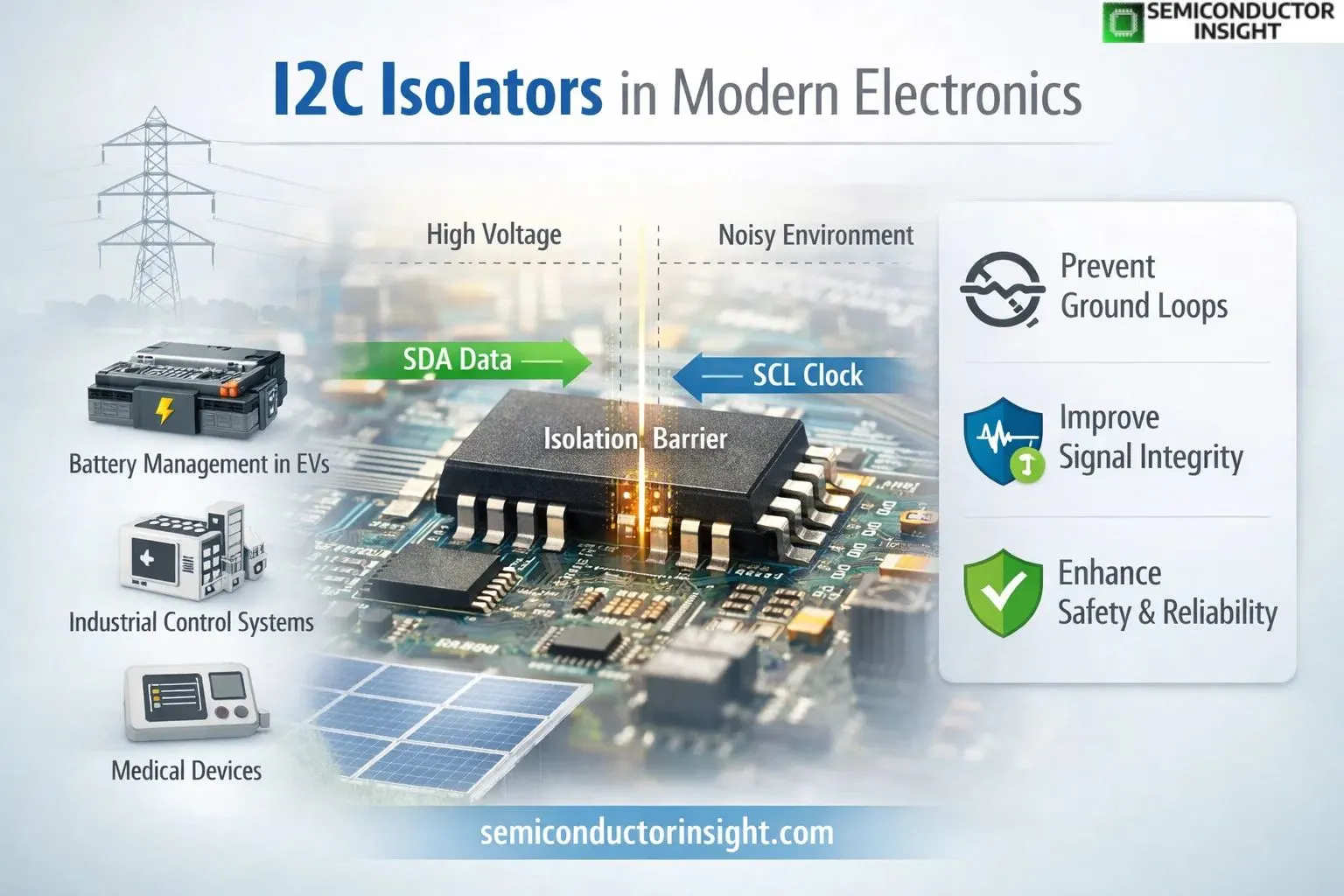
However, as devices scale from simple circuit boards to high-voltage, multi-domain systems, direct communication over I2C introduces risks such as ground loops, signal distortion, and electrical interference. This is where I2C isolators play a critical role. These components create a physical separation called an isolation barrier allowing data transfer without direct electrical connection, improving reliability and protecting sensitive components.
From renewable energy systems operating at up to 1500V to compact wearable electronics, I2C isolators are increasingly embedded in designs where safety, precision, and stability are non-negotiable.
Why Two Wires Are Not Enough in Modern Systems?
The simplicity of I2C requiring only two lines once made it ideal for short-distance communication within a single printed circuit board. Typical implementations operate within distances of less than 1 foot and use standard voltage levels like 3.3V or 5V.
But modern electronics are no longer confined to single boards. Systems now span multiple modules, power domains, and voltage levels. For example:
- Battery management systems in electric vehicles connect dozens of cells
- Industrial control systems operate across high-noise environments
- Medical devices require strict electrical isolation for patient safety
In such scenarios, even a small voltage difference between grounds can introduce errors or permanently damage components. I2C isolators address this limitation by allowing communication across isolated domains without compromising signal integrity.
Engineering Insights, How Isolation Transforms Signal Reliability?
An I2C isolator works by transmitting digital signals across an isolation barrier using technologies such as magnetic coupling or capacitive isolation. Unlike traditional optocouplers, modern isolators are designed to handle the bidirectional nature of I2C communication.
One key advantage is noise immunity. In industrial environments, electromagnetic interference (EMI) can corrupt data signals. Isolators prevent this by ensuring that noise currents do not travel across the communication path.
Additionally, isolators eliminate ground loops an issue that arises when multiple grounding points create unintended current paths. By breaking this loop, systems achieve higher accuracy and fewer communication errors.
This capability is especially important in systems where precision data such as temperature, voltage, or current measurements must remain consistent across electrically noisy environments.
I2C Isolator Technology Framework and Functional Dynamics
- To comprehend the market, you need to know what makes I2C isolators different from each other in terms of technology. The I2C bus is a unique technical problem because it has a bidirectional, open-drain topology, which is different from other signal isolators.
- The I2C bus works in half-duplex, bidirectional mode, but standard digital isolators only work in one direction. To make the most of both technologies, external circuitry is needed to split the bidirectional bus into two unidirectional signal paths without adding too much propagation delay.
- Texas Instruments addressed this challenge directly with its ISO154x family. The ISO1540 and ISO1541 devices have logic input and output buffers separated by TI’s Capacitive Isolation technology using a silicon dioxide (SiO2) barrier. When used with isolated power supplies, these devices block high voltages, isolate grounds, and prevent noise currents from entering the local ground and interfering with or damaging sensitive circuitry.
- The numbers are clear when it comes to performance. The ISO1540 and ISO1541 use up to 38% less power than other ICs while delivering a maximum propagation delay of just 62 nanoseconds, which is 52% better than other devices. They have a maximum current of less than 8.5 mA at 5V. Also, this kind of capacitive isolation makes the isolators last more than three times longer than optocouplers or magnetic isolators.
- When it comes to high voltage, Analog Devices’ MAX14937 sets a new standard. The MAX14937 is a two-channel, 5kVRMS I2C digital isolator that can send digital signals between circuits with different power domains at temperatures up to +125°C. It works from DC to 1.7 MHz and supports isolated I2C buses with clock stretching.
To find out more, feel free to browse our latest updated report: https://semiconductorinsight.com/report/i2c-isolator-market/
The Rise of Compact and Integrated Isolation Technologies
One of the most notable shifts in I2C Isolator Market is the move toward miniaturization and integration. Technologies like chip-scale transformers enable isolation within extremely small footprints, making them suitable for dense circuit designs.
Modern isolators now combine multiple functions, including:
- Signal isolation
- Level shifting between voltage domains
- Protection against electrostatic discharge (ESD)
This integration reduces the need for external components, saving board space and simplifying design. It also improves system longevity, with some devices engineered for extended operational lifetimes under harsh conditions.
As electronics continue to shrink while increasing in complexity, such compact solutions are becoming indispensable across industries.
Design Realities Engineers Are Navigating Today
Designing with I2C isolators is not without complexity. Engineers must carefully balance parameters such as bus capacitance, signal timing, and voltage compatibility.
The I2C protocol itself supports multiple speed modes from standard to high-speed requiring isolators to maintain timing accuracy across different operating conditions.
Another consideration is bidirectional communication. Since both data and clock lines are shared, isolators must intelligently manage signal direction without introducing latency or distortion.
Despite these challenges, advancements in isolation technology are making integration easier, enabling engineers to deploy reliable communication systems across increasingly complex electronic architectures.

Comments (0)