
Humanoid Robotics Enters a Touch Era in 2026: Humanoid Robot E-Skin Market Advances With High-Resolution Tactile Sensing
Humanoid robots have become increasingly capable of seeing objects, recognizing speech and planning movements, but physical touch remains a more difficult engineering problem. A camera can identify an egg, for example, but it cannot directly tell a robot whether its fingers are squeezing the egg too hard.
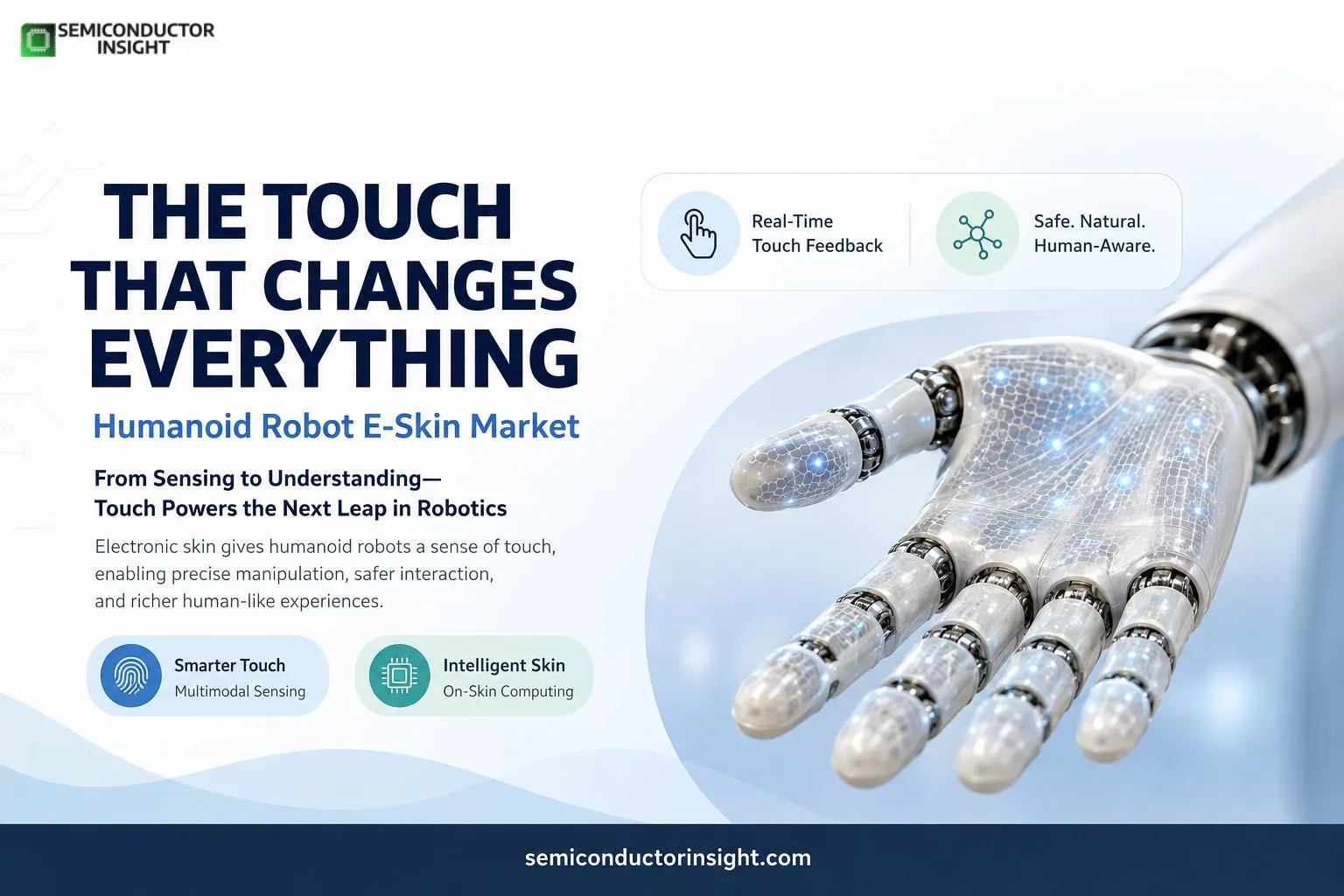
That gap is putting electronic skin at the center of embodied robotics. Modern e-skins combine flexible sensor arrays, conductive materials, signal-processing circuits and increasingly sophisticated algorithms to detect pressure, shear force, vibration, temperature and proximity. Research published in Nature Sensors describes multimodal tactile sensing as increasingly important for robotic manipulation and human-robot interaction.
Trend One Turns Robot Fingers into Precision Instruments
- The fingertip is emerging as one of the first practical deployment points for e-skin because dexterous manipulation requires extremely precise feedback.
- A 2025 initiative reported by the Wuhan municipal government highlighted Huaweike’s multidimensional fingertip tactile sensor for humanoid robots.
- The company said the sensor had undergone more than 1 million compression tests, while its electronic skin technology had already been integrated into more than 10,000 dexterous robotic hands.
- The professional-grade sensor was also reported to achieve 5% data accuracy.
- These numbers show where the technology is heading: tactile hardware has to survive repeated physical contact while continuously producing reliable data.
Trend Two Moves from Pressure Detection to Multimodal Touch
Simple pressure sensing is no longer enough for advanced humanoids. Robots need to distinguish between pressing, sliding, gripping, brushing and collision events.
Research published in 2026 demonstrated an origami-inspired capacitive e-skin covering 60,000 mm². The system incorporated shear-force and proximity sensing and used machine learning to achieve a reported super-resolution factor of 241, with average localization and force-estimation errors below 3.5 mm and 0.04 N, respectively.
This type of architecture points toward larger sensing surfaces that can capture several physical signals without requiring a separate sensor for every function.
Trend Three Brings Semiconductor Processing Closer to the Skin
The semiconductor opportunity is shifting from sensors alone toward the electronics that sit immediately behind them.
Traditional tactile systems often transfer large amounts of sensor data to separate processing units. A 2025 Nature Communications study explored in-sensor tactile computing specifically to reduce unnecessary data conversion and transmission, targeting lower latency and power consumption.
For humanoid robots, this matters because hundreds or thousands of sensing points can generate continuous streams of information. Local analog front ends, multiplexers, ADCs, microcontrollers, edge AI accelerators and communication interfaces can therefore become important parts of the e-skin architecture.
Trend Four Gives Robots a Larger Physical Awareness Zone
The next generation of e-skin is moving beyond fingertips.
Researchers have demonstrated large-area tactile systems designed for robotic surfaces, while another 2025 study developed a large-area e-skin capable of locating touch with an error below 10 mm using a bio-inspired neural architecture.
Large-area coverage could eventually allow humanoids to detect contact on arms, hands, faces, torsos and other surfaces. That is particularly relevant for safe human-robot interaction because the robot could detect an unexpected touch before its vision system has fully interpreted the event.
Trend Five Makes the Robot Face Part of the Interface
- Electronic skin is also moving into social interaction.
- A 2025 Nature Communications study developed large-area laser-induced graphene e-skins for humanoid robot faces. The demonstrated system used seven sensor channels across different facial areas, combining static and dynamic tactile sensing with wireless signal transmission and on-chip filtering. The researchers showed responses to actions including touching, squeezing, slapping and brushing.
- This creates an unusual intersection between semiconductor sensing and human-machine interaction. Touch is no longer being treated only as a manipulation signal. It can become an input for a robot’s social response.
Don’t Forget to Surf Our Updated Report for More Detailed Analysis: https://semiconductorinsight.com/report/huamanoid-robot-e-skin-market/
Trend Six Connects Touch with Materials and Chemistry
The most advanced research is beginning to push e-skin beyond mechanical perception.
In 2025, researchers developed an optical/electronic artificial skin combining carbon nanotube-based tactile sensing with embedded optical fibers. The system could detect force and temperature while also extracting near-infrared information associated with molecules. Demonstrations included fruit assessment and robotic applications.
For humanoids, such capabilities could eventually help machines distinguish not just how an object feels, but potentially what material it is or whether its physical condition has changed.
A Real-World Signal from China
The commercialization story is becoming visible alongside laboratory research. In February 2026, Wuhan authorities highlighted a humanoid robot named Jingchu demonstrating the ability to gently pick up tofu using multidimensional electronic skin. The system was described as providing millisecond-level low-latency tactile responses and resistance to magnetic interference.
At the 2026 World Robot Conference in Beijing, multiple companies were also showcasing humanoid robots for industrial, logistics, healthcare and service applications, reinforcing the broader shift toward embodied machines.
Where E-Skin Meets the Semiconductor Supply Chain
Humanoid Robot E-Skin Market is therefore developing into more than a flexible-sensor opportunity. Its semiconductor layer can include MEMS and micro-sensor structures, flexible circuits, readout ICs, ADCs, wireless interfaces, embedded processors and edge-AI hardware.
The commercial race in 2026 is increasingly about making these components thin, durable, low-power, high-density and fast enough to operate in real time. As humanoid robots move from demonstrations toward practical manipulation and human interaction, electronic skin is becoming one of the key technologies connecting semiconductor intelligence with the physical world.

Comments (0)