
Humanoid Robot Micro Motors Market Accelerated by Precision Motion Control Breakthroughs
Precision Motion as the Core of Humanoid Intelligence
The evolution of humanoid robots is no longer defined solely by artificial intelligence or software capabilities; it is increasingly driven by the quality of motion at a micro level. Micro motors, often embedded within joints, fingers, and facial mechanisms, are enabling robots to replicate human-like dexterity with remarkable accuracy. These motors are engineered to deliver controlled torque, minimal latency, and compact integration, making them indispensable in modern humanoid systems.
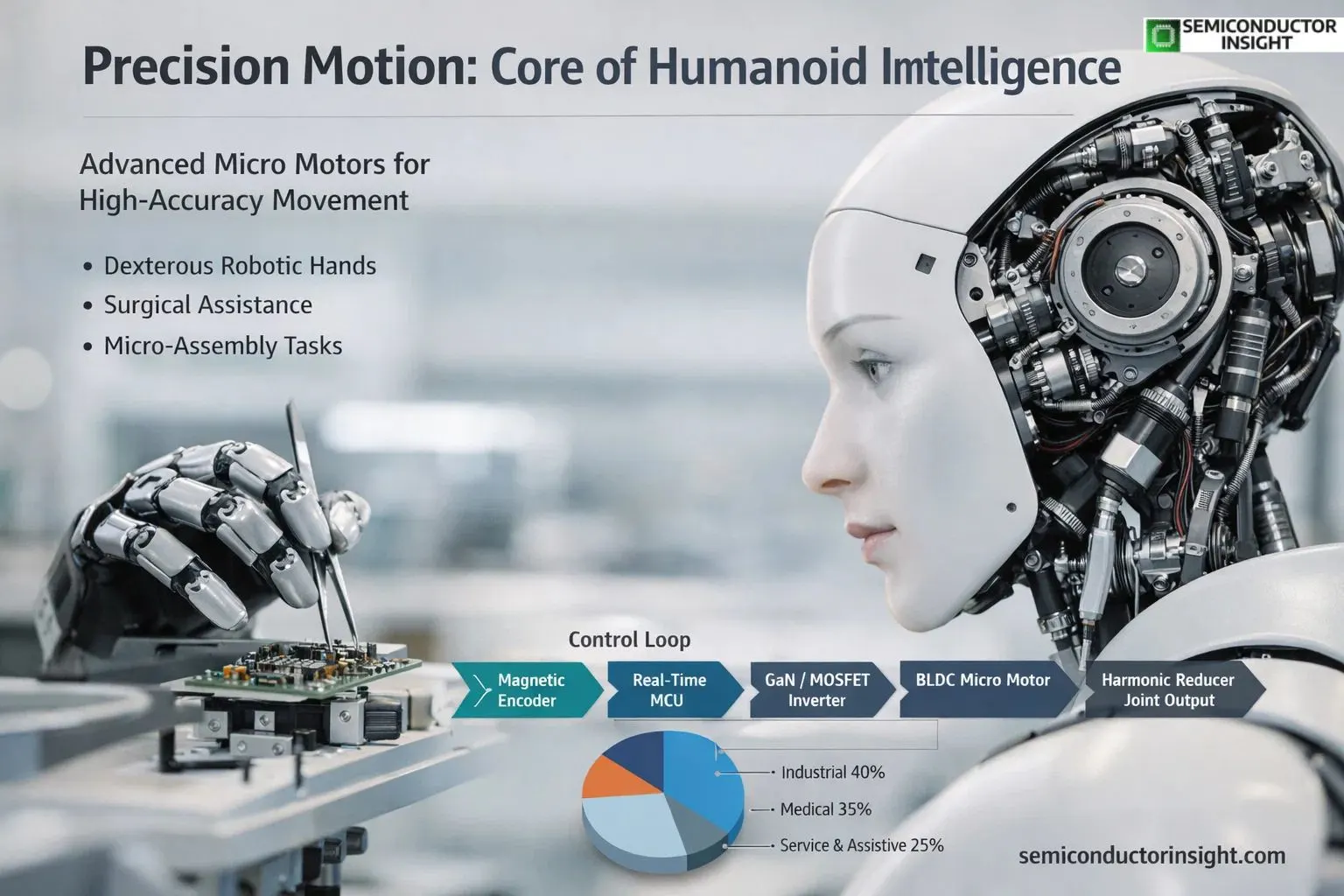
Micro motors used in humanoids need to be able to move with very high positional accuracy, which is not the case with regular robotic parts. For example, advanced robotic hands can have more than 20 micro motors in one unit to make them move like real hands. Humanoid robots can do delicate activities like putting together electronics or helping in surgery since they are so precise with their mechanics.
Before Proceeding, Feel Free to Overlook Our Updated Report: https://semiconductorinsight.com/report/humanoid-robot-micro-motors-market/
Motor control loop, semiconductor chain inside a robot joint
Magnetic encoder (IC) → Real-time MCU (TI C2000 / STM32) → GaN / MOSFET inverter→ BLDC micro motor→ Harmonic reducer → Joint torque output
A complete current control loop is finished by TI’s C2000 real-time MCUs in less than one microsecond. Because the GaN inverter switches at 100 kHz, a 32 mm joint disc may accommodate ceramic capacitors rather than large electrolytics. In integrated modules going into production in 2026, the harmonic reducer transforms high-speed motor rotation into low-speed, high-torque joint output of up to 36 Nm/kg.
Integration across High-Precision Robotic Functions
Micro motors are now deeply integrated into high-precision robotic functions beyond basic mobility. In humanoid robots designed for healthcare assistance, micro motors are used to control grip strength with high sensitivity, allowing robots to handle fragile objects such as medical instruments or glassware without causing damage.
In industrial settings, humanoid robots equipped with micro motors are increasingly deployed for micro-assembly tasks. For example, in semiconductor manufacturing environments, robots perform repetitive and precision-intensive operations where even minor deviations can lead to defects. Here, micro motors provide positional accuracy measured in microns, ensuring consistency and reliability.
This expansion into precision-critical domains underscores the growing reliance on micro motor technology as a foundational component of humanoid robotics.
Key semiconductor firms in humanoid motor stack
- Infineon (GaN + OptiMOS MOSFET)
- EPC Corp (eGaN ICs [joint drives])
- Texas Instruments (C2000 MCU + mmWave radar)
- NVIDIA (Jetson Thor SoC [AI])
- STMicro (STSPIN32 SiP [FOC])
- Microchip (SiC MOSFETs [700–3300 V])
Material Innovations Supporting Motor Efficiency
Material science is playing a significant role in enhancing micro motor performance. The use of rare-earth magnets, particularly neodymium-based materials, has significantly increased magnetic flux density, allowing motors to deliver higher torque within smaller dimensions.
Additionally, advancements in lightweight composite materials have reduced the overall weight of motor assemblies, contributing to improved energy efficiency. Thermal management materials are also being integrated to prevent overheating during prolonged operation, ensuring reliability in continuous-use scenarios.
These material innovations are not only improving performance but also enabling scalability, making it feasible to integrate a larger number of micro motors within a single humanoid platform.
Regional Technology Hubs Shaping Development
Two regions stand out prominently in the advancement of humanoid robot micro motors, each contributing distinct technological strengths.
East Asia, particularly countries like Japan and South Korea, is at the forefront of precision motor manufacturing. Japan’s industrial robotics sector has consistently demonstrated high adoption of micro motor technologies, with production facilities capable of manufacturing millions of precision motors annually. The region’s expertise in miniaturization and quality control has set global benchmarks for motor reliability and performance.
North America, led by the United States, is driving innovation through robotics startups and advanced research initiatives. The U.S. National Science Foundation has supported multiple robotics research programs focusing on human-like motion systems, where micro motors are a central component. Additionally, collaborations between technology firms and academic institutions have accelerated the development of high-performance actuation systems tailored for humanoid applications.
Expanding Role in Human-Centric Robotics
- As humanoid robots transition from experimental prototypes to functional systems, the role of micro motors is expanding into areas that require direct human interaction. From assistive robotics in elderly care to collaborative robots in workplaces, the demand for smooth, safe, and precise motion is increasing.
- Micro motors are enabling robots to operate with reduced noise levels and enhanced motion control, which are critical factors in environments where human comfort and safety are priorities. For example, newer motor designs have achieved noise levels below 40 decibels, making them suitable for indoor and healthcare settings.
- This shift toward human-centric robotics is reinforcing the importance of micro motor innovation, as the quality of motion directly influences user acceptance and operational effectiveness.
Technological Convergence Enhancing Market Momentum
The growth of the humanoid robot micro motors market is being amplified by convergence with other advanced technologies. Integration with AI-driven control systems allows motors to adapt dynamically to changing conditions, improving efficiency and responsiveness.
Sensor integration is another key development, enabling real-time feedback and closed-loop control. This allows micro motors to adjust torque and speed instantly, enhancing precision in complex tasks.
Such convergence is not only improving performance but also expanding the application scope of humanoid robots, positioning micro motors as a critical enabler of next-generation robotics.

Comments (0)