

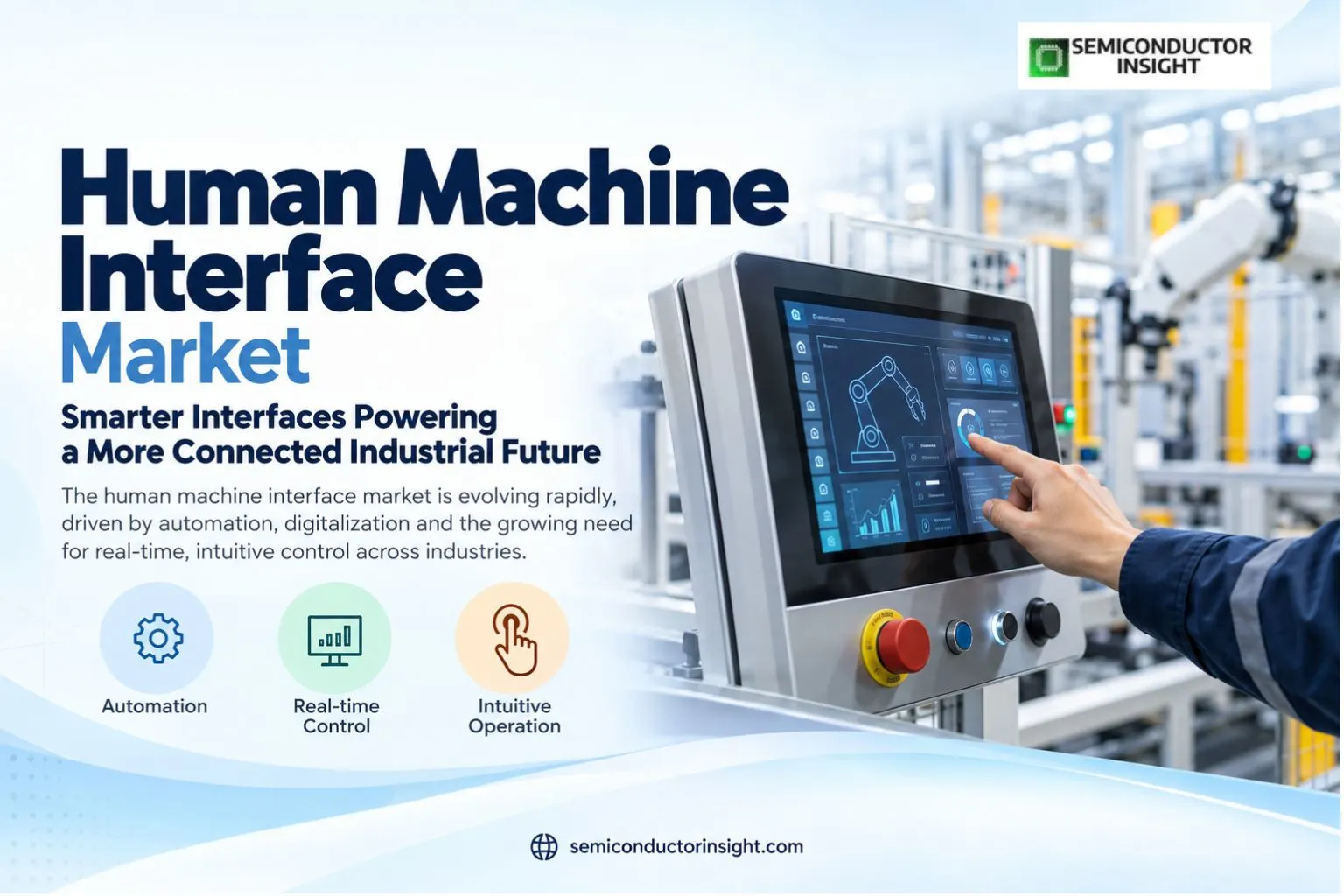
Human Machine Interface Market Outlook for 2026 through Industrial Automation, Digital Twins and Operator Safety
A human machine interface (HMI) is the point where an operator interacts with a machine, production line, or industrial control system. Modern interfaces do far more than display temperatures or start and stop equipment. They bring together production status, process parameters, alarms, maintenance information, and operator instructions in a single working environment.
This shift is particularly relevant to semiconductor manufacturing, where fabrication equipment must operate under tightly controlled conditions. Operators need clear visibility into process stages, equipment status, environmental conditions, and faults that could affect production. As factories connect more machines to industrial networks, HMI design is becoming closely linked to operational intelligence rather than hardware alone.
Industrial AI is changing what operators see
- The growing adoption of AI is creating new expectations for industrial interfaces. Instead of displaying raw machine readings, an HMI can present prioritised alarms, maintenance recommendations, production anomalies, and information that helps operators understand why a process has changed.
- Rockwell Automation’s 2026 State of Smart Manufacturing report surveyed more than 1,500 manufacturers across 17 countries.
- The company reported that 90% of global respondents considered digital transformation essential to competitiveness, while 71% of Asia-Pacific respondents planned to increase their use of AI and machine learning over the following 12 months.
- These findings highlight the expanding role of intelligent manufacturing systems, although they do not measure HMI adoption specifically.
Semiconductor fabrication demands clearer process visibility
In semiconductor facilities, a small process deviation can affect wafer quality, equipment availability, and production consistency. HMIs help engineers and technicians monitor equipment conditions, review alarms, and coordinate maintenance without relying exclusively on separate diagnostic tools.
Applications extend across wafer processing, deposition, etching, inspection, material handling, and cleanroom utilities. Different tasks require different information layouts. A maintenance technician may need diagnostic codes and component status, while a process engineer needs trends and recipe-related information. Designing the interface around these distinct roles can make complex equipment easier to operate.
Edge computing brings information closer to the machine
Industrial HMIs are increasingly connected to edge devices, programmable logic controllers, industrial PCs, and manufacturing execution systems. Processing selected data closer to the equipment can reduce dependence on distant systems for routine visualisation and local operational decisions.
This architecture is useful when production facilities need timely alarms, local access to machine information, and continued visibility during interruptions to external connectivity. It also creates additional requirements for network segmentation, software updates, authentication, and secure access to industrial devices.
Cybersecurity is becoming part of interface design
Connected interfaces can expose operational technology to risks that traditional isolated control panels did not face to the same extent. Unauthorised access, altered configurations, compromised credentials, and unapproved software can affect both information integrity and physical operations.
The US National Institute of Standards and Technology addresses these concerns in its guidance on operational technology security. In September 2026, NIST published an initial public draft of SP 800-82 Revision 4, expanding guidance on asset management, network monitoring, and security architecture, including zero-trust principles. The document is a draft rather than a final standard.
Discover more report insights; just browse our latest free update here: https://semiconductorinsight.com/report/human-machine-interface-hmi-market/
Touchscreens are not the whole story
- The next generation of HMIs is being shaped by industrial PCs, larger multitouch displays, configurable dashboards, remote visualisation, and software that adapts information to the operator’s task.
- Voice and gesture controls may also suit selected environments, but their usefulness depends on noise levels, gloves, safety requirements, and the reliability of recognition systems.
- For equipment manufacturers, the priority is not to add every available interaction method. It is to make essential information easy to understand, reduce unnecessary navigation, and prevent confusing displays from contributing to operator errors.
What manufacturers should evaluate before upgrading?
HMI selection increasingly requires a combined assessment of hardware, software, and operating conditions. Buyers should consider display readability, response time, supported industrial protocols, integration with existing controllers, alarm handling, lifecycle support, and cybersecurity controls.
In semiconductor facilities, compatibility with specialised equipment and established process workflows is especially important. A modern interface must present information accurately without disrupting validated production procedures.
Human machine interface market is therefore moving toward more connected and context-aware industrial control. Its next stage will depend on how effectively manufacturers combine real-time visibility, useful AI assistance, secure connectivity, and operator-centred design. The strongest systems will be those that help people make better decisions while keeping industrial processes reliable and safe.

Comments (0)