

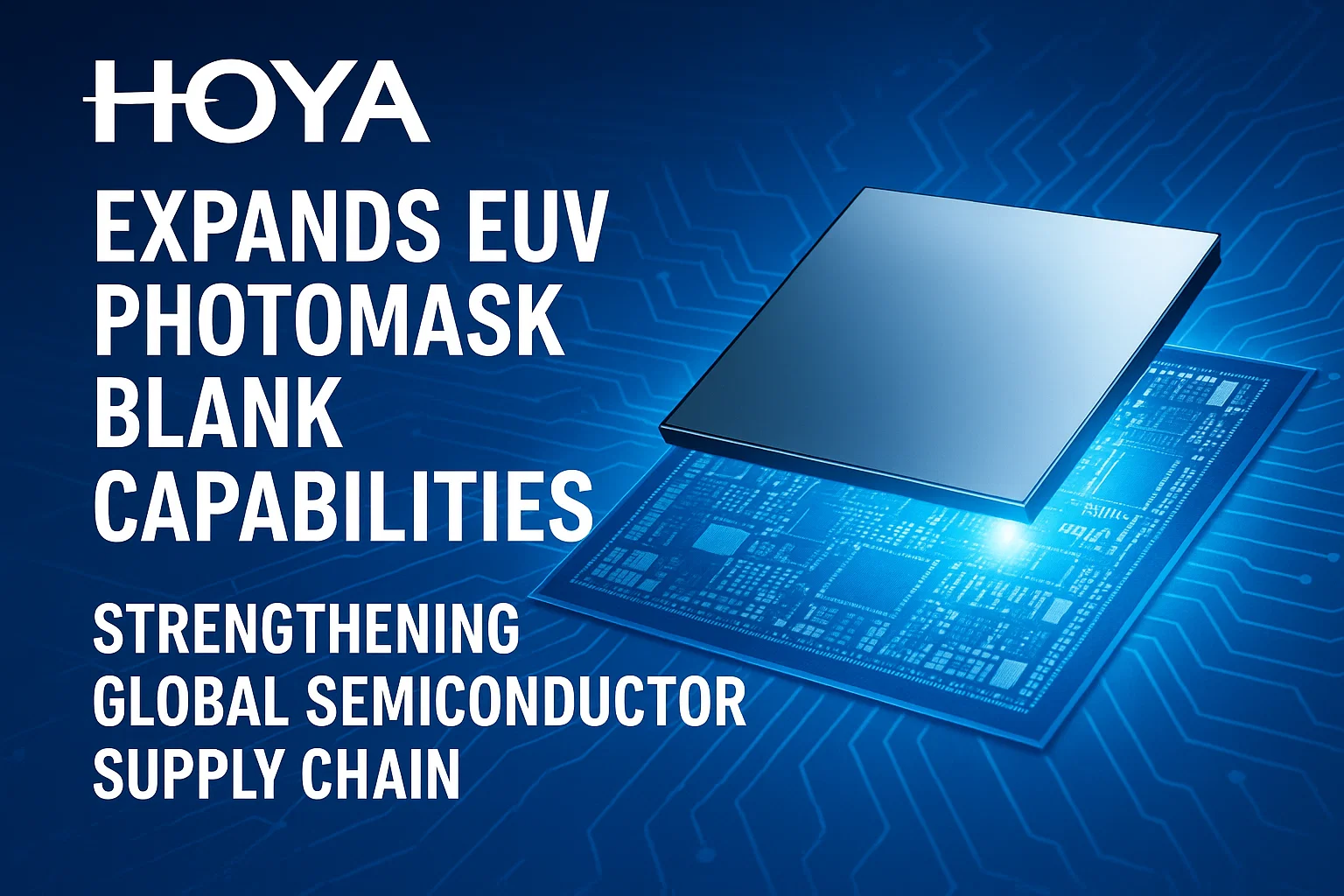
HOYA Expands EUV Photomask Blank Capabilities, Strengthening Global Semiconductor Supply Chain
The semiconductor industry has always been at the heart of technological progress, powering everything from smartphones and data centers to artificial intelligence and advanced medical imaging systems. At the core of this ecosystem lies an essential but often overlooked component: the photomask. Built primarily on quartz substrates with chromium patterns, photomasks serve as the master blueprint for transferring intricate circuit patterns onto silicon wafers through lithography.
In recent years, the Quartz Chromium Photomask Market has entered a phase of transformation, driven by a mix of technological innovation, competitive restructuring, and rising demand across both advanced nodes and mature process technologies. According to industry estimates, the global market was valued at USD 5.288 billion in 2024 and is projected to reach USD 7.440 billion by 2032, expanding at a compound annual growth rate (CAGR) of 5.1%.
This growth is not merely numerical it reflects how the photomask industry is adapting to challenges such as the transition to extreme ultraviolet (EUV) lithography, increasing mask complexity, and the need for cost-optimized yet defect-free quartz and chromium-based solutions.
Access Your Free Sample Report- Quartz Chromium Photomask Market
Understanding Quartz Chromium Photomasks
Before diving into recent developments, it is essential to understand the fundamentals of photomasks:
- Quartz Substrate: The base of most photomasks, quartz provides exceptional optical transparency and dimensional stability, crucial for accurately transferring circuit patterns during lithography.
- Chromium Layer: Chromium films are deposited on the quartz substrate to create the opaque areas of the mask. Precise etching forms the intricate circuit patterns that are projected onto wafers.
- Role in Semiconductor Fabrication: Each wafer layer requires a corresponding photomask. As node sizes shrink, the number of masks and their complexity increases, making high-quality quartz chromium masks indispensable.
Although EUV masks have gained attention, quartz chromium masks continue to dominate due to their reliability, cost-effectiveness, and suitability for both advanced and legacy technologies.
Market Snapshot and Growth Dynamics
- Market Size 2024: USD 5.288 billion
- Forecast 2032: USD 7.440 billion
- CAGR (2024–2032): 5.1%
Several factors underpin this growth:
- Semiconductor Scaling: As chipmakers push toward 3nm and 2nm process nodes, mask precision requirements tighten.
- Increased Mask Layers: Advanced chips now require 70–100+ mask layers, each demanding flawless quality.
- Rising Demand from Displays: Beyond semiconductors, flat panel displays, OLED, and QLED rely heavily on quartz-based photomasks.
- Regionalization of Supply Chains: Geopolitical factors are prompting countries to secure domestic photomask capabilities.
- EUV Transition: Although chromium-on-quartz remains mainstream, demand for EUV mask blanks is accelerating, with suppliers like Hoya and AGC leading the charge.
Recent Developments in the Quartz Chromium Photomask Industry
1. HOYA’s Push into EUV Mask Blanks
HOYA, one of the leading global suppliers of photomask blanks, has doubled down on its role in EUV lithography. In mid-2025, the company unveiled new advancements in EUV photomask blanks, which rely on quartz substrates but incorporate highly specialized multilayer coatings.
- EUV mask blanks require extreme flatness and virtually zero defects.
- HOYA’s expansion signals a long-term investment in supplying critical blanks for foundries like TSMC, Samsung, and Intel.
- This move strengthens HOYA’s position as one of the few capable players in this highly specialized domain.
Implication: While EUV is often associated with novel materials, quartz and chromium technologies remain integral, especially for hybrid production environments where both DUV and EUV coexist.
2. Photomask Japan 2025 – Renewed Industry Energy
At Photomask Japan 2025 (PMJ 2025), industry experts emphasized the revival of innovation in photomasks and mask blanks. The conference highlighted:
- Continued relevance of chromium-on-quartz masks in mature nodes and display technologies.
- Integration of AI-driven defect inspection systems for chromium mask quality control.
- Collaboration between academia, suppliers, and semiconductor manufacturers to tackle mask complexity challenges.
Implication: The industry recognizes that while EUV dominates headlines, quartz chromium masks are the backbone of both current and legacy semiconductor production.
Download Sample Report PDF- Quartz Chromium Photomask Market
3. Corporate Restructuring and Workforce Adjustments
DuPont Photomasks, a long-standing industry player, recently announced a 5% workforce reduction (approx. 96 roles) as part of a cost optimization initiative.
- This reflects broader margin pressures in the photomask ecosystem.
- Rising R&D expenses, coupled with the complexity of modern masks, are straining profitability.
- Despite downsizing, DuPont emphasized continued investment in advanced photomask solutions.
Implication: Even major players are recalibrating operations to remain competitive in a high-cost, high-stakes environment.
4. Material Innovation and Strategic Supply Chain Security
Quartz remains the material of choice for photomasks due to its optical transparency and durability. However:
- Suppliers are exploring low-thermal-expansion quartz to improve lithographic accuracy.
- New chromium etching techniques are being introduced to reduce edge roughness and enhance pattern fidelity.
- Governments in the US, Japan, and Europe are investing in domestic quartz supply chains, recognizing photomasks as a strategic asset in semiconductor sovereignty.
Implication: Material innovation and supply chain localization will define the next decade of photomask manufacturing.
5. Rising Complexity in Mask Fabrication
Photomasks now require:
- 30+ sub-process steps, from quartz polishing to chromium deposition and inspection.
- Defect control at sub-nanometer levels, making the process highly sensitive.
- AI-driven metrology and e-beam inspection systems for defect detection.
As chip designs grow more complex, mask costs are rising sometimes exceeding USD 1 million per mask set.
Implication: The quartz chromium photomask industry is not only growing in value but also becoming increasingly capital intensive.
Industry Challenges
- Escalating Costs: High-end photomask sets for advanced nodes are extremely expensive, straining both suppliers and chipmakers.
- Geopolitical Risks: Export controls on lithography and mask-making equipment could disrupt global supply chains.
- Limited Suppliers: A handful of players (Hoya, Toppan, Photronics, AGC, DuPont) dominate, creating bottlenecks.
- Talent Shortages: Specialized expertise in mask fabrication is scarce, leading to workforce challenges.
- EUV Transition Risks: While EUV adoption grows, balancing investments between chromium-on-quartz and EUV mask blanks is strategically challenging.
Opportunities Ahead
Despite challenges, opportunities abound:
- Growth in Mature Nodes: Automotive, IoT, and power electronics continue to rely on 28nm and larger nodes, ensuring sustained demand for quartz chromium masks.
- Advanced Displays: Photomasks are critical for OLED, QLED, and microLED displays, a rapidly growing sector.
- AI & HPC Demand: Advanced computing requires ever-smaller nodes, pushing innovation in mask blank quality.
- High-NA EUV: The shift toward high-numerical-aperture EUV lithography will demand even stricter mask blank standards, benefiting innovators.
- Localization of Production: National semiconductor strategies (e.g., US CHIPS Act, Japan’s subsidies) could fuel new investments in domestic photomask facilities.
Regional Insights
- Asia-Pacific (APAC): Dominates photomask demand due to TSMC, Samsung, SK Hynix, SMIC, and leading display manufacturers.
- North America: Strong demand from Intel, GlobalFoundries, and Nvidia ecosystem, coupled with US government push for semiconductor independence.
- Europe: ASML and regional fabs are focusing on EUV mask ecosystems, creating opportunities for quartz suppliers.
- Japan: Continues as a key supplier hub for quartz substrates and photomask blanks, led by Hoya, AGC, and Toppan.
Click Here To Download Full Sample Report- Quartz Chromium Photomask Market
Future Outlook (2025–2032)
The Quartz Chromium Photomask market is expected to evolve along three main paths:
- Technological Integration: Coexistence of DUV and EUV masks, with quartz chromium remaining relevant for legacy and display technologies.
- Supply Chain Diversification: More localized production to mitigate geopolitical risks.
- AI in Mask Making: Adoption of AI and machine learning for real-time defect detection and yield optimization.
The Quartz Chromium Photomask industry may not grab mainstream headlines, but it is one of the most strategic enablers of the semiconductor revolution. With the market poised to grow from USD 5.288 billion in 2024 to USD 7.440 billion in 2032, the sector reflects a blend of resilience, innovation, and adaptation.

Comments (0)