
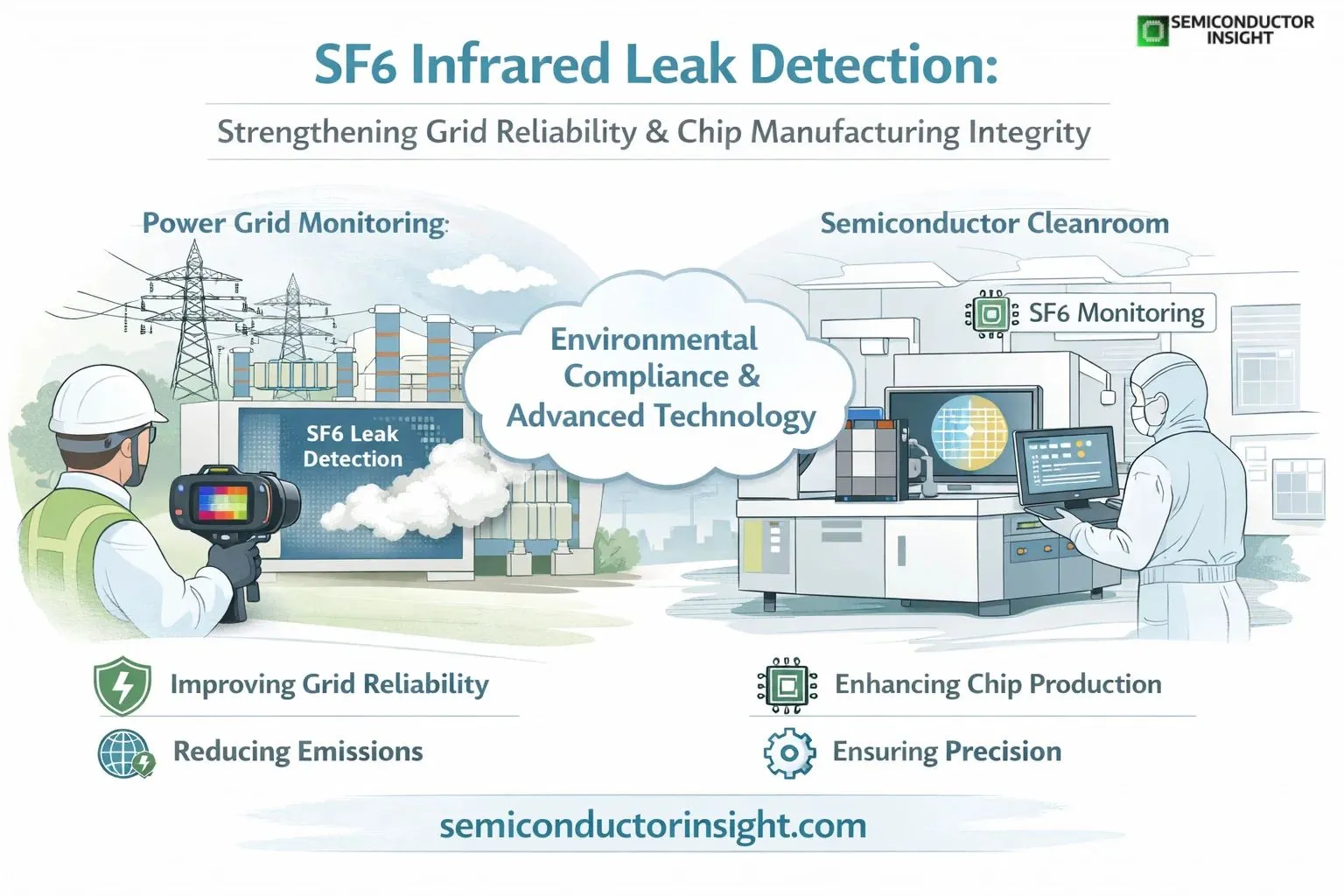
How SF6 Infrared Leak Detection Is Strengthening Grid Reliability and Chip Manufacturing Integrity?
The Silent Gas Powering Critical Infrastructure
Sulfur hexafluoride, commonly known as SF6 gas, is one of the most widely used insulating and arc-quenching gases in high-voltage power systems. From gas-insulated switchgear to circuit breakers, it plays a central role in maintaining grid stability. What makes it remarkable is also what makes it concerning: it is highly stable, non-flammable, and possesses a global warming potential thousands of times higher than carbon dioxide.
Because of this environmental impact, even minor leaks demand immediate detection. That is where the infrared leak detector market has gained significant traction. Infrared technology identifies SF6 by analyzing its unique absorption spectrum, enabling highly selective and non-contact detection in substations, manufacturing plants, and controlled cleanroom environments.
Over the last five years, tightening environmental reporting requirements and rising semiconductor production have elevated these detectors from optional tools to operational necessities.
Why Infrared Technology Became the Industry Standard?
Traditional soap-bubble tests and handheld sniffer devices once dominated leak detection practices. Today, optical gas imaging and fixed infrared monitoring systems are replacing these methods due to higher accuracy and faster response times.
Infrared sensors can detect leaks as small as a few parts per million. Utilities increasingly rely on portable thermal cameras capable of visualizing invisible gas plumes in real time. According to environmental agency reports, proactive leak detection programs have reduced SF6 emissions in several developed countries by more than 40% compared to early 2000 levels.
The shift is not only regulatory. It is operational. Substations equipped with continuous monitoring systems report significantly shorter maintenance downtime. Instead of periodic inspections, facilities now use continuous analytics dashboards that alert engineers instantly.
Semiconductor Fabrication and SF6 Monitoring in Cleanrooms
- While power utilities represent the largest installed base, semiconductor fabrication has quietly become a key growth arena. In wafer etching and plasma processes, SF6 is used for silicon and compound semiconductor patterning. Precision is critical: even slight variations in gas flow or contamination can impact yield.
- Modern fabs operate in ultra-controlled environments where air purity is measured in particles per cubic meter. Integrating infrared detection systems ensures that fugitive emissions do not accumulate in enclosed process chambers or duct systems.
- Recent expansion announcements from global chip manufacturers highlight the scale of this demand. Facilities being developed under the CHIPS and Science Act in the United States and advanced nodes expanding in Asia require highly monitored gas delivery networks. Semiconductor production capacity worldwide increased by over 6% in the last reported year, according to industry associations, intensifying the need for precise gas management technologies.
- Infrared detectors are now integrated into automated gas cabinets and tool interfaces, linking directly to fab management systems. This integration reflects the broader trend toward real-time monitoring in smart manufacturing environments.
Environmental Accountability and Emission Transparency
Governments and environmental agencies have significantly tightened reporting standards for greenhouse gases. In many regions, SF6 emissions must be documented annually by utilities and industrial operators. The European Union’s F-Gas Regulation, for instance, mandates strict control and recordkeeping requirements for fluorinated gases.
Utilities in several European countries have reported emission intensity reductions of more than 50% since early regulatory enforcement began. Such outcomes are closely tied to the deployment of advanced detection systems rather than simple manual inspections.
In addition, grid modernization projects are accelerating globally. More than 70% of new high-voltage substations commissioned in developed economies now incorporate gas-insulated systems. Each installation increases the installed base of equipment requiring continuous leak surveillance.
Technology Evolution beyond Handheld Devices
- The market has moved beyond portable units to integrated, networked ecosystems. Fixed infrared sensors mounted near switchgear continuously scan ambient air. Some systems combine thermal imaging with acoustic detection for layered verification.
- Wireless connectivity allows these devices to transmit alerts directly to maintenance teams. In digital substations, leak detection is becoming part of centralized control architecture. Data logs provide historical emission trends, enabling predictive maintenance rather than reactive repair.
- In semiconductor facilities, leak detection modules are embedded into gas distribution lines. The integration with factory automation platforms improves traceability and aligns with broader Industry 4.0 strategies.
- Manufacturers are also enhancing sensitivity thresholds. Modern infrared analyzers achieve detection limits in the low ppm range, representing substantial improvement over earlier generations.
Don’t Forget to Surf Our Updated Report for More Detailed Analysis: https://semiconductorinsight.com/report/sf6-gas-infrared-leak-detector-market/
Substation Modernization and Urban Infrastructure Growth
Rapid urbanization and renewable energy integration are pushing utilities to adopt compact, high-capacity substations. Gas-insulated switchgear occupies up to 40% less physical space compared to air-insulated systems, making it ideal for dense metropolitan areas.
As smart grids expand, reliability expectations increase. Unplanned outages are increasingly unacceptable in data-center-driven economies. Infrared leak detection reduces the risk of insulation failure caused by unnoticed gas loss.
Grid reliability statistics published by energy authorities in multiple countries show measurable improvement in outage duration metrics over the past decade. While modernization involves many factors, better asset monitoring has been repeatedly cited as a contributing element.
Semiconductor Scaling and Gas Management Precision
- The transition toward advanced packaging, smaller process nodes, and high-performance computing chips requires exceptional process stability.
- Chipmakers manufacturing at sub-5 nanometre scales operate with tight tolerances where minor environmental deviations can affect performance.
- Gas management systems incorporating optical gas imaging ensure containment integrity. With semiconductor equipment utilization rates often exceeding 80%, maintaining uptime is critical. Leak detection thus becomes directly tied to yield optimization.
- Furthermore, sustainability reporting in the semiconductor industry is gaining prominence.
- Several major manufacturers have publicly committed to reducing greenhouse gas intensity per wafer output. Monitoring and minimizing SF6 emissions contributes directly to these targets.
From Compliance Tool to Strategic Infrastructure Component
What was once a maintenance accessory has evolved into a strategic infrastructure safeguard. The SF6 gas infrared leak detector market now intersects energy reliability, environmental governance, and semiconductor precision manufacturing.
With increasing electrification, data center expansion, and global chip production scaling, the installed base of SF6-dependent systems continues to grow. Simultaneously, regulatory transparency and sustainability commitments are tightening.
Infrared detection technology sits at the center of this intersection, quietly ensuring that critical infrastructure remains efficient, compliant, and environmentally accountable. In both substations and semiconductor cleanrooms, its presence is no longer optional but integral to operational excellence.

Comments (0)